The first thing Xavier Leport wants you to notice about a pizza order is not the pizza. It is the path. A customer sees an offer, taps a screen, chooses a restaurant, changes a topping, pays and waits. Somewhere between appetite and the front door, a local meal has produced a neat chain of decisions. At Pizza Salvatoré, Leport learned to treat that chain as part of the business itself.
The useful number is 75 percent. In a 2024 conversation about the chain's expansion, Leport said three quarters of its restaurant conversions passed through the website. For an old category built around ovens, counters and phone calls, that figure redraws the marketing job. The website is no longer an electronic brochure. It is a storefront, a cashier and an instrument panel. It shows the company where attention becomes an order.
Leport's career has unfolded inside that redraw. Based in Quebec City, he led marketing for Pizza Salvatoré as the family-owned chain pushed beyond 100 locations. He later stepped into a broader marketing role at Groupe Abbatiello, working across the restaurant portfolio while staying close to the pizza brand. The move makes sense when viewed through the order path. Once a marketer learns how to connect brand, data and operations for one fast-growing chain, the next question is whether the system can help several.
A degree in the digital handoff
Leport studied at the University of Ottawa from 2018 to 2022. His public profile offers one small clue about the direction of his attention: a project with Canada Post aimed at increasing use of its digital applications. The product was different, but the behavioral question was familiar. How do you persuade people to move from an established habit into a digital flow that feels easier?
In restaurants, that handoff is unusually concrete. Nobody wants a strategy deck for dinner. They want the right food, from the right location, at the right time. Every extra screen or confusing choice stands between intention and dinner. A digital conversion rate therefore contains more than a marketing result. It reflects menu design, pricing, location logic, kitchen capacity, payment and fulfillment.
This is why Leport's public comments about customer engagement feel operational. In 2022, when Pizza Salvatoré adopted a multichannel personalization platform, he described meaningful connections in restaurants and across digital channels as critical to growth and retention. The sentence is corporate on the surface. Underneath it is a practical problem: a customer should not become a stranger every time they move from an app to a counter.
“Engaging with our customers in a meaningful way - whether in-person at our restaurants or online across our digital channels - is critical for our business growth and retention strategy.”Xavier Leport, on Pizza Salvatoré's customer-engagement approach
Personalization can easily become a foggy promise. The grounded version begins with recognition. A useful offer reflects what someone tends to buy, where they are and where they are in the ordering journey. It helps a new customer get started and gives a returning customer a reason to come back. At scale, those small recognitions become retention infrastructure.
The restaurant journey Leport's work connects
The expansion behind the dashboard
Pizza Salvatoré's footprint gave the work urgency. The chain traced its history to 1964, but its recent phase moved at the tempo of a technology company with leases. In his 2024 interview, Leport discussed the approach used to reach 100 restaurants in a few years and Groupe Abbatiello's stated aim of reaching 500 openings by 2029.
Every new pin on the map multiplies the brand promise. The photograph is a ribbon cutting. The reality is a larger menu database, another local audience, new delivery boundaries and more chances for the customer experience to drift. Marketing has to create demand without outrunning the restaurant's ability to serve it. It also has to learn which signals belong to one neighborhood and which can travel across the chain.
Leport's transition from Pizza Salvatoré to Groupe Abbatiello captures that shift in scope. When he announced that the pizza chain was looking for a new marketing director, he described his own change as an adjacent move inside the group. He would remain closely involved with Pizza Salvatoré while collaborating across the broader set of brands.
A multi-brand group cannot solve marketing by painting every sign the same color. Shared measurement, customer technology and operating discipline can create leverage. The concepts still need their own voices and occasions. Pizza competes for a different moment than breakfast or a sit-down meal. The group marketer's work is to know which machinery should disappear into the background and which differences deserve to stay obvious.
There is another complication hiding in the word “restaurant.” A guest ordering at noon, a family feeding several people on Friday night and a traveler searching from an unfamiliar neighborhood may all land on the same page with different clocks running. The system has to be broad enough to serve them without turning every choice into a generic discount. Location data can improve relevance. Purchase history can shorten the route. Neither replaces the simple work of making the menu understandable.
There is a personal note in the way Leport framed the move. He used it to recruit the person who would take his chair, named the team around the role and promised continued involvement. Ambition often appears as departure. His version sounded more like adding another table to the room.
That continuity is particularly useful in a family-owned group. A new group title can create distance from the brand where the lessons were earned. Leport's stated intention to stay involved preserves a feedback route: group-level ideas can return to a working restaurant chain, meet actual customers and come back improved. The title widens, but the test remains an order that someone is waiting to eat.
When context becomes part of the brand
Growth marketing also creates exposure. More partnerships, channels and attention mean more borrowed context. In March 2025, Pizza Salvatoré removed its branding from a sponsored podcast episode after the guest and the episode's content drew criticism. Leport confirmed the withdrawal and explained that the company wanted to avoid association with potentially polarizing subjects.
His response included a procedural consequence: the company would better identify interview guests before approving sponsorships. That detail matters. A response becomes useful when it alters the next decision. Brand safety is often presented as a list of forbidden subjects. In practice, it is a research habit performed before the logo arrives.
The episode reveals a second side of the connective marketing Leport advocates. A brand does not only connect customer data across channels. It also inherits meaning from the spaces it funds. The same sensitivity that helps a restaurant recognize a customer should help it recognize the context surrounding an advertisement.
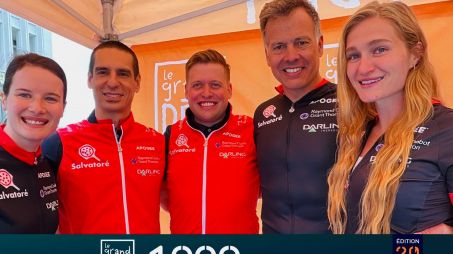
Leport's public record is sparse on biography and rich in operating clues. He talks about conversion, channels, retention, restaurant openings and the mechanics of moving from one brand remit to a group remit. Even his visible community activity fits the pattern. In 2026, he appeared on Pizza Salvatoré's roster for the Grand défi Pierre Lavoie 1000 KM, alongside colleagues riding under the company banner.
The browser tab and the pizza box
The cleanest way to understand his work is to hold two images at once. One is the browser tab where a customer makes a quick series of choices. The other is the pizza box arriving warm. Marketing sits between them, but it cannot control either alone. The promise begins before the click and is judged after the doorbell.
That makes restaurant growth a coordination problem disguised as an advertising problem. The offer has to be clear. The local restaurant has to be ready. The website has to remember enough to be useful without becoming intrusive. The next message has to arrive with a reason. And when a partnership creates the wrong association, the company has to notice quickly and change the process.
Leport's progression suggests that these are no longer side tasks for a restaurant marketer. They are the job. His Pizza Salvatoré period supplied the proving ground: a familiar product, a quickly expanding footprint and a customer journey increasingly routed through owned digital channels. Groupe Abbatiello widened the canvas.
The 500-location target is still a target, not a finish line. Its value in Leport's story is the pressure it places on the system. A campaign can spike demand for a week. A growth system has to remain legible after location 101, after a customer changes devices and after the marketer responsible for one brand becomes responsible for learning across several.
Pizza remains a pleasingly stubborn test. The data can be sophisticated, but the final review is immediate: open the box. Leport's work lives in that distance between dashboard and dinner, trying to make each one tell the other something useful.