Two hours is a peculiar amount of time to spend sending somebody to work. At Source Support, an outsourced technical support business, that was the reported interval from work order to dispatch. The company had a network of more than 12,000 field engineers. What it needed was a less cumbersome way to put that network to use.
- Onboard, qualify, assign and pay contractors in one system.
- Bring your own network; use the IT marketplace when you need more talent.
- Best suited to recurring volume: the sales page specifies 10+ contractors a month.
After integrating WorkMarket, Source Support reported bringing that interval down to ten minutes. The technicians had not suddenly become twelve times faster. The emails and calls needed to identify and assign someone had largely disappeared. It is a useful introduction to WorkMarket by ADP: software concerned with the surprisingly expensive interval between having talent and getting something done.
A budget line arrives late
Jeffrey Leventhal and Jeff Wald founded WorkMarket in 2010. Leventhal had already founded OnForce, another business in the labor marketplace. Union Square Ventures and Spark Capital backed the new venture. The premise was sensible: companies using an expanding mix of independent workers would need software to manage them.
The timing was less obliging. In his account of the eventual sale, investor Fred Wilson wrote that large companies took longer than expected to include contingent workforce management in their software budgets. A real operational problem had arrived before a dependable purchasing category.
“The market was a bit slower to develop than we had initially hoped”
Fred Wilson, early investor · January 2018
Leventhal stepped aside at the end of 2014; Stephen DeWitt became CEO. Wilson described a market that accelerated in 2016 and 2017, bringing competitors and interested buyers. WorkMarket raised $25 million from Accenture and Foundry Group in 2017 and acquired OnForce that year. In January 2018, ADP bought WorkMarket. Wilson pointed to the buyer’s customer base, resources and business fit. ADP did not disclose the price.
The clever part is the list
Today, WorkMarket’s distinctive organizing device has an atmospheric name: Labor Clouds. In practice, these are groups of contractors who satisfy requirements a business chooses. Skills, location, insurance, licenses, background checks and signed agreements can determine membership. The groups are dynamically monitored, so eligibility can change as requirements are met or lapse.
That detail matters. An ordinary spreadsheet can tell you who once supplied a certificate. A monitored pool helps establish who meets the requirements now. Instead of beginning every assignment with a fresh document hunt, a dispatcher can start with a qualified group. The product moves some of the checking to a calmer moment.
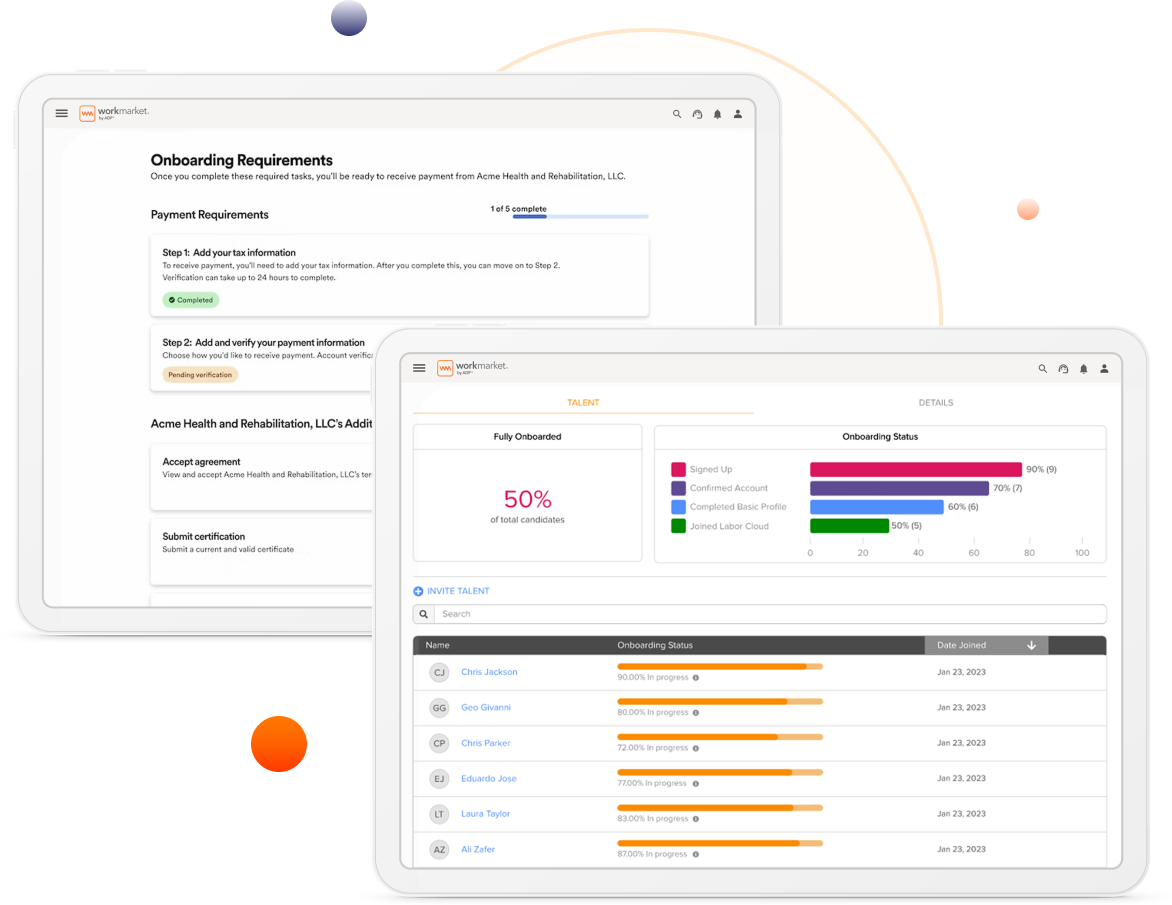
Businesses can invite their existing contractors into the platform. They do not have to recruit everyone from a public marketplace. Onboarding collects documents and supports U.S. tax ID and bank verification; assignments carry the work through completion; invoices and payment follow. For contractors, mobile tools handle opportunities, check-ins and deliverables. The marketplace itself concentrates on IT field services.
Growth trips over the payment file
Edutech Lab offers another revealing example. The assessment and learning-content business had doubled its contractor base from 2018 to 2019, then needed to triple it. Its manual processes produced payment confusion and made expansion harder. Processing thousands of payments each month made small administrative errors a recurring operating problem.
WorkMarket’s published case study describes verified onboarding, bulk payment files and more international payment options. Edutech Lab reported roughly 20% less manual work. That figure belongs to one customer’s experience, rather than a universal savings promise. The broader lesson is practical: expanding the contractor roster also expands the checking, paying and year-end reporting that follows it.
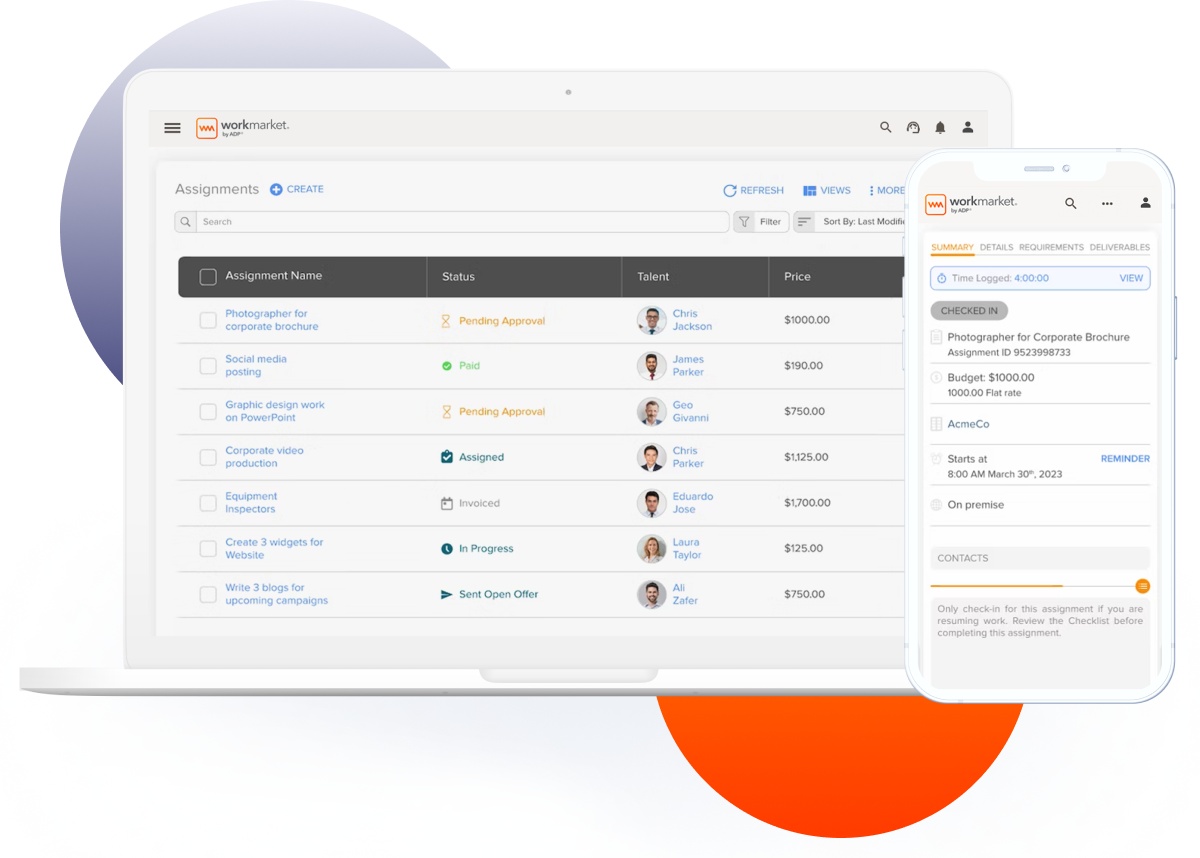
For the person doing the job, the system has a different center of gravity. An assignment can be accepted or countered, checked into, and completed with uploaded photographs, documents or a signature. The contractor’s phone becomes the place where evidence of completion meets the request for approval. Some functions, including downloading tax documents, still require the website.
Where the money changes hands
WorkMarket sells to businesses through a sales-led process. Its terms distinguish transactional and subscription clients and describe platform fees separate from what a contractor earns. A buyer needs a quote for its own arrangement. That leaves a sensible purchasing exercise: compare the proposed charges with the staff time and errors your current process produces.
Workers face a separate choice. Optional FastFunds costs 2.5% of an eligible approved assignment’s value under the published terms. On $1,000, that is $25 for earlier payment. Faster access has a concrete price, even when the interface makes the transaction feel effortless.
A useful place between systems
WorkMarket sits between contractor management, payments and work-order coordination. Field Nation competes directly in IT field services. WorkMarket also addresses language services, education and other contractor-heavy businesses, including those bringing their own people. Its open API, webhooks and automation rules connect recruiting, service and accounting systems; customers can adopt modules rather than replace everything.
The fit has boundaries. Buying businesses need a U.S. entity, although international contractor payments are supported. Low-volume users should weigh setup against the administration they actually have. Verification tools help enforce chosen requirements; they do not replace decisions about worker classification. The mobile help center also identifies tasks that still require the website.
For a buyer evaluating that promise, a useful demo would follow one real assignment all the way through. Who defines the requirements? Which system creates the ticket? What counts as acceptable proof of completion? Who approves the invoice? These are implementation questions with consequences for the working day. Automating a vague approval rule can simply move the waiting into a different screen. The integration is only useful when the people using it agree on what should happen next.
What can another operator copy? Measure the time between each handoff. Set qualifications before the urgent request arrives. Connect the work order to its approval and payment. WorkMarket packages those habits into software. Their value begins with a modest discovery: sometimes the people are ready, and the process is what needs fixing.