A winery sells a bottle. Simple enough. Then someone joins its club, changes an address, updates a card, books a tasting, and orders another case online. The bottle is the visible business. The records surrounding it are another business entirely. Fullsteam has built a company around the proposition that the software keeping those records should also help collect the money.
- Buy specialist software businesses with customers and industry knowledge already in place.
- Connect their products to payments and shared operating resources.
- Keep earning the customer’s trust through the migration, the monthly bill, and the next support call.
This is vertical software: programs designed around a particular trade. A hotel, a bridal shop, and a storage facility have different vocabularies and different routines. Fullsteam owns businesses serving all three. Its customers generally encounter a specialist brand, rather than a single application bearing the parent’s name. That distinction explains much of the strategy.
Buy the expertise. Share the plumbing.
Michael Lawler and investment firm Aquiline established Fullsteam in 2018. By December 2021, its investment announcement described nearly 50 founder-led software companies brought together. Lawler put the thesis plainly: “We believe the future of payments delivery is with integrated software.” The customer already needs the program to run the business. Payments give that program another useful job.
“We believe the future of payments delivery is with integrated software.”
Michael Lawler · December 2021
Aquiline describes the parent as a holding company that supplies centralized operations, technology, and payments capabilities. The appeal for an acquired operator is practical. Finance, legal work, hiring, and payment infrastructure demand attention even when the product team would rather be fixing its software. Fullsteam’s acquisition pitch offers those resources alongside sales guidance and access to peers.
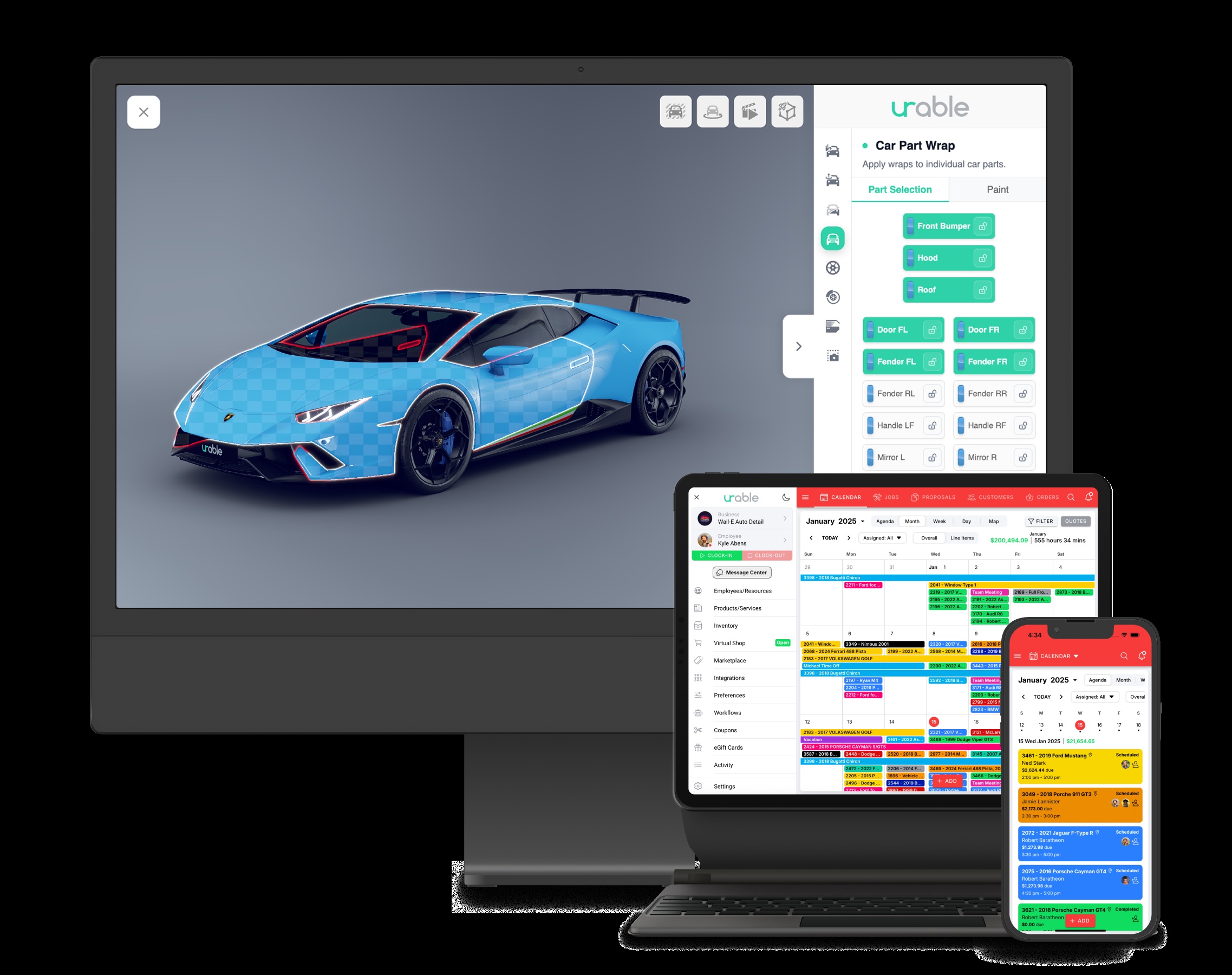
Urable makes the arrangement tangible. Its software serves detailing, paint-protection film, tint, wrap, and ceramic-coating businesses. When its parent was acquired in May 2025, the announcement said Michael, Kris, and Kyle Abens would continue leading strategy, operations, and development. Their stated attraction was the buyer’s software expertise and resources. Ownership changed; the people responsible for the product stayed.
The parent earns through software and services, with payments embedded in the commercial relationship. Its wider offering includes marketing, insurance, and merchant capital. This places Fullsteam between a software operator and a financial-services platform. An independent software vendor can connect to a processor too. Fullsteam’s distinction is ownership of the specialist businesses alongside the shared capabilities.
There is a second audience here: the founder considering a sale. Fullsteam promises continuity for the brand and team, plus operating help. That offer competes with remaining independent or choosing another buyer. Its careers page reflects the same organization-wide proposition, advertising opportunities across industries, remote roles, and a retirement match. Those are the company’s stated terms of attraction, rather than evidence that every acquired team experiences ownership the same way.
A winery gets a moving date
In January 2025, Commerce7 announced that Fullsteam had acquired WineDirect’s direct-to-consumer SaaS division. Approximately 35 WineDirect employees were to join the Commerce7 team. The customer plan covered two substantial moves: payment processing into Fullsteam, followed by the winery’s operational data and software. This is where an acquisition becomes somebody else’s Tuesday.
Commerce7 said WineDirect clients would move to Fullsteam Payments within six months. It offered to cover data-migration costs and work with partners on free or reduced-cost website transfers. WineDirect’s January guidance told customers they could remain on the Classic platform for up to two years, while estimating onboarding at six to eight weeks depending on data and website complexity.
Those details matter more than a slogan about integration. A winery has customer histories, club memberships, and a website to preserve. Paying for the data transfer addresses one obstacle. Training people and coordinating a working storefront remain operational tasks. The announced assistance explains how the companies intended to reduce friction; it does not establish that every migration went smoothly.
Commerce7 Lite’s published software price in USD. Card processing is additional. This is a winery plan, not a Fullsteam-wide tariff.
Lite targets wineries below $100,000 in annual direct-to-consumer revenue and requires Fullsteam Payments. Its documentation lists processing at interchange plus 2.5%, despite a zero platform transaction fee. It also limits users to one POS profile and one inventory location. Software, processing, and equipment belong in the same purchasing calculation. A low subscription alone cannot settle the decision.
The Cancel button tells on everybody
Consider a less photogenic document: an April 2025 PEAK 15 support release. It described users clicking Cancel after submitting a payment. The result could be a payment visible in MerchantTrack but absent from PEAK 15. The fix disabled Cancel once processing began. A small interface decision had allowed the financial record and the application record to disagree.
The release note does not tell us how often this happened or how much it cost. It does show what integrated payments must get right. A processor completing a charge is only part of the job. The business software must reliably recognize the same event. Anyone copying the model should test that whole sequence, including what happens when an impatient human clicks twice.
The trade is still the point
Expansion keeps testing that discipline. In December 2025, adviser Covington Associates announced CounselEAR’s sale to Fullsteam. CounselEAR serves hearing-healthcare and speech-pathology practices with scheduling, billing, device tracking, insurance claims, and documentation. The adviser said its team and leadership would remain. A clinic brings an entirely different set of records to the same broad ownership model.
For a founder, the useful question is which shared resources will actually improve the product. For a merchant, it is whether the specialist software fits the work, whether the total bill makes sense, and whether the transition is manageable. Businesses wanting unrestricted processor choice should examine the product’s requirements carefully. Fullsteam’s proposition depends on the trade-specific layer staying useful. The money can follow only if the customer does.
Follow the work
Fullsteam website ↗ · LinkedIn ↗ · Selling a software company ↗
Commerce7’s WineDirect announcement ↗ · Explore Urable ↗
Urable videos and product walkthroughs ↗ · Watch the Urable acquisition interview ↗