Somewhere in a bank, a perfectly ordinary number is trying to become a regulatory filing. Before it gets there, it may cross a thicket of source systems, definitions, approvals, jurisdictions and deadlines. If anyone asks where it came from, “the spreadsheet on Priya's laptop” is not an answer. Wolters Kluwer Financial Services Solutions exists for that unlovely journey. Its software turns regulations into tasks, loan rules into documents, transactions into alerts, and data into reports that can survive a regulator's follow-up question.
The name describes a portfolio, not a tidy startup. Today the offerings sit mainly inside Wolters Kluwer's Financial & Corporate Compliance division. The lineage runs through Bankers Systems, acquired in 1999, FRSGlobal, acquired in 2010, and eOriginal, agreed at approximately €231 million in cash in 2020. OneSumX is the flagship across finance, risk, regulatory reporting and compliance management. ComplianceOne and Expere handle regulated lending documents and workflows. Wiz covers fair lending, HMDA, CRA and small-business data. GainsKeeper takes care of cost basis and investment tax reporting. eOriginal makes a digital loan authoritative enough to be stored, pledged and sold.
The product is a defensible chain of custody
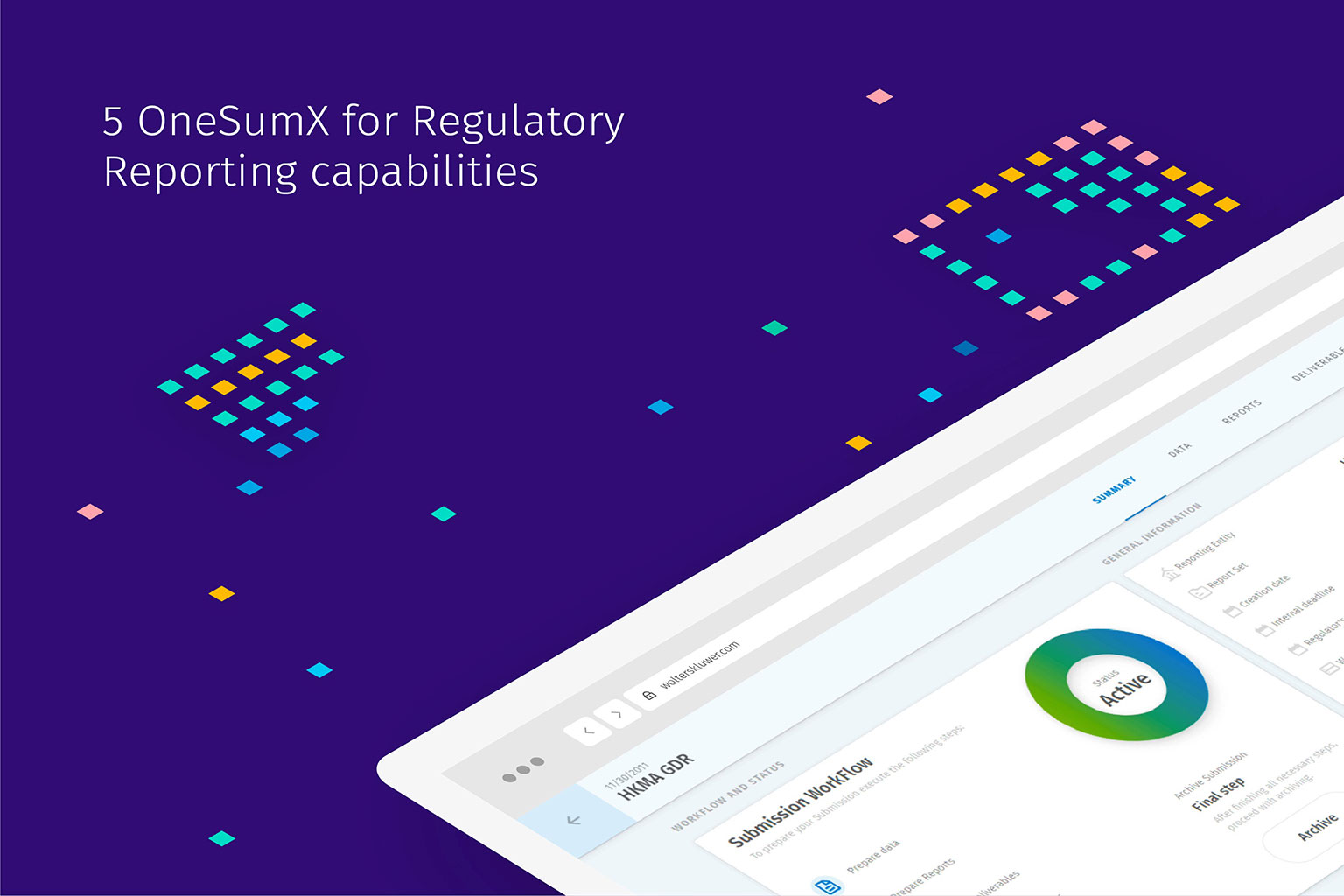
“Regtech” can sound like a neat dashboard placed on top of a messy institution. This portfolio is more ambitious and less photogenic. OneSumX for Regulatory Reporting collects governed data, applies jurisdiction-specific logic, runs validations, manages approvals and produces returns. Its risk products cover credit, market, liquidity and capital calculations. The compliance suite watches authoritative sources, interprets changes, maps them to obligations and tracks what the institution did next. Financial Crime Control joins monitoring, sanctions screening, investigations and suspicious-activity reporting.
The differentiator is not merely a larger rule library. It is the connection between content and execution. A regulation is useful only when somebody can decide whether it applies, assign an owner, amend a policy, test a control and retain evidence. Wolters Kluwer employs regulatory specialists to structure and validate content, then places that content inside software. That human-software combination matters in banking, where an eloquent but invented AI answer is worse than no answer.
The real difficulty comes from understanding how many different requirements apply across jurisdictions - and keeping pace as the complex requirements change.Steve Swenson, CTO, Wolters Kluwer Financial & Corporate Compliance
What fails first is usually the handoff
Compliance disasters rarely begin with a cinematic server explosion. They begin with a form that did not update, a field copied twice, an alert nobody owned or a number that changed after sign-off. Manual processes can work at modest scale. Then a new jurisdiction, product or acquisition adds another spreadsheet and another interpretation. The first failure is often not calculation but coordination.
That is what changes a buyer's mind. The case for an integrated platform becomes persuasive when the institution must prove the whole path, not just deliver the final PDF. Triodos Bank UK implemented OneSumX regulatory reporting in 2025. Afin Bank UK followed with a cloud deployment covering COREP, FINREP, Bank of England statistical reporting and PRA 110. These are not decorative installations. They put recurring statutory work onto a controlled system with repeatable logic.
For lenders, the chain extends beyond reporting. A compliant loan starts with current documents and correct disclosures. If it becomes an electronic asset, the lender also needs tamper evidence, an authoritative copy and a credible transfer history. eOriginal handles that second life. The acquisition widened Wolters Kluwer's position from preparing the paperwork to maintaining the asset's legal integrity as it moves through secondary markets.
The customer is an institution, but the user has a deadline
The buyer may be a chief compliance officer, chief risk officer or finance executive. The daily users are more varied: a regulatory-reporting analyst reconciling a return, a lending operations team preparing disclosures, an investigator clearing transaction alerts, an internal auditor collecting evidence, or a tax specialist calculating cost basis after a corporate action. The portfolio stretches across global banks, community banks, credit unions, insurers, securities firms, mortgage lenders and fintechs. Compliance Solutions says it serves more than 10,000 U.S. banks and credit unions. After the FRSGlobal acquisition, Wolters Kluwer said its broader financial-services business reached more than 15,000 institutions, including 41 of the world's 50 largest financial firms at that time.
Scale creates an odd product challenge. A global bank needs country packs, entity hierarchies, data lineage and controls that work across a sprawling organization. A community institution needs trusted interpretation without staffing a miniature law firm. OneSumX Reg Manager was designed around community banks, insurers and credit unions, while the finance and reporting suite serves large international institutions. The common product is not identical functionality. It is packaged institutional memory: current rules, known calculations, repeatable workflows and a record of the last decision.
A price list is not part of the product
Wolters Kluwer does not publish standard OneSumX pricing. The honest answer to “what did it cost?” is: the contract is negotiated. Modules, countries, legal entities, reporting regimes, data feeds, cloud choice, implementation and consulting all change the bill. The sticker price is only part of it. A bank must map source data, settle definitions, test outputs, train owners and run parallel reporting before trusting the system.
Public economics are visible one level up. Financial & Corporate Compliance reported €1.239 billion in 2025 revenue. Financial Services represented 45 percent of that division's revenue and grew 1 percent organically on a pro forma basis. Across Wolters Kluwer, 83 percent of 2025 revenue was recurring. This is not a hypergrowth story. It is a durability story: subscriptions, maintenance, expert content and workflow dependence, with consulting and transactions around the edges.
The parent has also used acquisition as product development with a balance sheet. Bankers Systems supplied a base in U.S. compliance documents. FRSGlobal brought global finance, risk and reporting. eOriginal added the infrastructure behind transferable electronic assets. Each purchase moved the company closer to the transaction and further from its publishing roots. That shift is the quiet strategic achievement: information that once sat beside the work now executes part of the work.
The AI pitch is better with a rulebook attached
Compliance Intelligence, launched in October 2025, is the clearest expression of the current strategy. It uses what Wolters Kluwer calls Expert AI to connect alerts from regulators to an institution's obligations and change process. The phrase is marketing, but it contains a sound product judgment: a model is more useful when grounded in curated sources, a defined taxonomy and a workflow that records human decisions.
The company should still be judged on mundane questions. Can users see the source? Can they trace why a rule applies? Can an expert override the model? Who is named when an automated process goes wrong? In 2026, its own banking-compliance specialists were publicly discussing AI kill switches and accountable owners. That restraint is appropriate. The market is crowded with Nasdaq AxiomSL, Regnology, Fenergo, NICE Actimize, MetricStream, Workiva, Thomson Reuters and specialist consultancies. “AI-powered” does not separate anyone for long. Trusted content, integration depth and evidence might.
The copyable bit is the seam, not the suite
A smaller software company cannot copy decades of regulatory content or thousands of bank relationships. It can copy the design principle. Find the seam where knowledge becomes action. Attach the source to the decision, the decision to an owner and the owner to evidence. Integrate with systems users already inhabit. Wolters Kluwer's partner network does this with Adobe Acrobat Sign, Fiserv, ICE Encompass, Jack Henry, MeridianLink, Salesforce and nCino. The product becomes part of the transaction rather than another tab demanding attention.
Multiple jurisdictions, frequent change, high reporting stakes, complex data lineage and a real need to prove who approved what.
A small institution with narrow exposure, clean standard processes and no team to own implementation may be better served by a point tool or managed service.
The caveat is integration appetite. A unified system does not unify an institution by itself. Dirty data stays dirty. Conflicting definitions do not vanish because the dashboard is teal. A buyer without executive sponsorship, assigned data owners and enough time for parallel testing can purchase sophisticated software and preserve the same old chaos underneath it. Nor is breadth automatically economical: institutions that need one narrow filing may find a specialist product cheaper and faster.
Still, the portfolio occupies a useful place between raw regulation and a bank's core systems. Consultants can interpret rules. Point products can solve one task. Large platforms can centralize data. Wolters Kluwer's wager is that regulated firms will pay one supplier to join those layers and keep them current. The company has been making versions of that wager since paper forms ruled the back office. The medium changed. The anxiety did not.