The auction catalog is an odd place to encounter a climate idea. There are chromatography systems, incubator shakers and bioreactors. They once belonged to Windfall Bio, a company built around a proposition almost indecently tidy: feed waste methane to microbes, let the microbes grow, and turn their nitrogen-rich bodies into organic fertilizer. A troublesome gas becomes something a farmer might actually buy.
In December 2025, Windfall announced the opening of a demonstration plant in the Houston area. In May 2026, AgFunderNews reported that the company had ceased operations the previous month. Equipment from its California headquarters and Texas facility subsequently appeared in auctions. The interval between those two pictures - the opening and the sale - gives this company’s story its uncomfortable interest.
- Natural, non-GMO microbes consumed methane and produced fertilizer biomass.
- Dairy and landfill trials reported substantial methane reductions within their tested boundaries.
- Windfall raised $37 million and disclosed a $5 million Texas facility investment.
- Reported closure in April 2026 followed a period of commercialization and further fundraising.
01 / Give the gas a different customer
Windfall’s organisms were methanotrophs. Its rather more hospitable name for them was “mems,” short for methane-eating microbes. These were naturally occurring soil organisms, selected and combined into proprietary communities. Windfall’s expertise lay in choosing the organisms and arranging the conditions in which they could do useful industrial work.
The process joined two jobs. Methane supplied carbon and energy for microbial growth. Nitrogen from the air was incorporated into the growing biomass. That nitrogen-rich material could become FOUNDATION, the company’s organic fertilizer. Methane did not somehow turn into nitrogen; the two inputs met in a living organism. The distinction matters, even if the shorthand fits more comfortably on a pitch slide.
Carbon + energy
+ nitrogen from air
Organic fertilizer
Conceptual process diagram. It shows inputs and outputs, not conversion yields or a complete carbon balance.
The intended customers had gas that was awkward to sell: dairy farmers, landfill operators, wastewater facilities and oil and gas businesses. Windfall positioned its systems for streams whose concentration, location or scale made conventional energy recovery unattractive. Instead of upgrading methane for a pipeline or burning it for electricity, an operator could use biological conversion to make a different saleable product.
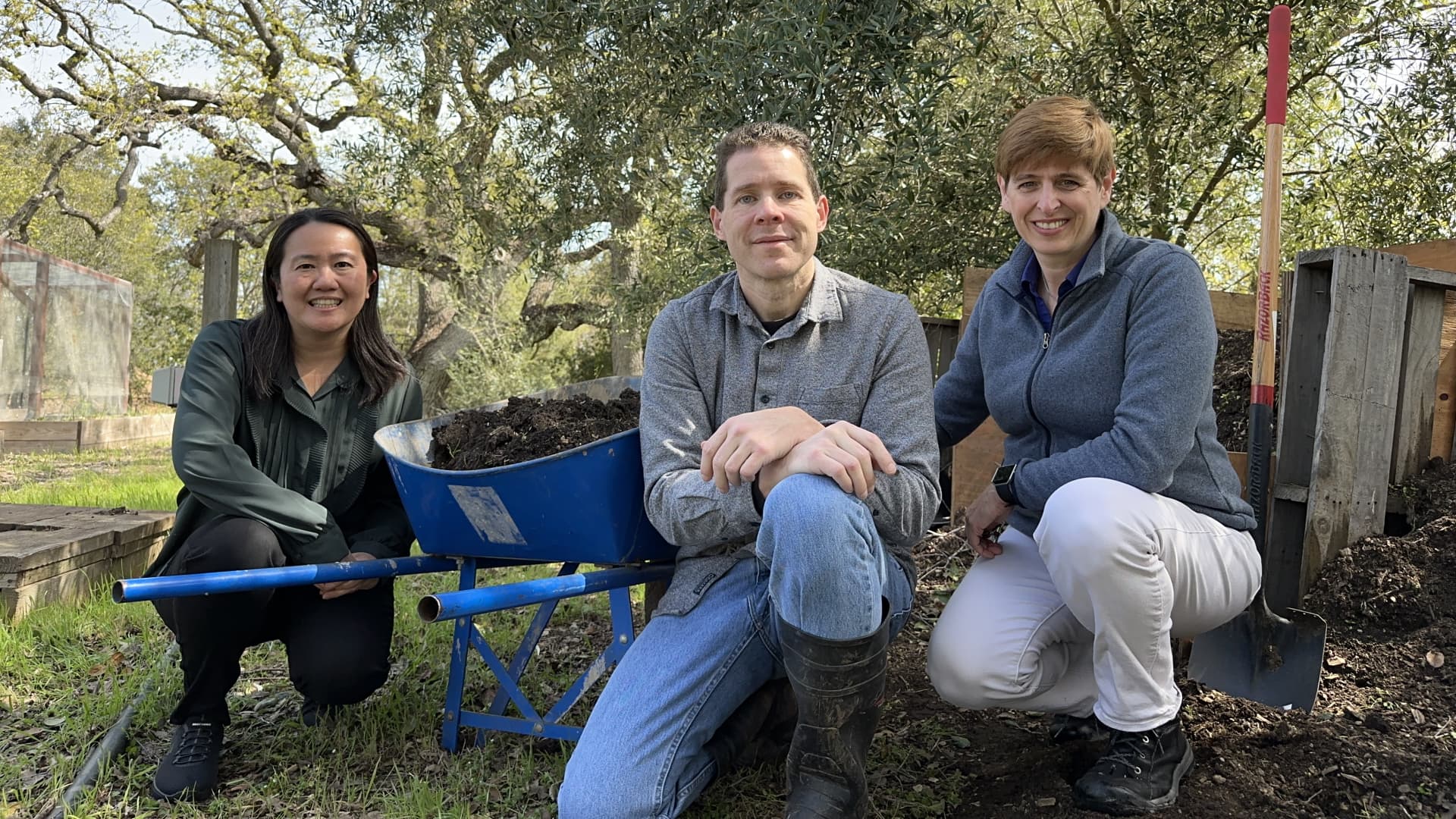
Josh Silverman brought experience from Calysta, the gas-fermentation company he co-founded. Carla Risso supplied deep microbial research expertise; Louis Stenmark’s role included marketing. The company also drew on engineering, fermentation and agricultural experience. This was a business in which understanding the organism was only the beginning. Someone still had to connect the pipe, grow the culture and persuade a grower to spread the result.
02 / The lagoon is only part of the farm
The most tangible agricultural test took place at Correia Family Dairy, a supplier to Straus Family Creamery, in Petaluma, California. Whole Foods Market introduced Windfall to Straus and helped facilitate the pilot through Windfall’s relationship with Amazon’s Climate Pledge Fund. Here an investor connection led to a place where the technology could be tried against actual manure gas.
Windfall reported that its reactor ran continuously for more than a month and converted over 85% of the methane in the treated biogas. It handled raw gas without pretreatment and also removed hydrogen sulfide. Those details are useful because an elegant laboratory process becomes less elegant if its feedstock first requires an expensive cleaning routine.
More than one month of continuous operation. This is a reactor-stream result, not an 85% reduction in the whole farm’s emissions.
A dairy’s methane comes from more than its manure storage. This system’s test addressed the gas entering the reactor. Keeping that boundary visible prevents an impressive engineering result from becoming a much larger claim by accident. A farmer evaluating a similar installation would need to know how much of the farm’s methane can reach the treatment system in the first place.
At Republic Services’ Sunshine Canyon Landfill, the arrangement was different. Windfall applied microbes to the landfill cover to address emissions at the surface. The July 2025 announcement described a field trial aimed at methane and odor-related compounds. In January 2026, Silverman reported over 75% methane reduction from a single application for more than 30 days. A biocover and a fertilizer-producing reactor shared biology, but served different operational purposes.
03 / The lettuce gets a vote
For a grower, the climate credentials of fertilizer are a conversation starter. The crop still gets the final vote. FOUNDATION therefore had to establish itself in the familiar language of plant nutrition, application and yield.
In August 2025, Windfall announced that FOUNDATION had received an OMRI listing for organic use under USDA National Organic Program standards. That gave it access to an important customer group. The listing concerned permitted use in organic production; it did not establish superior performance in every field.
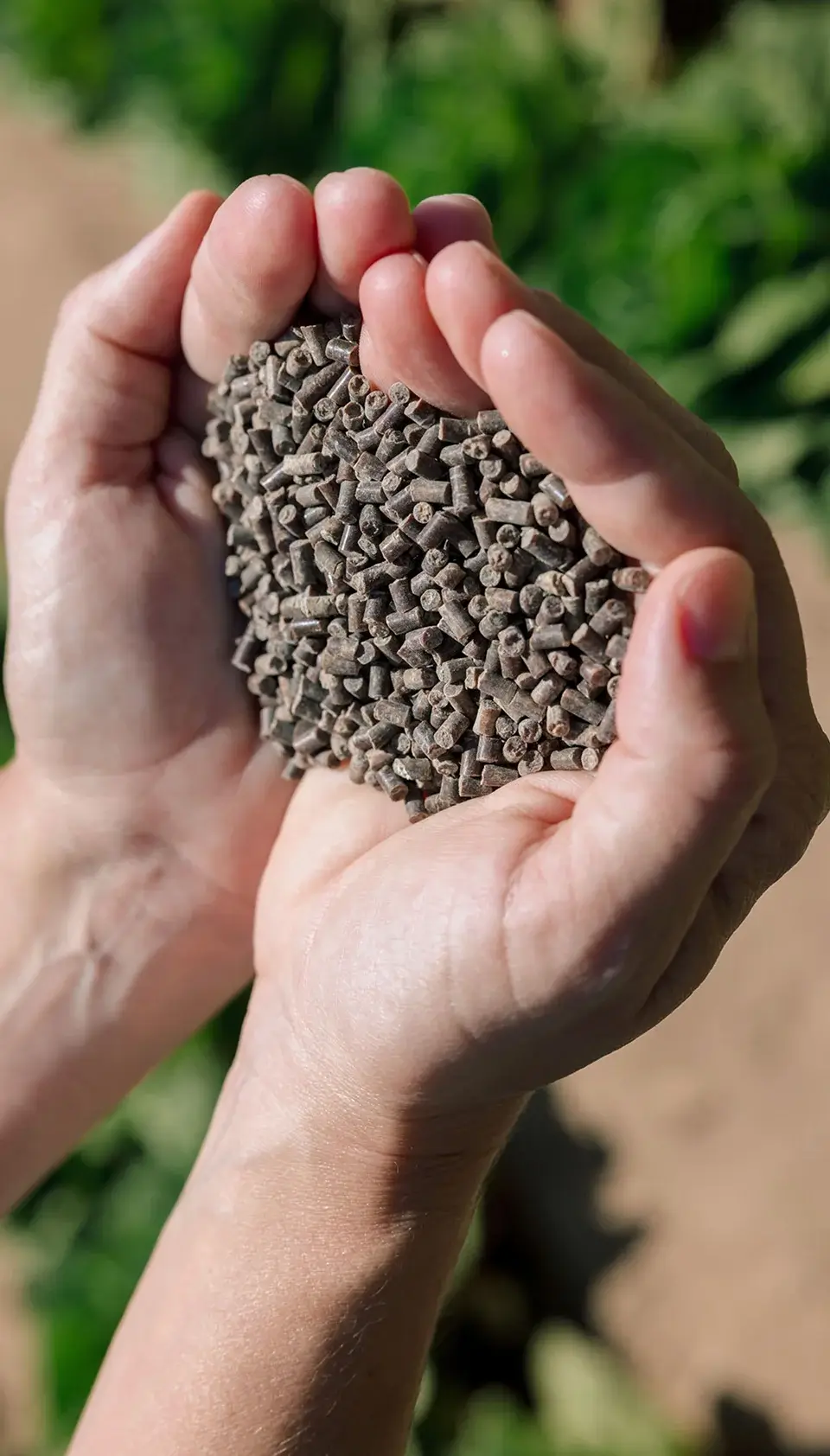
A later Romaine lettuce trial conducted by Ag Metrics Group reported yields 23-34% above feather meal and performance comparable to soy hydrolysate. That comparison placed FOUNDATION among organic fertilizers, with a specific crop and specific alternatives. The result offered a reason for a grower to pay attention without settling the question for tomatoes, different soils or another season.
Silverman was explicit in January 2026 that Windfall did not expect to compete directly with synthetic fertilizers in the near term, citing different nitrogen content and use cases. That is a useful piece of commercial restraint. “Fertilizer” sounds like one market until the buyer starts asking about nitrogen concentration, equipment compatibility and cost per useful application.
04 / Two customers, one awkward supply chain
Windfall had to please both the methane producer and the fertilizer buyer. A landfill operator could become a producer of crop inputs without wishing to become an expert fertilizer salesperson. Windfall described fixed-price offtake agreements and a distribution relationship with Wilbur-Ellis as ways to bridge that gap. Making the material and finding its next owner belonged to the same business problem.
The manufacturing plan also tried to avoid owning every expensive step. In January 2025, Windfall announced repeatable production of its microbes at 17,000-liter fermentation scale with contract manufacturer FERMWORX. Producing the inoculum at that scale was a supply milestone. It was a different activity from continuously treating customers’ methane streams at dispersed sites.
Its offerings extended to reactor formats, monitoring and remote operation. Carbon credits could add another revenue stream where methane reductions met the required verification rules. In economic terms, the attraction was several benefits from one installation: useful fertilizer, avoided waste and potentially a credit. Each benefit still needed its own buyer, measurement or avoided expense.
“We are actively raising capital to support our commercialization and deliver the product to our customers.”
Josh Silverman / Fertilizer Daily / January 2026
05 / The expensive distance between proof and permanence
The company emerged from stealth with a $9 million seed announcement in March 2023. A $28 million Series A followed in April 2024, led by Prelude Ventures with participants including Amazon’s Climate Pledge Fund. Disclosed funding reached $37 million. Capital raised measures investor commitments; it does not tell us the cost of a customer installation or the company’s lifetime expenditure.
The Texas facility provides a more specific number. Windfall disclosed a $5 million investment in its approximately 5,000-square-foot demonstration operation and said it had generated ten new full-time jobs. The plant was designed to demonstrate blends of gas feedstocks and let prospective customers observe continuous operation. It offered a place to turn a slide presentation into something visitors could inspect.
Seed + Series A
facility investment
Different measures, not a spending breakdown. The facility investment is not an additional funding round.
The later sequence complicates any neat victory story. A Department of Energy project selected in December 2024 appeared on a list of terminated awards in October 2025, according to subsequent reporting. The company was also seeking more capital. By spring 2026, the reported cessation and later asset sales had overtaken the commercialization plan.
That chronology does not establish which difficulty proved fatal. The documented ending supports a narrower conclusion: the company did not sustain operations through this phase, despite its reported technical progress. Calling the microbes a failure would go beyond the trial record. Calling the business proven would ignore the auction record.
06 / What survives the auction
There is a practical lesson here for someone building a business around industrial waste. Begin with an output that customers already understand. Match the equipment to the actual site. Arrange a destination for the product before asking an operator to manufacture it. Windfall’s approach gives those ideas concrete form, even though its own commercial effort ended abruptly.
The conditions deserve equal attention. A reactor needs reliable contact between microbes and gas, suitable operating conditions, monitoring and an outlet for the material it produces. The value calculation weakens when collecting the gas costs too much, the fertilizer cannot be used or sold nearby, or projected credits lack a workable verification route. These are questions for a site-level assessment, not conclusions that a headline percentage can answer.
Windfall’s story leaves an idea that is easy to explain and demanding to execute. Waste methane could feed organisms that feed crops. The reported trials gave that sentence substance. The sale of the equipment adds another requirement for anyone who tries it next: keep the company alive long enough for the customer’s second order.
Keep following the methane
Explore the company’s technology, its public record and the people who tested it.