Consider the office trailer. It arrives looking like an answer: four walls, a roof, somewhere to spread out the drawings. Then come the questions. Where will everyone sit? How do they get inside? Who brings the storage? At what point does a delivered building become a functioning workplace? WillScot has spent decades turning that last question into a business.
- The offer: temporary space, fitted out and delivered.
- The economics: rent assets, recover them, put them back to work.
- The lesson: solve the chores surrounding the product.
Its customers include builders, schools, retailers, industrial operators and event organizers. They share an awkward timing problem: people need somewhere to work before a permanent facility is ready, while it is being renovated, or for an occasion too brief to justify building one. WillScot rents the space and offers the equipment and services needed to use it.
01 / The race before the race
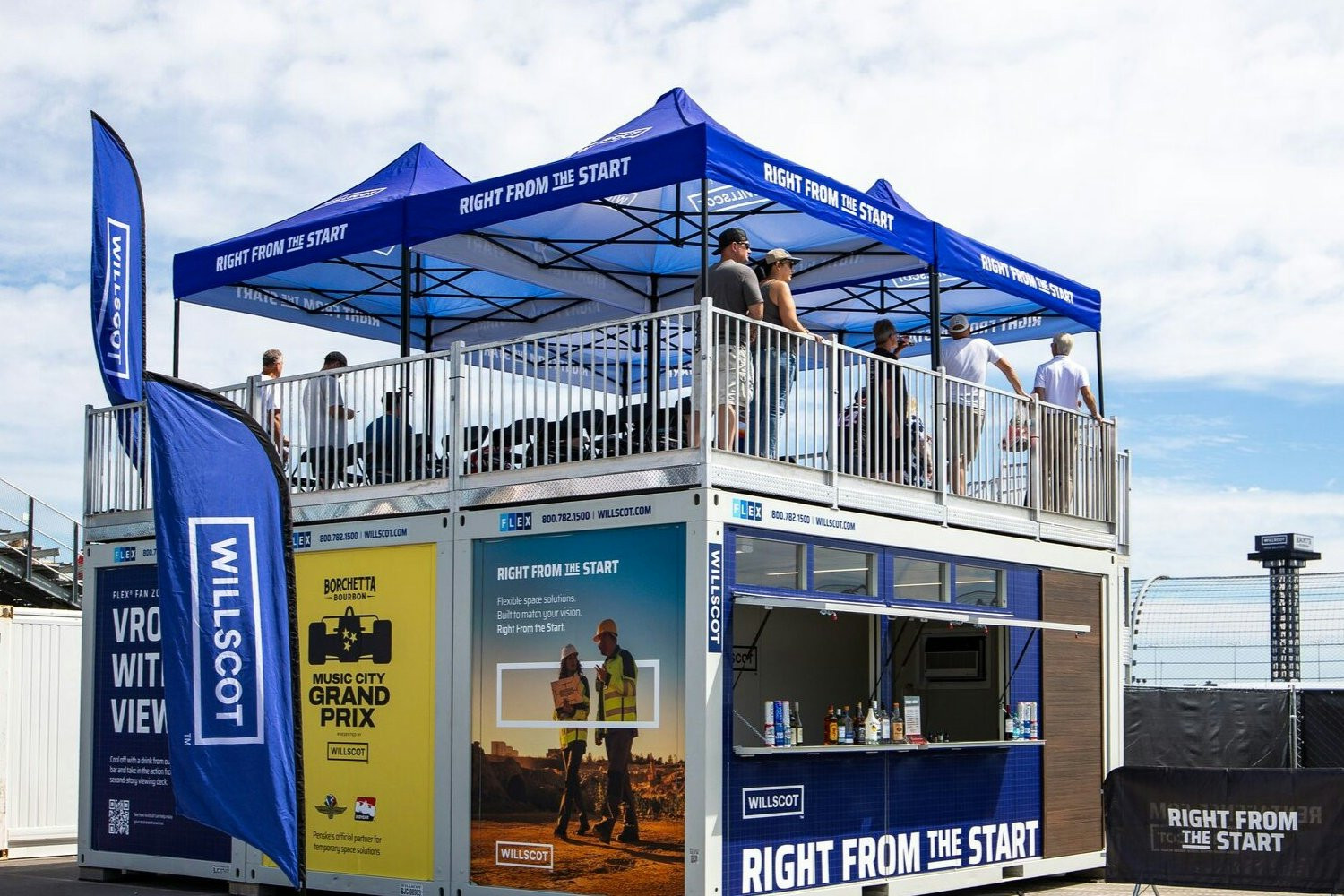
For the 2026 Freedom 250 Grand Prix in Washington, WillScot announced more than 6,400 square feet of temporary office and storage space. The assignment covered medical, broadcast, production, vendor and race operations. A FLEX workspace would serve as the main operations compound. The company was also the event’s presenting paddock sponsor.
That list explains the market better than a photograph of an empty container. A race needs a small working settlement around it. The deadline belongs to the event; the buildings have to fit the deadline. WillScot’s role spans transporting, installing and servicing that infrastructure. Its expertise lives in the handoffs between those tasks.
02 / A building with a shopping list
The catalogue runs from mobile offices and classrooms to storage containers, refrigerated trailers, blast-resistant modules and large fabric structures. FLEX, introduced in 2015, uses a panelized system that can be reconfigured, connected and stacked. Different products answer different site requirements; a classroom and a refinery workspace are hardly interchangeable.
The less photogenic offering is The Essentials: furniture, appliances, steps, ramps, connectivity and other accessories. These are the items a customer would otherwise have to remember, source and coordinate. A desk is a modest object. A missing desk on the first morning is a management problem. Bundling it with the building gives WillScot another item to rent and the customer one fewer arrangement to make.

Competitors understand this too. McGrath’s Mobile Modular offers furnishings, site preparation and installation alongside rental buildings. WillScot’s case rests on the breadth of its offering and the network that supports it. Buyers should compare the local equipment, service scope and delivery commitment. A national brand cannot make every configuration available everywhere on the same day.
03 / Temporary is a long-term business
The company traces its history to an eight-foot-wide construction trailer that could be towed behind a car in 1944. Williams Mobile Offices incorporated in 1955. Its 1990 merger with Scotsman Manufacturing produced Williams Scotsman; the 2020 Mobile Mini merger added another major strand. Today’s company is an accumulation of fleets, branches and services.
Its income follows the equipment. In 2025, leasing generated roughly $1.75 billion, delivery and installation $389 million, and sales of new and rental units another $144 million. Together, they produced $2.28 billion in revenue. Customers can buy equipment, but the recurring rental relationship is the centre of the model.
Long asset lives make refurbishment consequential. WillScot says a full refurbishment can cost 20-30% of a new unit and help extend a modular unit’s service to 30 years. That is the company’s estimate, rather than a promise for every building. The underlying logic is plain: earn again from something already owned.
People make that circulation possible. WillScot’s 2026 proxy puts about 81% of its year-end 2025 workforce in branches. The company gives employees stop-work authority and describes safety as a core value. This is a service business conducted with heavy objects, moving trucks and changing sites. Dispatchers, installers and branch teams determine whether the customer experiences the promised simplicity.
04 / The $180 million stop sign
Expansion has limits. In January 2024, WillScot announced a proposed $3.8 billion acquisition of McGrath. By September, the companies had agreed to end it. Their stated reason was regulatory clearance: after discussions with the Federal Trade Commission, they concluded there was “no commercially reasonable path” to satisfying the requirements. WillScot paid a $180 million termination fee.
Regulatory clearance was the obstacle the companies identified before the combination could happen. Management said pursuing approval would be excessively onerous and distract from other opportunities. The payment was a cost of stopping, separate from other transaction expenses. It is a useful corrective to any tidy account of growth through acquisition: scale has a price, and sometimes permission is unavailable on acceptable terms.
The operating business has needed adjustment too. A network optimization plan approved in December 2025 led to a $302 million non-cash restructuring charge, reflecting accelerated depreciation of rental equipment identified for abandonment. Full-year revenue accompanied a $53 million net loss. Reusable assets still require decisions about which ones deserve another deployment.
05 / Order the first working day
Tim Boswell became CEO in January 2026. By the second quarter, WillScot reported $612 million in revenue and $47 million in net income, and raised its annual outlook. Management pointed to large installations and event activity while describing overall non-residential construction as muted. The recovery depends partly on which projects are happening, not simply how many.
The practical buying lesson is to price the complete assignment. Specify occupancy, duration, access, utilities, furnishings, delivery, installation and eventual removal. Ask who owns each task. A short project with difficult access can have very different economics from a long lease on a prepared site. Permitting and site preparation still matter; modular equipment does not erase them.
The useful unit of purchase is a first working day.An editorial takeaway
Other businesses can copy the question behind the bundle: what must happen after delivery before the customer can use the product? WillScot keeps extending its answer. Its July 2026 Quick-Connect Canopy creates covered workspace between compatible units, with typical installation in a day, subject to engineering and site conditions. Even the gap between the buildings can become something useful.