A portfolio manager can have six screens and still struggle to see the whole picture. William J. Wu uses that crowded desk to explain the problem behind Menos AI. Market information arrives in one place, positions in another, research somewhere else. The person in the chair supplies the connections. Technology has furnished the office beautifully and left its occupant to do the wiring.
Wu has spent enough time around investment operations to recognize that arrangement. Before becoming co-founder and chief executive of Menos AI, he worked in quantitative finance, including a role as Head of Quant at Northern Trust. His company begins with a complaint familiar to anyone who has reconciled two systems: useful information loses much of its usefulness when it cannot meet the other information it needs.
The complaint has become a business. Menos AI launched its Sonαr research agent in August 2025 with an announced $5.2 million seed round. In September 2026, it announced another $5.1 million financing. Money gives the project room to develop. Wu’s more interesting challenge is persuading investment organizations that their own accumulated reasoning deserves infrastructure.
A risk manager’s view of the room
Wu also appears publicly as Junchen (William) Wu. He holds a Northwestern University PhD and a CFA charter. His professional background spans more than a decade in the hedge fund industry, giving him a view of the business from several positions rather than a single trading desk.
Earlier in his career, he was a risk portfolio manager at a Boston quantitative hedge fund, overseeing a $3 billion multi-strategy portfolio. That figure describes the portfolio under his oversight; it is a measure of the responsibility in the job. Risk work requires an account of how different positions fit together, including the ways seemingly separate bets can respond to the same event.
At Northern Trust, he supported front- and middle-office functions and worked with firms including Bridgewater and Citadel. These were professional relationships from his previous role. Their significance here is practical: his experience included the systems surrounding investment decisions, where accounting, analytics and portfolio records have to coexist.
A founder’s origin story often arrives with a sudden revelation. Wu’s is an extension of an earlier project. At Northern Trust’s Front Office Solutions, he worked on a Total Portfolio View, bringing disparate information together. Menos AI carries that concern into a different technical setting. The continuity is the point: he had encountered the organizational problem before offering an AI answer.
Earlier career responsibility.
The airplane experiment
There is a smaller, more cheerful version of the same habit in Wu’s account of building a World Cup fantasy bracket. His team was discussing predictions for the 2026 tournament. Existing options did not fit what he wanted, including images people could share and an experience that did not lean heavily toward gambling. So he made his own on a flight home.
His description is pleasantly specific. He prompted an AI tool to create an HTML bracket, supplied the knockout draw as context, added an image-download button and sharing features, then iterated. He put the exercise at about an hour. A colleague who merely wanted to discuss football might reasonably have considered this an energetic interpretation of team spirit.
The prototype still required his testing, and an engineer handled deployment. Wu used those remaining tasks to explain why enterprise applications demand more than a convincing first version. The anecdote supplies a useful reading of his public persona: willing to experiment himself, interested in sharing the result, and quick to distinguish a working sketch from software other people can depend on.
Prompt02
Iterate03
Test04
Deploy
A good engine still needs a car
That distinction also appears in a June 2026 essay whose title compares Claude to an engine and an institutional workflow to a car. Wu’s argument concerns the surrounding machinery: permissions, integration, verification and the ability to keep operating when a provider changes. His preferred metaphor gives a complex software argument a familiar shape. Owning a fine engine does leave one rather exposed to the weather.
The essay argues against treating a single model vendor as a complete enterprise strategy. It presents model selection as an ongoing responsibility and puts institutional context around the model itself. For Wu, the question is how an investment firm can use changing AI capabilities while retaining control over its process.
His own bracket makes this position more interesting. He has tried the accessible tools and described enjoying their speed. The criticism comes from the distance between that experience and a firm’s operational needs. In his account, the same ease that makes a prototype inviting can obscure the work required to connect it safely to an organization.
This is also where his role becomes recognizably that of a chief executive. He must explain why customers should buy the surrounding system when they can already obtain the model. A memorable metaphor helps start that conversation. Whether the product earns the comparison depends on its daily use inside the customer’s business.
Who made the call, and why?
Sonαr entered the market as an idea-generation and research agent. The launch described a system that examines market updates, external research and internal material for timely investment ideas. Wu’s launch remark was succinct: “Alpha doesn’t scream. It whispers.” The language fits a product concerned with finding a useful contribution inside a noisy stream.
The launch also described Voice Scoring, then forthcoming, intended to examine which contributors were early and accurate. That ambition shifts attention from the volume of commentary to the record behind it. A person can sound assured and be late; another can be tentative and identify a change before everyone agrees about it.
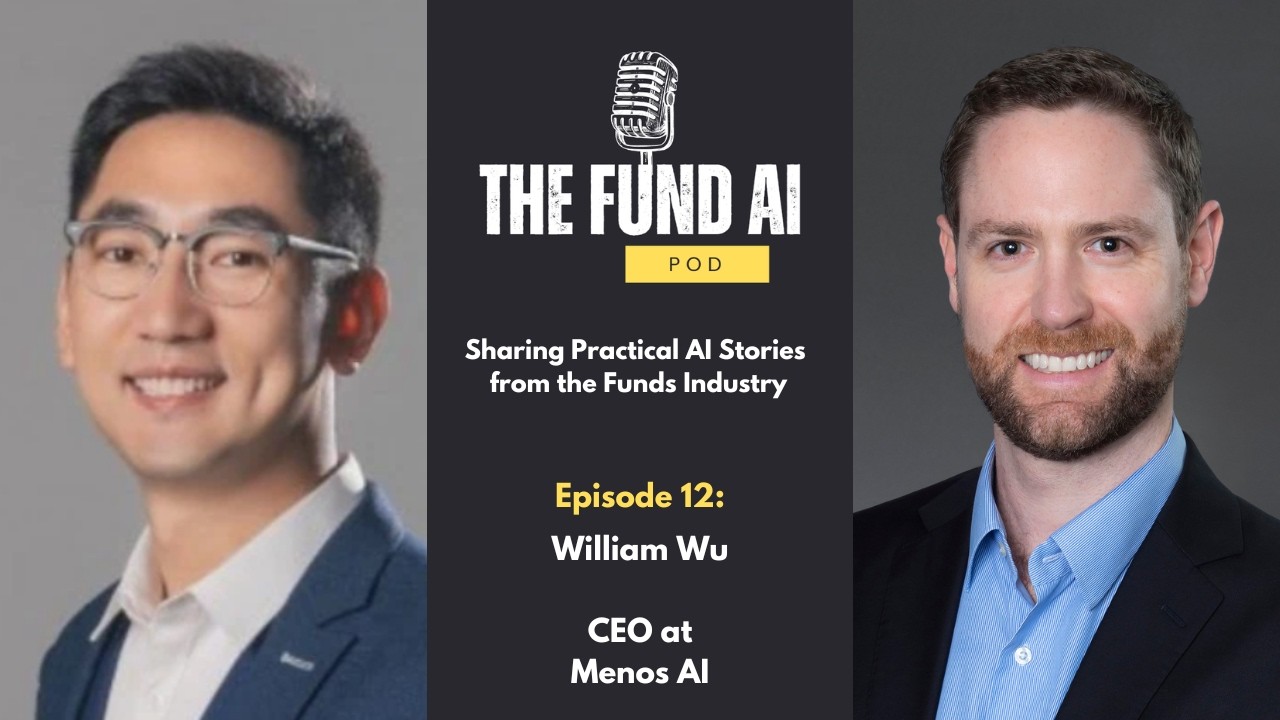
In his March 2026 appearance on The Fund AI Pod, Wu discussed research, idea generation, trade reconciliation and total portfolio exposure. The range matters to his story. His view of AI extends from the analyst’s reading pile into the routines that keep an investment operation functioning. It reflects a career spent seeing more of the institution than its final trade.
A research record can also preserve disagreement. An idea may be rejected for reasons that become interesting later, or accepted with conditions that a brief summary leaves out. Keeping those qualifications available makes the past easier to question. In the system Wu describes, retrieving a conclusion would be only the beginning of understanding the decision that produced it.
The episode also addressed the difference between skill and luck. An investment call carries a rationale as well as an outcome. Preserving those two things together gives colleagues something to revisit. They can ask what the author expected, which assumptions mattered, and whether subsequent events supported the reasoning. A scoreboard alone offers a thinner account.
Keeping the reasoning in the building
By September 2026, Menos AI’s funding announcement put a private, traceable context layer at the center of its offering. The company described capturing proprietary research, portfolio information, investment reasoning and workflows. This broadened the public pitch from surfacing ideas to organizing the knowledge that gives those ideas meaning inside a particular firm.
Wu’s statement began with the job description of his customer: “Asset managers are paid for judgment and execution.” His aim is to connect those activities through a system that makes reasoning usable by people and AI agents. The announced financing, led by returning investor Copper Sky Capital with Alpha Square Group participating, brought total company funding above $10 million.
Institutional memory is a useful way to understand the ambition. A finished memo can tell a new colleague what a team decided. The surrounding record can tell them why it decided, what it doubted and how its view changed. Wu’s company wants that material to become a resource that remains under the firm’s control.
Menos AI’s leadership includes co-founders Chris Yang, its chief AI scientist, and Xiang Pan, its chief technology officer. The company describes its tools as supporting investment professionals’ judgment. That places Wu’s commercial role alongside technical specialists while keeping the investment team responsible for the decision. The organization he is building joins those different kinds of expertise.
“Asset managers are paid for judgment and execution.”William J. Wu · September 2026
The next conversation
Wu’s recent public work also includes co-authorship of Narrative Factors: A Dynamic Factor Framework for Risk Management and Alpha Generation, with Alex Wang and Andrew Chin. The stated subject connects market narratives to measurable sources of risk and return. It brings his earlier quantitative responsibilities into contact with his present interest in interpreting investment language.
An AIAS+ industry workshop scheduled for November 6, 2026, in San Francisco lists him as organizer, with a welcome and a conversation with Northern Trust Asset Management president Mike Hunstad on the agenda. The event is still ahead. Its planned program places discovery, institutional adoption and investment practice in the same room.
Wu’s ambition is for investment organizations to have their own central intelligence. It is a large proposition with a decidedly unromantic daily expression: information should arrive with context; an old idea should remain intelligible; a useful experiment should survive the handoff to production. His career and his public writing keep returning to that handoff.
The football bracket is an apt place to leave him. He could make a prediction game quickly, invite others to use it and recognize the engineering still needed. At Menos AI, the stakes and the organization are larger, but the question retains that ordinary shape. Once something promising appears on a screen, who will make it work for everyone else?