Deepanshu has spent much of his adult life near complicated machinery. First came mechanical engineering at IIT Kharagpur. Then the less visible machinery of finance: an FX sales desk, algorithmic trading research, and eventually the Global Derivatives Clearing business at J.P. Morgan. Clearing is the part after the apparent action, where a trade becomes a chain of obligations and somebody must make certain the promises survive contact with reality. It is rarely the part that gets a movie. It is exactly the part that teaches a person where the bodies are buried.
By 2022, Deepanshu had reached vice president in quantitative research. He had also accumulated more than eight years in quantitative finance and a useful suspicion of the number of institutions required to make a sophisticated trade behave. He left to co-found EthosX with Smit Patoliya, another quantitative-finance practitioner. The pair joined Y Combinator's Summer 2022 batch with an insistently infrastructural idea: put the trading, clearing and settlement of derivatives on blockchains, end to end.
The proposal sounded technical because it was. Two hedge funds could trade directly through smart contracts, the founders argued, instead of sending the transaction through the familiar parade of brokers, banks and clearing entities. Settlement could occur automatically. The payoffs could live in code. For retail users, EthosX imagined hedging products that behaved like familiar tokens rather than contracts written in dialects available only to the initiated.
“As insiders, we have seen how much everything hangs by a thread.”Deepanshu and Smit Patoliya, EthosX launch
A résumé made of systems
There is a tidy way to tell Deepanshu's story by reciting institutions. IIT Kharagpur, IIM Calcutta, Royal Bank of Scotland, Quant One Technologies, J.P. Morgan, Y Combinator. The more useful reading is that each stop offered a different view of a system. Engineering supplied the instinct to break a large mechanism into interacting pieces. At IIM Calcutta, where he finished among the institute's top 20 and received the B.P.L. Prize, he studied management and finance. His student work ranged from Indian takeover rules and IPO valuation to a supply-chain finance paper accepted for presentation at an international operations-research conference.
Scholarships carried him into other research settings: MITACS in Canada, the University of Tokyo, and a DAAD-supported exchange in Germany. Then the market became his laboratory. He worked in corporate FX sales at RBS and in quantitative research at Quant One. At J.P. Morgan, his remit reached the plumbing of global derivatives clearing. By the time he became a founder, his complaint with the system was not academic. He had watched the handoffs.
This background also explains his attraction to blockchain without requiring the usual sermon. A clearing specialist naturally notices what happens when records can be shared, collateral can be programmed and settlement can execute without a telephone chain. The technology is interesting to him insofar as it removes a coordination problem. His public biography describes a passion for using blockchain and cryptocurrencies on real financial-market problems. The word “real” does a great deal of work there.
Keep the engine. Change the dashboard.
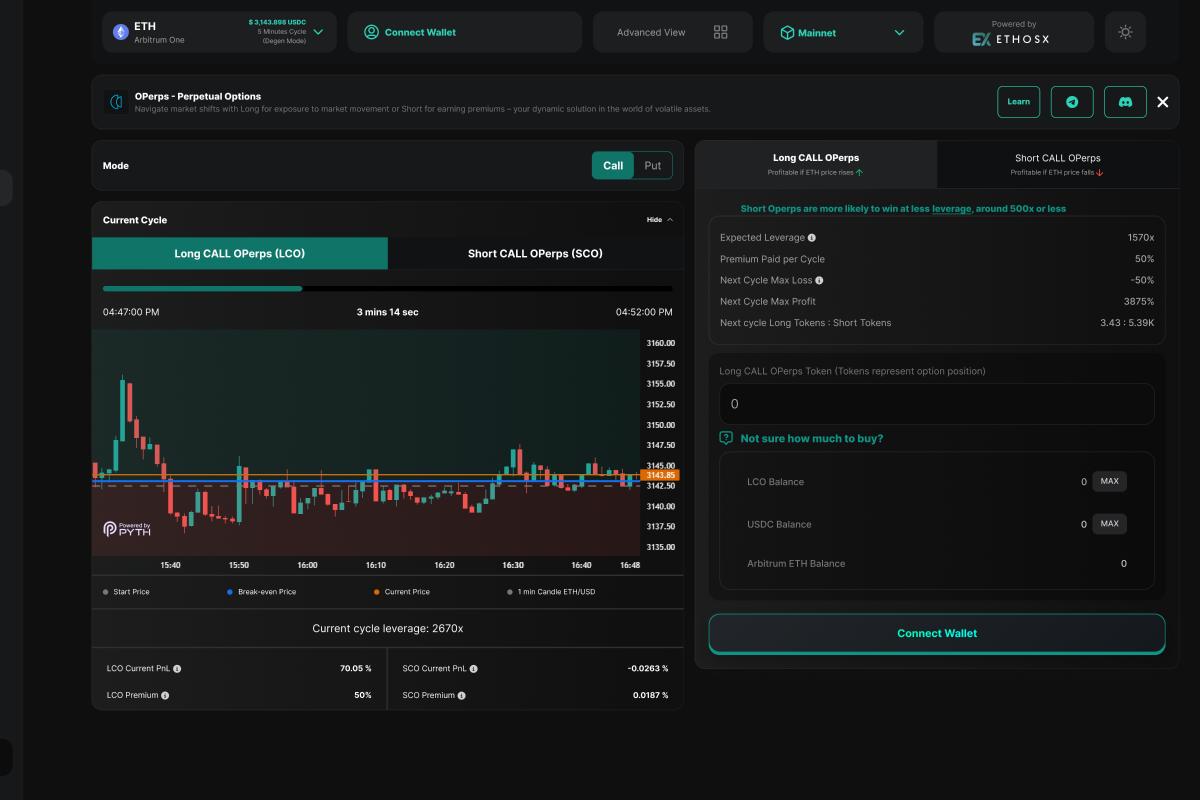
EthosX's first products remained close to the original thesis. There was an institutional request-for-quote system for customized derivatives. There was on-chain clearing. There was liquidation protection under development for lending protocols. And there were OPerps, perpetual options that removed an expiry date and presented a fixed maximum-loss structure. In 2024, the product was operating on Arbitrum through Kana Labs, with short settlement cycles and profits delivered to wallets.
The company was selected for Consensus 2024 PitchFest in Austin. The moment offered a neat visual: a startup built around invisible clearing infrastructure standing on a stage and explaining itself in minutes. Yet product development was pointing toward a larger difficulty. Moving financial machinery on-chain can reduce intermediaries. It does not automatically make a market welcoming. A perfectly settled product may still arrive wrapped in charts, jargon and the faint social warning that beginners should keep their hands in their pockets.
Fliq, the creator-led prediction-market product now associated with EthosX, tackles that upper layer. Instead of asking a user to understand option Greeks, it asks whether something will happen. A football result. A price threshold. An election outcome. The financial expression follows a human instinct everyone already possesses: having an opinion and wanting to know whether it was right.
Creators are part of the rails
Deepanshu's public argument for Fliq begins with exclusion. The best-known prediction platforms have demonstrated demand, but their infrastructure remains centered on a limited set of countries, identity systems and banking habits. A platform may be online everywhere while being practical almost nowhere. Documentation, geo-blocking, minimum deposits, unfamiliar rails and language turn an open door into a handsome painting of one.
His alternative is not a single venue with a heroic localization budget. It is a network of creator-owned markets. A football analyst in Lagos, an entertainment creator in Manila or a political commentator in Mumbai can launch questions their audience already follows. Users arrive through people they trust and payment habits they recognize. The creator is not merely an affiliate link wearing better clothes. The creator supplies context, distribution and the subject itself.
That arrangement changes the usual startup arithmetic. A financial platform traditionally acquires users, then attempts to manufacture community around the transaction. Fliq begins where community already exists. The creator has spent years learning which subjects produce argument, which claims need explanation and which moments can hold attention. Those skills are difficult to encode in a market-making formula, but they determine whether anyone bothers to open the market in the first place. Deepanshu's thesis gives them a place in the architecture.
It also gives creators a more interesting role than endorsement. An endorsement borrows trust for a fee and returns it slightly worn. A creator-owned market can align the question, the audience and the economics. The creator frames and promotes the market, then shares in the activity it generates. The community is invited to act on conviction instead of donating another impression to an advertising dashboard. The model will still meet the hard problems that every market meets: liquidity, resolution, regulation and the limits of human judgment. Its novelty lies in recognizing that distribution is not an errand performed after the product is finished. Distribution helps define the product.
“This matters to me. I come from this world.”Deepanshu, writing about participation in emerging markets
This is also the cleanest connection between EthosX and Fliq. The first venture focused on the bottom of the stack: can the obligations of a derivative be made direct, programmable and transparent? The newer product focuses on the top: can a person encounter a market in a language and community that already make sense? One removes the institutional handoffs. The other removes the ceremonial gown.
The quant discovers culture
There is a pleasing tension in a quantitative founder arguing that culture is infrastructure. Quants are trained to prize what can be measured. Creators trade in trust, taste and the peculiar ability to make thousands of people care about the same question at once. Fliq treats that ability as an economic input. It suggests that market design is partly social design, and that liquidity begins before an order is placed.
Deepanshu's recent writing names cities rather than abstractions: Lagos, Manila, Mumbai, São Paulo, Dhaka. This geographical specificity is part of the product argument. A global market can aggregate more information only when the globe can get in. Local creators know which questions are alive, which language carries them, and which payment rails people actually use. The grand “wisdom of crowds” requires the minor administrative miracle of admitting the crowd.
The aspiration is broad, but the career behind it is unusually consistent. Deepanshu began by studying machines. He moved into the machines behind markets. He built technology to shorten the chain of financial trust. Now he is working on the interface between those rails and ordinary curiosity. Each chapter asks the same systems question at a different altitude: which part is essential, and which part is merely how the old machine happened to be assembled?
There is an operator's patience in that sequence. EthosX did not leap from a white paper to a claim about global participation. The team built the obscure pieces first: quote requests, settlement logic, options and clearing. Fliq then placed a simpler object on top of them. The progression resembles good engineering because dependencies appear in the proper order. A friendly button without dependable settlement is a promise waiting to become an apology. Dependable settlement without a friendly button is a cathedral with no door. Deepanshu's work now sits in the awkward, useful business of building both.
Prediction markets will not become universal because their mathematics got easier. The mathematics was always hiding underneath. They become approachable when the front door looks like a question people were already debating over tea, in a group chat or beneath a creator's post. Deepanshu's wager is that finance can preserve rigorous machinery while losing some of its theatre. Wall Street may keep the engine. The rest of the world gets a dashboard it can read.