Profile · Founder
Jelena
Djuric
The co-founder building the rails that let digital dollars move natively across dozens of blockchains.
The co-founder building the rails that let digital dollars move natively across dozens of blockchains.
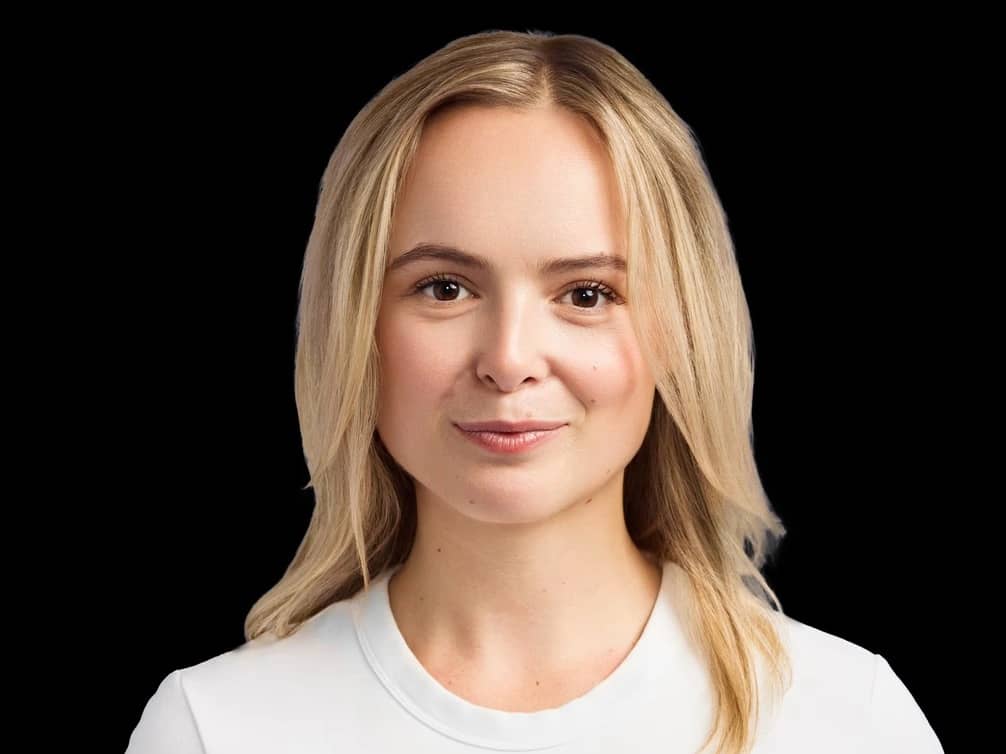
Jelena Djuric runs Noble, a blockchain with a single, unglamorous job: issue stablecoins and move them wherever they need to go. It is the kind of infrastructure most people never think about, which is exactly why it matters. When a company like Circle wants its dollar-backed token to reach dozens of smaller networks at once, Noble is the connective tissue that makes it possible.
Djuric co-founded the company in early 2023 with Stefan Coolican and John Letey. In under two years it went from an idea about crypto's liquidity gaps to a platform holding hundreds of millions of dollars in assets and backed by Paradigm, one of the most selective investors in the industry. The pitch she keeps returning to is deceptively simple: make sending a stablecoin feel like sending money on Venmo.
We're not a monolithic base layer like Solana, Ethereum or even Arbitrum. We're a chain with a validator set plugged into 45 or so distinct appchains, where we issue in under a second of block times.
The stablecoin market is crowded with issuers. What has been missing, in Djuric's telling, is a clean way to get those tokens onto the many blockchains where people actually want to use them. Every new network is its own island, with its own standards and its own liquidity problems. Noble sits in the middle as neutral infrastructure, minting assets natively and passing them across chains rather than relying on the bridged or wrapped versions that have caused so many blow-ups in crypto's history.
That neutrality is the product. Noble does not compete with the issuers it serves or the chains it connects. It brought native USDC to the Cosmos ecosystem, then extended the same model to a growing roster of partners. The result is a chain that behaves less like a destination and more like a switchboard for digital dollars.
Native USDC issuance and distribution across the interchain.
Tokenized real-world assets reaching more networks.
Regulated euro money and yield-bearing instruments.
Noble's design is a direct response to what went wrong before it. When Terra's UST unraveled in 2022, it took confidence in algorithmic and loosely backed stablecoins down with it. Djuric and her co-founders bet on the opposite approach: native, fully collateralized assets issued on infrastructure built for stability first. The name says as much - Noble's stated mission is "stability and security for assets on the interchain."
She also read a broader shift correctly. More builders wanted their own application-specific chains rather than renting space on a single crowded network. Noble was built to serve that fragmented future, plugging into each appchain instead of asking everyone to come to one.
Djuric did not arrive by the usual route. She studied peace, conflict and justice studies alongside political science at the University of Toronto, with exchange stints at Sciences Po in Paris and Hebrew University in Jerusalem. Her early career was in public policy and international relations - the National Democratic Institute, the Council of Canadian Innovators, the InterAction Council.
Crypto pulled her in through community and operations roles: DFINITY in 2018, then Celo, then years inside the Cosmos ecosystem with Informal Systems and the Interchain Foundation. Along the way she co-founded the Canadian Web3 Council to advocate for the industry at a national level. By the time she started Noble, she had spent half a decade learning how these ecosystems actually work from the inside.
Public policy and international relations roles in Canada.
Enters blockchain as Community Manager at DFINITY.
Partner in Global Community at cLabs / Celo.
Operations and business development across the Cosmos ecosystem.
Co-founds Noble; native USDC arrives on Cosmos.
$15M Series A led by Paradigm.
Platform surpasses $458M+ in assets, ~50 chains connected.
We're seeing a trend where a lot of builders and companies actually want to build their own appchain.
Ask Djuric where this goes and the answer is consumer-simple even if the machinery is not. Today Noble is infrastructure that issuers and developers rely on. The longer arc is a world where anyone can send a digital dollar as casually as tapping a name in a payments app, without thinking about which chain it lives on or how it got there.
The Series A capital is aimed squarely at that goal: new user-facing products and a bigger team to build them. Noble has also moved into yield with USDN, a stablecoin designed to put idle dollars to work. For a company that started by quietly wiring other people's tokens across the interchain, the direction of travel is toward the surface, where ordinary users live.
The co-founder and CEO of Noble, a blockchain for issuing and distributing stablecoins natively across the interchain.
An asset issuance blockchain that brought native USDC to Cosmos and connects roughly 50 networks, issuing in under a second.
A $15M Series A led by Paradigm in late 2024, bringing total funding to about $18.3M.
Work across the Cosmos, Dfinity and Celo ecosystems, co-founding the Canadian Web3 Council, and earlier a career in public policy.
To make sending stablecoins as easy as a Venmo payment, on neutral infrastructure any issuer can use.