FinChat is for the investor who has ever opened a 10-K, a transcript, a spreadsheet and six browser tabs, then forgotten which number started the whole expedition. The product gathers the awkward raw material of fundamental analysis into one orderly terminal. Ask about AWS revenue, compare two retailers’ same-store sales, chart a decade of margins, scan an earnings call or screen a global universe. The answer arrives before your coffee cools.
That convenience is the point. It is also the trap. A clean chart feels conclusive even when it is only the beginning of a question. FinChat, which became Fiscal.ai in June 2025, is best understood as a research accelerator. It reduces the clerical drag of collecting numbers. It does not know your circle of competence, your risk tolerance or why management suddenly changed the definition of an adjusted metric.
Who should actually use it?
The natural customer is a fundamental investor who researches public companies repeatedly. Solo investors get a single place for statements, estimates, company-specific KPIs, filings, call transcripts and portfolio statistics. Analysts get faster first drafts and comparisons. Students get a friendlier doorway into financial statements. Fintech teams can skip years of data plumbing by licensing the API.
It is less compelling for chart-first traders, people who only check a quote twice a month, or anyone hoping an AI will whisper tomorrow’s winner. The terminal is built around businesses and their reported economics. If your process lives in price action, options flow or macro dashboards, Koyfin, TradingView or a specialist tool may fit better.
The useful bit is hiding behind the chatbot
FinChat launched publicly in 2023 with a deliciously legible pitch: “ChatGPT for finance.” The first version answered questions using financial statements, transcripts and a growing library of business KPIs. On Product Hunt, co-founder Braden Dennis described the pain precisely: analysts spend absurd amounts of time surfacing data from filings and terminals, while company-level operating metrics are rarely gathered in one place.
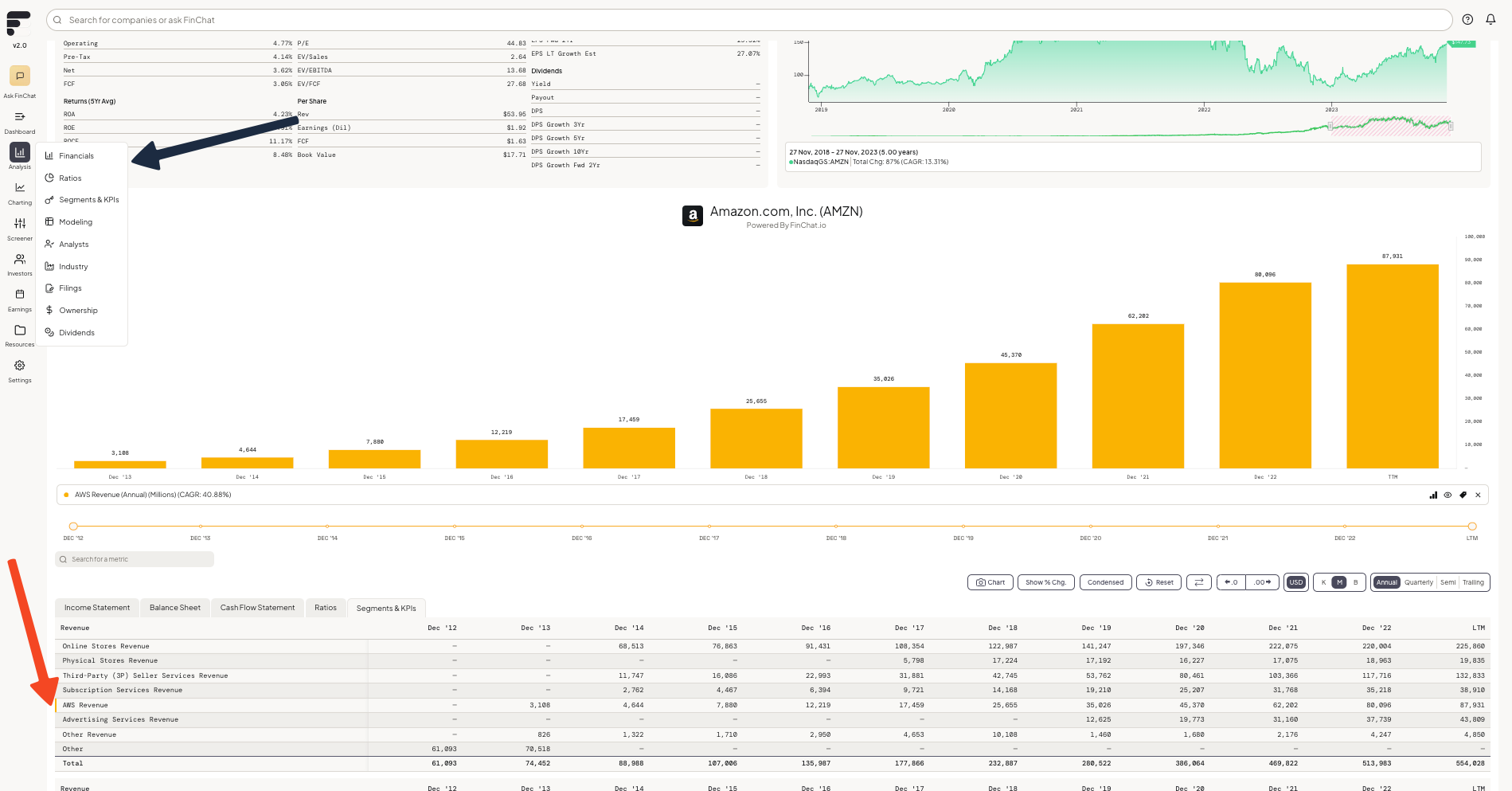
The chatbot made the demo. The database made the product. Revenue is easy to find anywhere. More revealing numbers - Disney+ subscribers, AWS revenue, restaurant unit growth, bookings or comparable sales - are scattered across presentations and footnotes, expressed differently by every company. FinChat’s wager was that collecting and normalizing those odd little numbers could become a durable advantage.
“It’s the easiest way to find data on stocks and not just US stocks.”A self-described non-professional investor on Reddit, explaining a workflow that moves custom metrics into Excel
From one clever box to a whole desk
The present product is much broader than chat. Company pages combine financial statements, valuation ratios, consensus estimates, analyst targets, ownership, dividends, filings and investor-relations events. The chart builder compares companies and mixes standardized financial measures with operating KPIs. Dashboards keep a thesis visible. A screener narrows the universe, while a DCF tool turns assumptions into a valuation rather than pretending the future came prefilled.
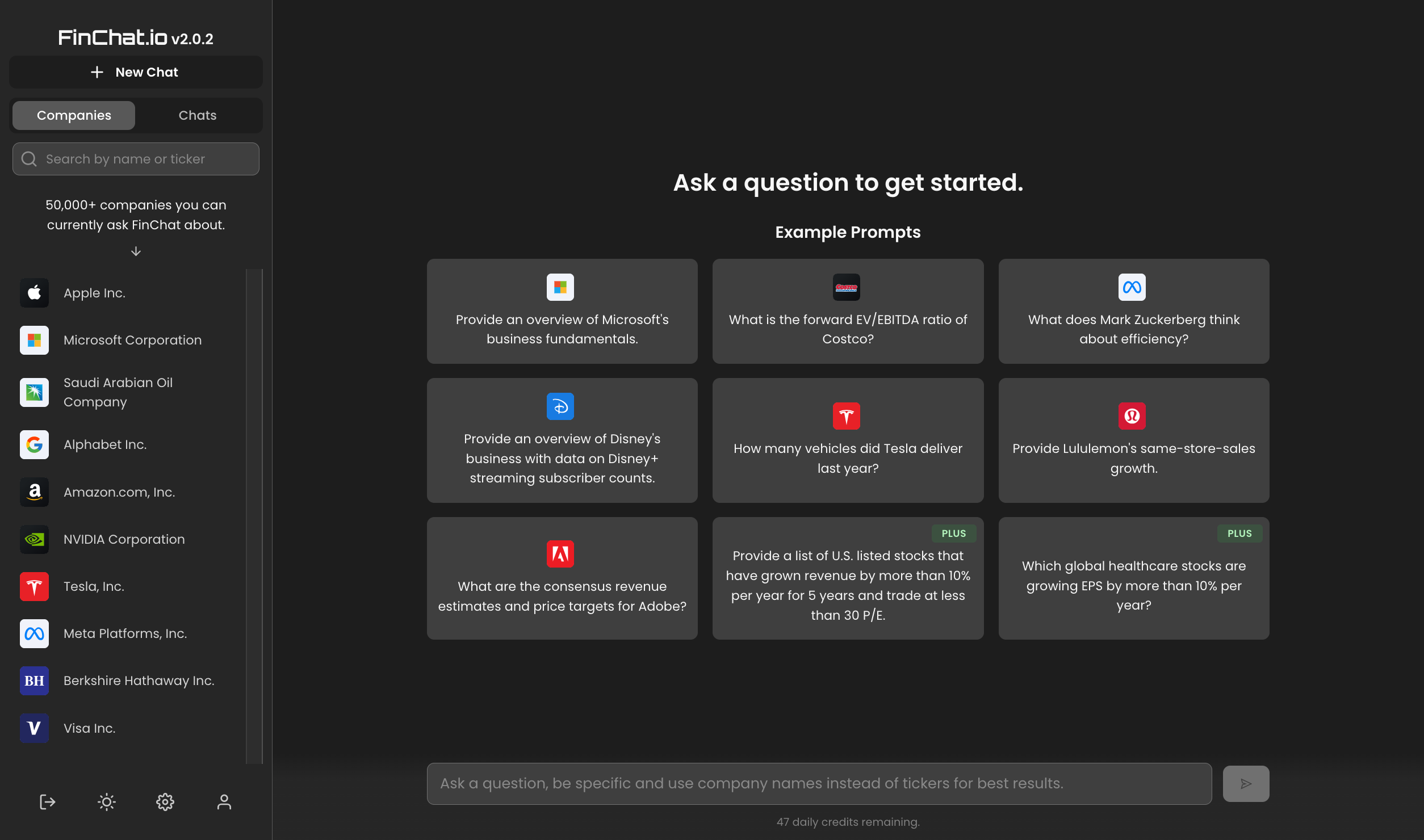
Copilot remains useful when the request is bounded: summarize management’s comments about margins, compare two companies on a specified metric, or locate a theme across calls. In 2024, version 3 expanded from structured figures into conference calls, annual reports and analyst models. Later releases added summaries inside document viewers and cross-document search. The current product uses multiple large language models rather than staking the company on one model vendor.
Pull standardized statements, ratios, segment results and company KPIs without rebuilding the same workbook on every new idea.
Open the filing, transcript, slides or call material. Enterprise audit links help trace eligible data points back to the source.
Put rivals on the same chart, switch periods and currencies, and keep the exact values in a table beneath the picture.
Use Copilot to locate evidence and surface differences, then decide which assumptions deserve human suspicion.
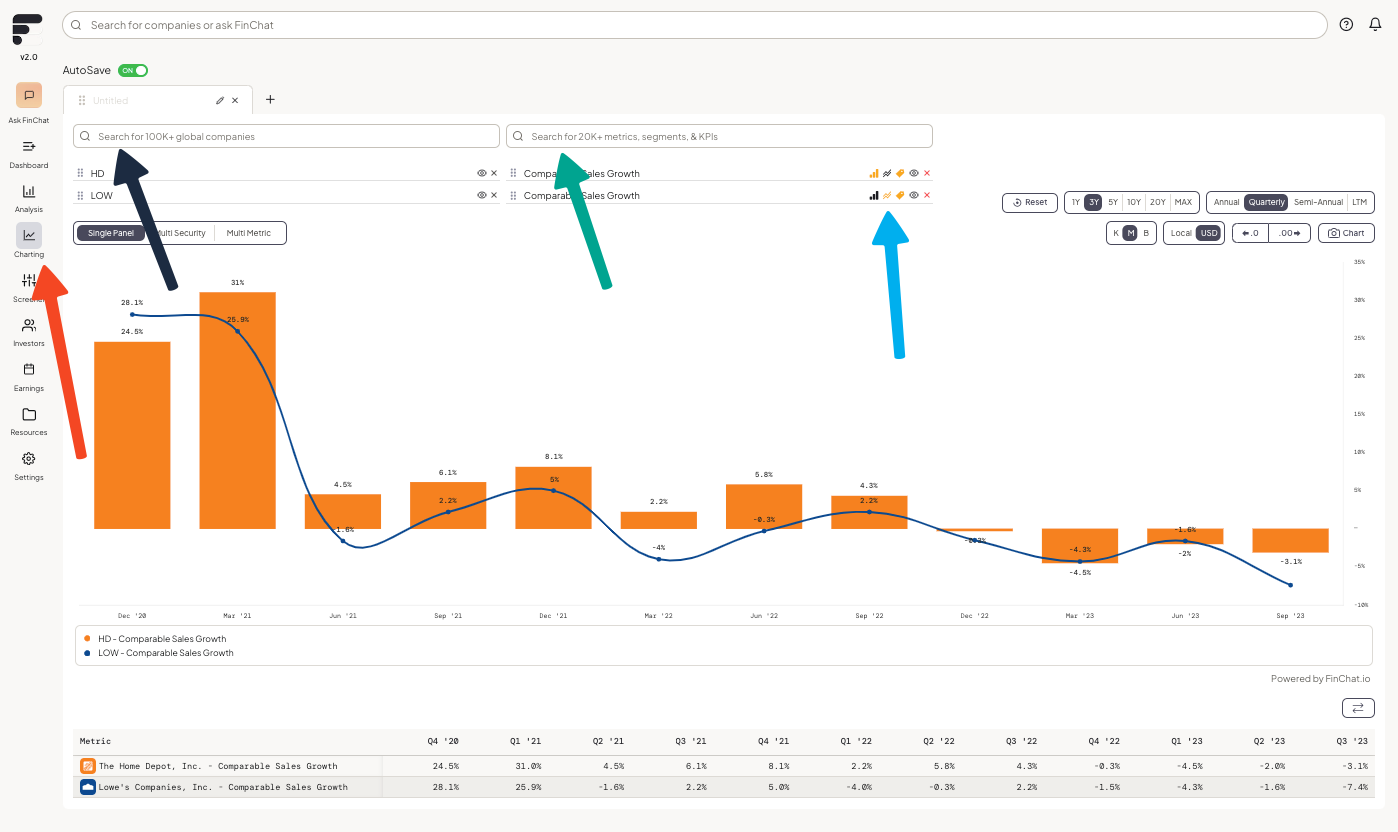
A four-step research habit that keeps the AI honest
- Screen for a specific economic trait, not a fashionable ticker.
- Chart the metric and inspect the underlying period labels.
- Ask Copilot for context, contradictions and management language.
- Open the filing and verify every number that carries the thesis.
Specific prompts beat broad ones. “What changed?” invites a generic tour. “Compare gross-margin guidance in the last four calls and cite the relevant passages” gives the system a job. Ask for tables when the task is quantitative. Name the period, currency and definition. If the response substitutes free cash flow for operating free cash flow, as one reviewer observed, that may be helpful - but it is also a signal to read the labels.
What you pay, and what the meter changes
The free tier is a capable test drive: ten years and six quarters of financials, shorter KPI and estimate histories, one dashboard, a stock screener, DCF modeling and ten Copilot prompts each month. Pro lists at $39 a month and extends history, dashboards, events, estimates, news and research while lifting Copilot to 250 monthly prompts. Enterprise lists at $199 a month and adds 20-plus years of annual data, 40-plus quarters, unlimited Copilot prompts and events, downloads, team administration and source auditability. Annual billing advertises up to 20 percent off.
| Plan | Best for | The practical limit |
|---|---|---|
| Free | Trying the workflow and occasional company checks | 10 monthly Copilot prompts; shorter data history; one dashboard |
| Pro · $39/mo | Active individual investors and independent analysts | 250 monthly prompts; 10 dashboards; 10 events |
| Enterprise · $199/mo | Full-time investors and teams that need exports and audit trails | Price is meaningful for a hobbyist; some export features focus on US stocks |
| API | Fintech builders and data products | Commercial pricing requires sales contact; free access is restricted |
FinChat, TIKR or Koyfin?
These products overlap, but they have different centers of gravity. Choose FinChat when company-specific KPIs, integrated documents and conversational research sit near the center of your process. Choose TIKR when long-run financial history and a lower subscription cost matter more than generous AI use. Choose Koyfin when customizable market dashboards, macro series and broad comparative views lead the work. AlphaSense serves document-heavy professional research at a different budget; OpenBB appeals to technical users who want an extensible workspace.
No table can settle the choice because the decisive question is behavioral: which tool will you open every week? Trial the same three companies in each. Rebuild one live workflow. Count the manual exports, missing metrics and moments of friction. A terminal you admire but do not use is merely expensive wallpaper.
The backstory explains the product
Dennis started an investing podcast from his university dorm while studying chemical engineering, then worked in nuclear and hydropower and taught himself to code. Frustrated by the gulf between costly professional terminals and cluttered free sites, he built a prototype in 2020. The Canadian Investor Podcast supplied an audience that most software founders spend years trying to find. When FinChat formally launched in 2023, it reportedly collected 65,000 sign-ups within hours.
The company, legally Stratosphere Technology Inc., was founded by Dennis, Ryan White, Kevin Bojan and Adrian Iwanicki. An earlier research platform named Stratosphere merged with FinChat, and the unified product kept the FinChat name. Then came the second name change. A $10 million Series A led by Portage in June 2025 arrived with the Fiscal.ai rebrand, a signal that the ambition had moved beyond a chatbot toward financial-data infrastructure.
By January 2026, Dennis said the business had passed $400,000 in monthly revenue, carried a mid-seven-figure annual run rate and supplied more than 50 enterprise customers. The team’s stated stack is refreshingly ordinary: React and Next.js in front, Python, Cloudflare and multiple LLMs behind. The hard technology is less theatrical - collecting, standardizing, updating and tracing messy financial data.
The 2026 version is spreading out
Recent releases show where Fiscal.ai is heading. Cross-document search arrived in February 2026. March brought real-time fundamental data for more than 5,000 UK and European companies. Brokerage connections followed in May. In June, the company launched a data plugin for ChatGPT and Codex, letting people call structured financial data from an AI workspace. Its API now exposes profiles, statements, KPIs, prices, filings, IR events, ownership and fund letters, with webhooks for fresh updates.
That expansion is good news for builders and demanding analysts. It also creates a risk familiar to every ambitious terminal: breadth can bury the thing users loved. FinChat earned attention because asking a financial question felt easier than rummaging through a filing. Fiscal.ai’s job is to preserve that directness while the product becomes a data warehouse, document search engine, portfolio monitor and developer platform.
The AI gets the attention. The normalized data does the heavy lifting.YesPress verdict
The verdict
FinChat is a strong fit for people who already have a research process and resent its repetitive chores. Its company KPIs are the distinguishing feature; Copilot is the quick way into them. The free plan is sufficient to test whether that combination changes your week. Pro makes sense when you research several companies every month and regularly use transcripts, estimates and custom dashboards. Enterprise is a work expense, justified by exports, history and audit trails rather than by prettier answers.
Keep two habits. Save your cancellation records, because public complaints exist. More importantly, click through to the source whenever a number can change a decision. Used that way, FinChat does something valuable and unglamorous: it gives an investor more time to think.