The key to Mineral Springs actually worked. William T. Dillard had received plenty of ceremonial keys, but the one from his Arkansas hometown opened city hall. His longtime friend Walter Smith remembered that detail when people gathered to mark Dillard’s life in February 2002. After decades of openings, acquisitions and annual meetings, here was an honor with a practical application. A merchant could appreciate that.
The detail belongs in his story because Dillard’s business grew so far beyond the place that formed him. His name came to sit above department store entrances across the country. Yet the business began with something much smaller: his father’s shop, a young person’s settled ambition and a loan that came with a family history.
Eight thousand dollars, and a name to borrow
William Thomas Dillard was born in Mineral Springs on September 2, 1914. His parents, Thomas and Hattie Dillard, were farmers and merchants. He spent time working in the family store while growing up. Retail was already familiar territory when he left for college. Recalling that period years later, he said, “I knew what I wanted to do.”
He nevertheless went away to learn more. At the University of Arkansas, he studied accounting and graduated in 1935. Columbia followed, with a graduate business degree in 1937. Then came management training at Sears in Tulsa. The route took him from a country store to a university in New York and into an established retailer before bringing him home to Arkansas.
On February 12, 1938, he opened T.J. Dillard’s in Nashville. Arkansas, to settle the geographical question. His father supplied the $8,000 loan and the initials above the door. Wholesalers who already knew the elder Dillard extended credit. The venture had a young proprietor, but its relationships were older than the business itself.
That first year brought $42,000 in sales and $3,000 in profit. Those are useful figures to keep together. Sales measure what passes through a store; profit measures what remains after the excitement has been paid for. Dillard had studied the distinction. Now he was responsible for it.
A small shop’s arithmetic, before the mall years.
He married Alexa Latimer in 1940. They would have five children, and the family would become closely involved in the company. But the familiar surname should not obscure the decisions that still lay ahead. The original shop was a beginning. Making it the permanent center of his working life was a choice he eventually declined.
His ambition extended well beyond making a comfortable living from the Nashville store. He wanted to become a department store merchant with a national business. That aim helps explain why the first successful shop did not become the end of the story. For a proprietor with a profitable local business, selling it could look like an odd reward for years of effort. For someone looking toward a chain, the sale could release money and attention for a bigger market.
The address was part of the merchandise
In 1948, Dillard sold the Nashville business and increased his investment in Wooten’s in Texarkana. Thereafter, expansion often meant taking responsibility for a business somebody else had built. Existing stores offered customers, buildings and local recognition. They could also offer unpleasant surprises, with no extra charge for delivery.
Brown-Dunkin in Tulsa supplied one in 1960. After the purchase, Dillard discovered a cigar box containing $150,000 in unpaid bills. He sold other stores and arranged financing as he worked to turn the operation around. An acquisition could be an opportunity and a demand for cash at the same time. The romance of buying a bigger business was liable to end at the first examination of its obligations.
Little Rock became the next important base, through the purchases of Pfeifer and Gus Blass in the early 1960s. The expanding business brought together stores whose names had meant something in their own towns. Dillard’s career was increasingly about deciding which parts of an inherited operation deserved to survive and which needed changing.
Location imposed a different kind of limit. Dillard believed that almost anything about an existing store could be changed except where it stood. As suburban malls drew shoppers away from older downtown settings, he went with them. By the mid-1960s, his business was opening mall locations in Little Rock and Tulsa.
This was a merchant’s reading of an American habit in motion. A good display could attract a person who was already nearby. A good address helped put the person nearby in the first place. The new shopping destinations offered a setting in which a department store could become part of an outing, rather than its sole purpose.
Dillard paired those locations with conspicuous openings: promotions, contests, giveaways and ribbon cuttings. Local newspapers carried the invitation. The machinery behind a chain might be centralized, but the opening still needed to feel like an event in the town where the doors were unlocking.
- 1938Nashville
The first shop opens. - 1948Texarkana
A larger stake in Wooten’s. - 1960Tulsa
The Brown-Dunkin purchase. - 1963-64Little Rock
Pfeifer and Blass join the business. - Mid-1960sThe suburban mall
A new setting for expansion.
A ledger with a longer reach
There was another change behind the counters. Dillard backed computers early in department store retailing, using information systems to support inventory control and administration. The usefulness was prosaic and considerable. A retailer needed to know what had sold, where it had sold and what was still waiting for a customer.
At one store, a proprietor might keep much of that knowledge in his head. Across a chain, memory needed assistance. A purchasing decision affected several places; a slow-selling item occupied space in each. Distribution and inventory systems gave the growing company a way to coordinate work that its founder could no longer supervise from one counter.
He continued to visit the stores. In 1988, Dillard and his sons were walking aisles, talking with clerks, inspecting interiors and handling merchandise. The figures and the fabric both mattered. A sales report could identify a problem; standing in a department could reveal what the report left out.
By 1997, managers could track sales of particular apparel and cosmetics brands across locations through the company’s computer system. The founder’s childhood trade had acquired a different instrument panel. Beneath the technology, the questions remained recognizable to anyone who had ever needed to order the next batch of stock.
Selling shares, keeping the keys
Dillard took the company public in 1969. He arranged two classes of shares, bringing in outside capital while preserving family control. By 1997, the family held almost all the Class B shares, which elected two-thirds of the board. Expansion could enlarge the shareholder register without dispersing authority in the same proportion.
The family was also present in daily management. William Dillard II became president and chief operating officer in 1977. His siblings worked in the business too. A company carrying the family name had become a family workplace, with responsibilities extending well beyond ceremonial appearances at a store opening.
That control came with a guarded public manner. The company often declined to return calls from journalists or speak freely with analysts. Dillard also withdrew advertising after unfavorable coverage. The local newspaper, so useful for bringing customers through the doors, could become an unwelcome visitor when it examined the office upstairs.
There were commercial limits as well. In Raleigh during the 1990s, the chain faced established competitors with strong customer loyalty. Shoppers could admire its clothing selection and object to its return policies. A large assortment did not settle every argument about service. Nor did a successful formula guarantee an equally warm reception in every city.
“You either grow or you wither.”
William T. Dillard, 1994
Growth could create its own difficulties. The $2.9 billion Mercantile Stores purchase in 1998 increased the business’s scale and its financial pressures. The final years of Dillard’s life included a company working to reduce debt and close underperforming locations. Building the chain had required buying stores. Managing the larger chain also required deciding which ones should go.
The figures make that tension visible. The company finished fiscal 1997 with 270 stores and fiscal 2001 with 338. Across those same reported years, long-term debt rose from about $1.37 billion to $2.12 billion. More entrances brought more obligations. The acquisition years resist a tidy story in which every increase in size is automatically an improvement.
Back to the accounting classroom
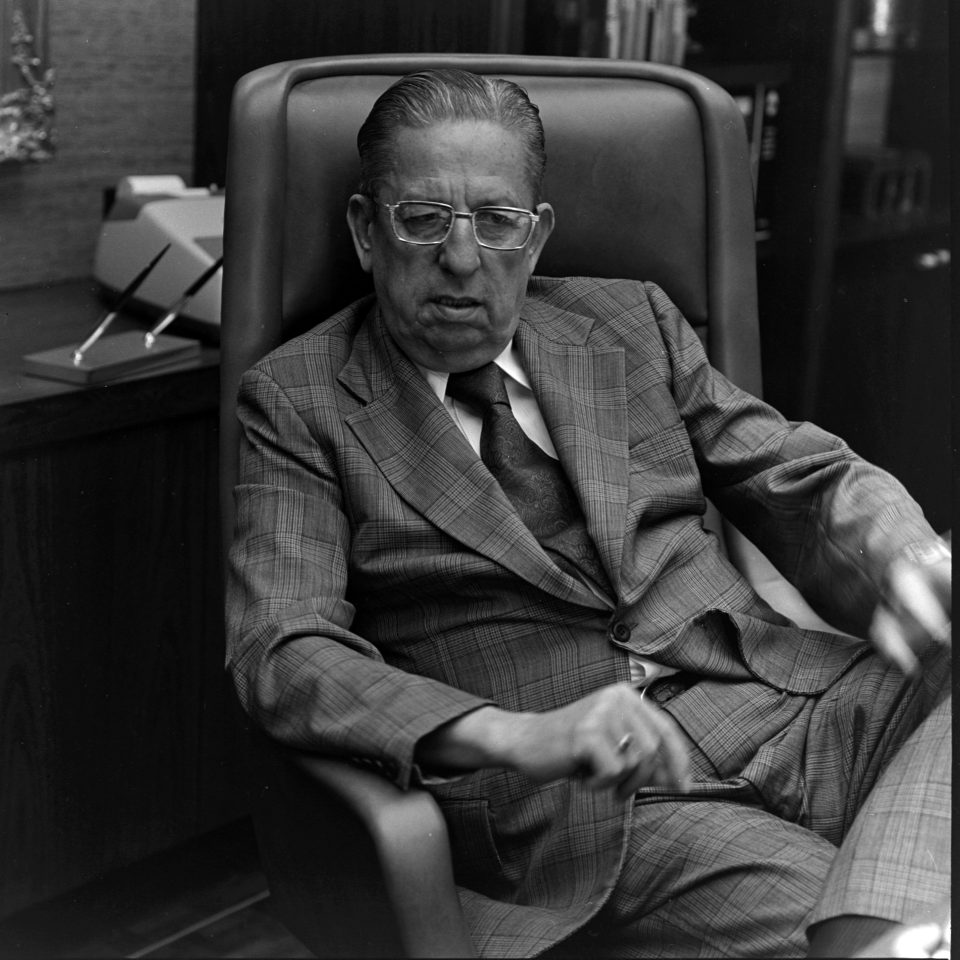
His eldest son succeeded him as chief executive in 1998. William T. Dillard remained chairman until his death in Little Rock on February 8, 2002, aged 87. He had received the National Retail Merchants Association’s Gold Medal in 1989 and entered the inaugural class of the Arkansas Business Hall of Fame in 1999.
Colleagues remembered a belief that a business deal should benefit both sides. The principle had a direct commercial meaning for someone whose work depended on suppliers, bankers, employees and customers returning to the relationship. A single transaction could be won at another person’s expense. Keeping a retail business supplied, staffed and visited required people to come back.
In 2020, the University of Arkansas named its accounting department for him. His son, also an Arkansas accounting graduate, supported the department’s endowment. The honor connected the founder to a working classroom rather than simply placing his name on a memorial. Students would encounter it while learning the discipline he had taken into his first business.
There is a pleasing fit between that classroom and the hometown key. Both are useful things. Dillard’s story contains plenty of larger numbers, but these smaller objects keep it within reach: a ledger, a counter, a door that opens. The business changed addresses many times. The work of making each address worth visiting occupied a lifetime.