A hundred days into his job running AIG Multinational, William Rabl had a stationery problem. He had been sitting with colleagues in London, watching how they served clients whose businesses crossed borders. There was, he reported, rather a lot to learn. His notebook was beginning to feel the strain.
It is an appealing detail in a business usually introduced with a world map. Countries are colored in; offices become dots; arrows sweep confidently across oceans. Rabl’s account brought the scale down to a desk and the people around it. A global insurance program still has to pass through somebody’s working day. He had gone to see what that day involved.
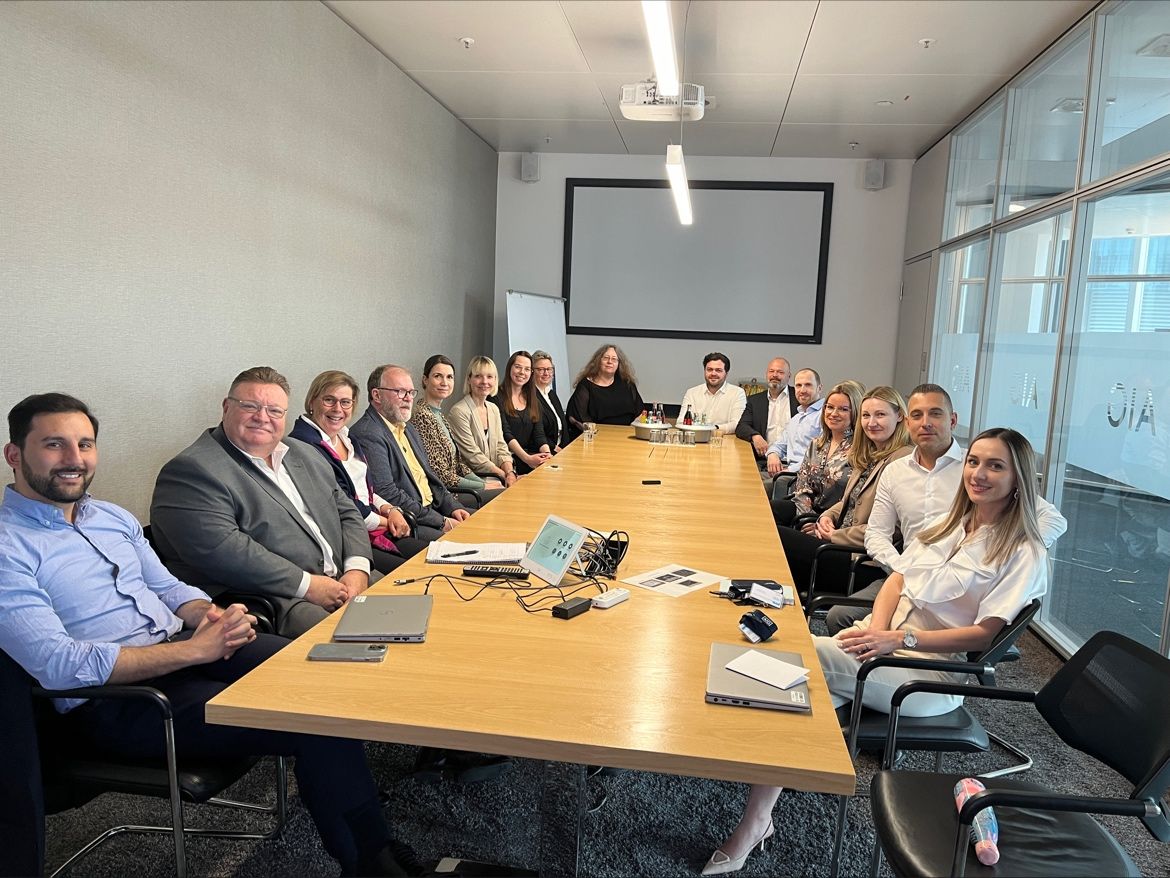
By April 2024, he was in Frankfurt for the third of these “Day in the Life” experiences. The subjects included service, contract certainty and captive fronting. These are unlikely candidates for a travel diary. They are, however, exactly the subjects that matter when a company expects an insurance promise made in one country to work in another.
“I may be running out of space in my notebook”
William Rabl, reflecting on his London colleague visit
A career spent between the clauses
Rabl, also known professionally as Bill, came to that notebook with years of experience. He studied quantitative analysis at St. John’s University and earned an MBA in finance and international business at New York University’s Stern School of Business. He also holds the Associate in Risk Management designation. The combination is unusually apt for the work that followed: numbers, international business and the practical business of deciding who carries a risk.
His career includes a period at Lockton, where he was senior vice president and director of global casualty. He joined ACE in 2002. By 2012, as chief operating officer of ACE Risk Management, he was taking on additional responsibility for its nine branch offices. Even then, the work involved joining a central business to the people delivering it in different places.
In July 2017, Chubb appointed him executive vice president of Global Casualty. The remit covered daily operations for global primary casualty coverage and services for large national and multinational companies based in the United States and Canada. He had previously been the business’s chief operating officer. He was based in New York and reported to Matt Merna, then chief operating officer of North America Major Accounts.
The significance is in the word “operations.” Insurance has an intellectual life in pricing models and policy language, but it also has an administrative life in branches, documents and decisions. Rabl’s appointments placed him in charge of that machinery as well as the coverage it delivered. A well-worded promise needs a functioning route from the underwriter’s desk to the client’s office.
- 2002Joins ACE
- 2017Chubb Global Casualty leadership; moves to AIG Risk Management
- 2020AIG Global Service Businesses
- 2023AIG Multinational
A new job, then another set of borders
In September 2017, Rabl moved to AIG to become chief executive of its Risk Management division, a newly created position. The appointment put him inside another large insurer at a moment of management change. He was among the executives joining or rejoining AIG’s General Insurance business that year.
William Curcio subsequently arrived as chairman of AIG Risk Management. The two were to work together on strategy, the division’s initial structural design and its integration into General Insurance. Curcio’s brief included assessing the loss-sensitive business, identifying talent and establishing underwriting practices. This was organizational construction as much as a change of employer: deciding how a business should operate, who should do the work and where responsibility belonged.
The pairing gave the division both a chairman and a chief executive with specified work to do together. Its structure was part of the assignment, alongside strategy and underwriting. For Rabl, the appointment therefore carried a task beyond running an established set of routines. The routines themselves, and the division’s place in the wider organization, were among the things that had to be worked out.
Rabl became CEO of AIG Global Service Businesses in 2020, before taking the Multinational chief executive role in October 2023. The titles changed, but there is a recognizable continuity in the assignments. Large accounts, casualty operations, service businesses and multinational programs all require coordination between specialist groups. The client may see a single insurer; the work behind that relationship involves many hands.
That helps explain why the London visit is a useful place to begin his story. An experienced executive had taken on a new remit and was spending time alongside the people doing the work. His account was about learning the business through their experience. The accumulating notes were a small, tangible record of the distance between knowing an industry and knowing a particular team’s daily problems.
The map has fine print
The organization he leads has a reach that makes those local conversations consequential. AIG describes its multinational network as providing local coverage in more than 200 countries and jurisdictions, using its own operations, licenses and authorizations, and network partner insurers. Its dedicated multinational service team includes more than 500 professionals across underwriting, legal, operations and claims.
Those figures describe the business, rather than a personal scorecard for its chief executive. They also suggest the coordination problem attached to the job. Broad geographic availability is only one part of the service. Clients need the right documents, agreed responsibilities and a clear understanding of how the pieces fit together. A map is a useful opening illustration. It is a poor substitute for an issued policy.
In Frankfurt, Rabl met European clients, brokers and colleagues. Philip Johnson’s account of the visit also identified Nima Rafiee, then EMEA head of Multinational, and regional service delivery manager Mihaela Hristova among the visiting group. The discussions covered multinational capabilities and captive solutions. Client relationships, regional leadership and service delivery were all represented in the same visit.
Rabl described the agenda as “service excellence, contract certainty and captive fronting capabilities.” Each phrase points to a different practical question. Is the work being delivered well? Is the insurance arrangement settled and understood? Can the structure accommodate a client’s chosen way of financing its risks? The vocabulary is dry. The consequences of getting the answers wrong are considerably less so.
Who does what, and by when?
One revealing item in AIG’s multinational service approach is its customized Client Brief. It sets out timelines and accountabilities alongside the rationale for the program’s structure, compliance considerations, territorial analysis and documentation requirements. There is no romance in an accountability chart. There is considerable comfort in knowing whose name belongs beside the next task.
For Rabl’s business, that detail links the leadership job to the client experience. A decision made at the center must survive the handoff to a country team, a broker or another specialist. The brief provides a common reference point for those parties. It makes an abstract ambition, consistency across countries, something that can be discussed in terms of work and deadlines.
structure
compliance
deadlines
One shared reference for a program with many participants.
Captive fronting adds another layer. AIG’s offering brings together fronting specialists with credit, claims, underwriting and client servicing expertise. Its approach emphasizes involving risk managers early and treating design as seriously as implementation. The arrangement has to fit the company and its challenges, with local knowledge contributing to the structure.
That is a useful lens on Rabl’s Frankfurt agenda. The technical and service questions belong together. A structure can be carefully designed and still require considerable effort to put into effect. The people responsible for implementation need to understand its purpose. The people designing it need to understand what implementation will demand. His visits put those conversations within reach of the chief executive.

The screen belongs in the story, too
Rabl’s public updates have also included the redesigned myAIG Multinational Client Portal. He described it as a way for clients and brokers to work more easily with AIG, bringing account, policy and claims information together with documents, regulatory requirements and insights into global programs. AIG provides an overview video showing the platform’s features.
The portal gives a digital form to the same coordination problem. Information distributed among several teams is more useful when the client can find it. For a business operating across borders, seeing the status of a program is part of managing it. The office visit and the client portal address different sides of that need: how the work gets done, and how its progress becomes visible.
It would be easy to make the software the main character. Rabl’s public account of the launch kept clients and brokers in the frame. The test he described was their ability to conduct business with AIG. That is a service question with a screen attached, and a familiar extension of a career that has repeatedly combined insurance expertise with responsibility for operations.
Room for another page
On later visits to Paris and Milan, Rabl again described time with multinational colleagues, clients, brokers, and product and country leaders. He also singled out conversations with developing talent about their growth. The itinerary had expanded, while the attention remained on the people inside the organization and the relationships around it.
There is a modest charm in the notebook detail because it makes a demanding title understandable. A chief executive can speak about global consistency. A colleague in a local office can explain what makes that consistency difficult on an ordinary working day. Rabl’s account placed value on being there to hear the explanation. The world map supplies the scale of his job. The notebook supplies a rather more human unit of measurement: one more thing worth writing down.