In January 1986, a Massachusetts state trooper drove out of a parking lot in pursuit of a car that had been designated “stolen” for a demonstration. A light on his dashboard pointed the way. More bars appeared as the cruiser drew closer. Around a corner, there it was. William R. Reagan’s proposition could be understood from the passenger seat: give the missing car a way to announce where it had gone.
The demonstration had a pleasing economy. No thief had to be caught in the act. No owner had to remember a secret sequence of buttons after discovering an empty parking space. A hidden device, a broadcast network and a police tracker were doing the work. Reagan called the system LoJack, a verbal reversal of hijack. Even the name was trying to get the car back.
He was talking about more than property. “we’re also going to save a lot of police lives,” he said that winter. The remark explains why the founder belongs at the center of this story. Recovering the vehicle mattered. So did the information available to the officer who would eventually walk up to it.
A town job with consequences
Reagan’s route to that dashboard passed through Medfield, Massachusetts. He moved there with his wife, Genevieve, in 1967, and served as a selectman from 1976 to 1981. The board’s duties included police oversight. A town responsibility gave him a close view of a problem that could easily sound abstract from farther away: an officer approaching a stolen vehicle might be approaching someone involved in another crime.
That concern gave his proposed system a particular shape. It had to help the people recovering the car, as well as the person who owned it. Knowing that a vehicle was stolen could change how an officer prepared, where a recovery happened and whether help was needed. The customer’s empty parking space and the officer’s next decision belonged to the same chain of events.
His earlier work had taken him through naval aviation and business. He served as a Navy patrol plane commander, worked at Avco and established his own mergers and acquisitions firm. Those were substantial changes of occupation. His town role supplied something more specific than a general interest in electronics: a reason to care about the few uncertain moments before a police officer reached a car.
“There’s got to be a better way to do it.”
A phrase his wife, Genevieve, remembered him using
The invention had to learn to cooperate
On November 16, 1977, an application for an auto theft detection system was filed with William R. Reagan named as inventor. The patent was granted on December 4, 1979. Its drawing sets out an arrangement of transmitters, receivers and location equipment. A car owner would eventually buy a small installed device. The invention described a larger arrangement around that device.
This is where the little box becomes interesting. A concealed radio cannot recover a car on its own. Someone must know which vehicle to look for. Something must activate the correct equipment. A receiver must detect a useful signal. A person with authority to recover the vehicle must then act. Each step gives the preceding one a practical purpose.
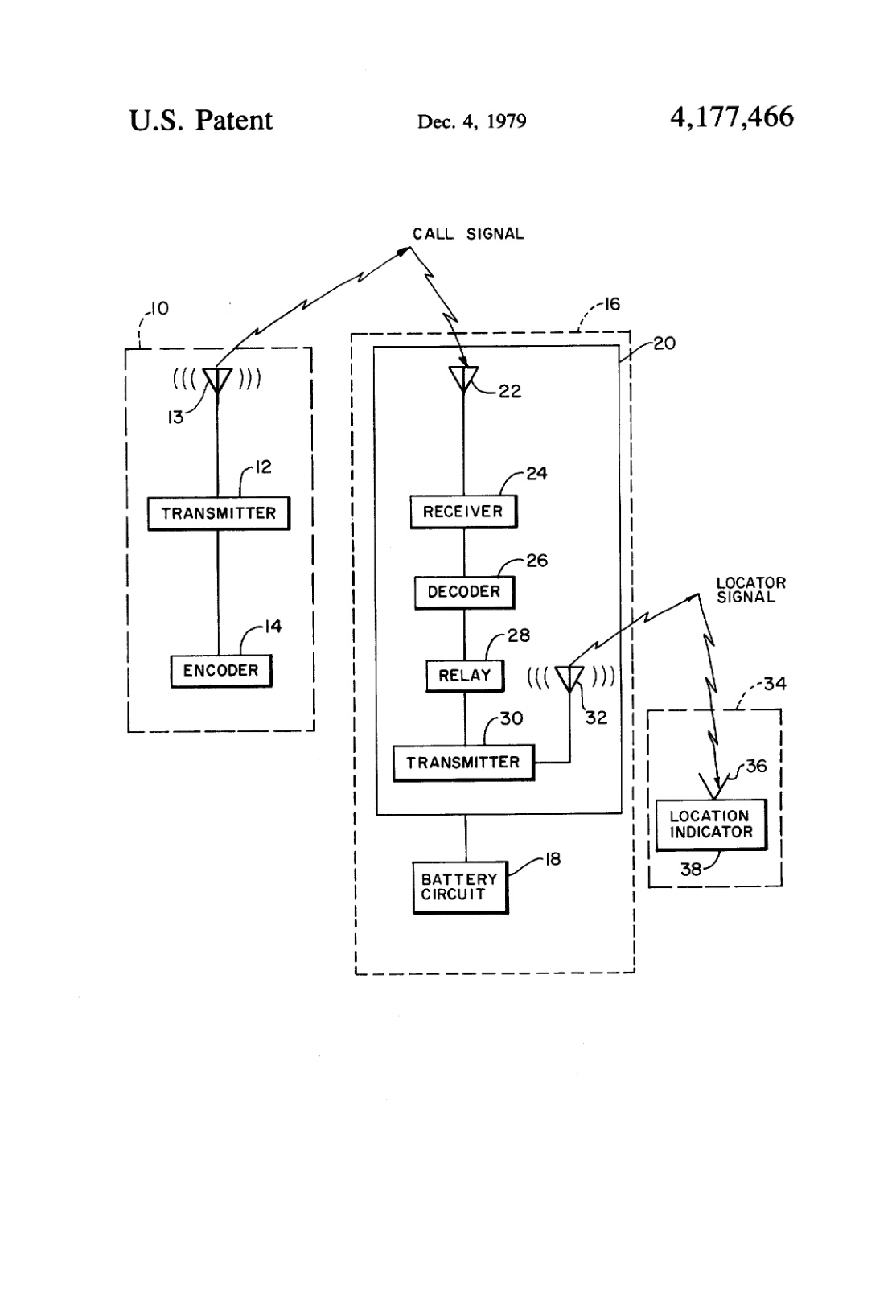
The original commercial process began with an ordinary human action: the owner reported the theft to police. The network then activated the concealed unit in the missing vehicle. Its signal could be followed using police tracking equipment. The owner did not have to become an amateur pursuer, and the car did not have to attract the attention of everyone within earshot.
That division of labor was part of the appeal. The person who had lost something supplied the report. The electronics supplied a trail. Officers supplied the judgment and the recovery. A useful way to understand Reagan’s work is to follow those handoffs. The device was small because much of the job happened elsewhere.
- 01Owner reports
the theft - 02Network activates
the hidden radio - 03Police follow
the signal - 04Officers arrange
the recovery
A simplified explanation of the historical radio-based system.
The long trip from an idea to a dealership
The origin story includes a wonderfully unceremonious setting. At three in the morning, over milk and cookies, Reagan thought of a small homing device that could be concealed in a car. The scene is easy to like. Anyone who has inspected the kitchen after midnight can appreciate an invention with a snack attached.
What followed gives the anecdote its substance. Reagan assembled engineers and technicians, and development stretched over years. The company raised public capital in 1983. Massachusetts became the testing ground, with police resources involved in demonstrations. By 1986, the system was reaching the state’s consumer market. The distance between imagining a hidden transmitter and selling a useful service had to be traveled in working equipment.
There were several people to persuade along the way. Drivers needed a reason to pay for an installation. Police needed something they could use. The network needed to operate where the vehicles traveled. None of those requirements disappeared because a demonstration went well. A successful test could show that a signal led to a car; a business had to make that result repeatable.
The January 1986 demonstration captured both the promise and the questions. Reagan anticipated an installed retail price of $495. Hand-built police trackers cost $2,500 each, before the communications network. Governor Michael Dukakis supported equipping more cruisers. An insurance-company spokesman remained cautious. A missing car appearing around a corner was persuasive theater, but the economics and reliability still deserved scrutiny.
A demonstration also has a different meaning from a guarantee. The car in the test had been prepared for the exercise, and the officers were showing how the equipment worked. A future theft would arrive without an appointment. Keeping that distinction in view makes the early scene more interesting: it records a promising method at the point when customers, police and insurers were still deciding what to expect from it.
That tension makes Reagan’s story more recognizable. A founder can show something working and still face the larger task of making it worth buying, maintaining and adopting. The car at the end of the signal answers one question. It opens several others. The next customer wants to know whether the same thing will happen when the missing vehicle belongs to them.
The people at the other end of the signal
LoJack’s relationship with law enforcement was built into its operation. Police equipment and police action were essential parts of the service. Reagan’s concern for officers therefore carried through into the way the product had to be used. The company could sell an installation, but its value depended on a recovery process outside the dealership.
Patrick Clancy helped connect those worlds. He joined LoJack from the Medfield Police Department in 1986 and became a senior figure in its law enforcement work. When the company introduced its “LoDown with LoJack” video series in 2014, Clancy returned to the founder’s purpose in the opening chapter. The company’s history was being told by someone who knew the police side of the relationship.
For a founder story, that is a useful change of camera angle. The engineer sees a signal. The customer sees a missing possession. The officer sees a situation that needs to be assessed. A design that serves all three has to take their different responsibilities seriously. Reagan’s original concern kept the recovery itself in view, beyond the moment a location could be established.
Countries using the system, as reported by LoJack at the time of Reagan’s death.
A name that outlived its first technology
Reagan’s leadership of the company ended in 1986. He died on July 1, 2013, aged 78. By then, LoJack reported more than 300,000 stolen-vehicle recoveries worldwide and nearly $4 billion in recovered assets. Those are measures of the company’s accumulated work, including the contributions of the people who developed and operated the system after its founder had left.
His ambitions also survived in the company’s explanation of itself. In 2016, LoJack was still describing the founder’s concern for officer safety when discussing the connected car. The equipment was changing. Better location information remained useful because someone still had to decide how to act on it. A more informative screen could assist that decision; the decision remained human.
The later ownership history belongs to a different period. Spireon acquired the LoJack U.S. stolen-vehicle recovery business from CalAmp in 2021. Solera acquired Spireon in 2022. Today’s LoJack offers GPS-based connected-car services. Reagan’s original radio system and the current product occupy different technological moments, connected by a name and the persistent problem of a vehicle that has disappeared.
Looking back from a phone screen, it is easy to compress these periods into one continuous product. The early version makes more sense on its own terms: dedicated radio equipment, police vehicles fitted to receive it and a network built for that purpose. Reagan’s problem was how to make those pieces available together. The convenience of later technology should not erase the coordination his approach required.
The private Reagan had room for interests beyond the business. He coached youth hockey, watched birds, painted and enjoyed entertaining people. Friends called him “Kojak from LoJack.” For someone whose commercial idea depended on staying concealed, he seems to have had little objection to being noticed himself.
His story leaves a concrete image: a police cruiser following a dashboard indication toward a car it cannot yet see. The invention becomes useful when uncertainty begins to shrink. Someone knows a little more, can prepare a little better and has a better chance of returning a missing possession. That was a sufficiently practical ambition to occupy years of Reagan’s life. It remains a clear way to understand what he built.