Peter Brand came to dinner with a job offer. Willem Sundblad came with an idea. By the end of the evening, Brand had withdrawn the offer and decided to join Sundblad instead. The two had picked Valentine’s Day without noticing. There are less awkward ways to find a co-founder, although perhaps fewer that come with such a useful test: can this person listen to you talk about factory waste for several hours?
That conversation in London in 2014 became Oden Technologies. Its subject was something Sundblad could hardly avoid growing up: how things get made. Raised north of Stockholm, he came from a family with four generations in manufacturing, particularly pulp and paper. He studied industrial engineering, worked at Vodafone, and wanted to bring better information into factories.
Today, based in New York, Sundblad is pursuing a problem with a deceptively ordinary shape. A factory knows how to make its products. But how much of that knowledge belongs to the factory, and how much belongs to the person who happens to be standing beside a machine?
A factory can forget
Consider the kind of decision Sundblad writes about: a newer operator has to maintain product quality while keeping a line moving. Increasing speed might improve output. It might also produce material that fails inspection. Experience helps a veteran judge the trade-off. A newcomer has much less to go on, and slowing down can feel like the sensible choice.
In his November 2024 writing on predictive quality, Sundblad described the hesitation that follows. Workers second-guess themselves because the cost of a quality mistake is real. Meanwhile, the experience required to make those judgments confidently takes time to acquire. A business can hire a replacement more quickly than it can replace someone’s accumulated understanding of a process.
His proposed answer puts predictions and suggested adjustments directly in front of operators. Historical production records and current conditions can help estimate what a change will do before the product reaches a later test. The ambition is practical: give someone enough confidence to act while there is still time for the action to matter.
This is a revealing place for a software founder to concentrate. The important encounter happens between a worker, a machine, and a decision. However elaborate the technology behind it, its usefulness has to survive that encounter. The operator already has a job. Admiring the software is unlikely to be on the shift plan.
- 01Production dataWhat is happening?
- 02Quality predictionWhat could happen next?
- 03Suggested settingWhat can the operator change?
Conceptual explanation of Oden’s prediction-and-recommendation approach.
The engineering was only part of it
Sundblad studied production-focused industrial engineering at Lund University and École Centrale Paris. It is a fitting education for someone whose business depends on understanding a process rather than simply putting a screen beside it. Production has constraints. A useful recommendation must make sense within them.
His early work at Vodafone offered an approach through communications technology. Yet the question that has persisted through Oden’s development is how people actually use information. Connecting a machine creates possibilities; it also creates another stream of data that someone has to interpret. The distance between those two achievements can be considerable.
By his 2021 conversation with Manufacturing Happy Hour, Sundblad was emphasizing the culture of the workforce. New technology requires translation across executives and employees. The people expected to use it need both the ability and the willingness to change how they work. A purchase order cannot supply either automatically.
“You want the skill and the will in the factory to be high.”
Willem Sundblad
That observation makes his job sound less like installing a futuristic factory and more like the familiar work of persuasion. Who needs the information? What decision will it improve? Will the person receiving it trust it? Those questions give his engineering background a human complication. The model can produce an answer; adoption requires a relationship.
A cheque, some flowers, and an American market
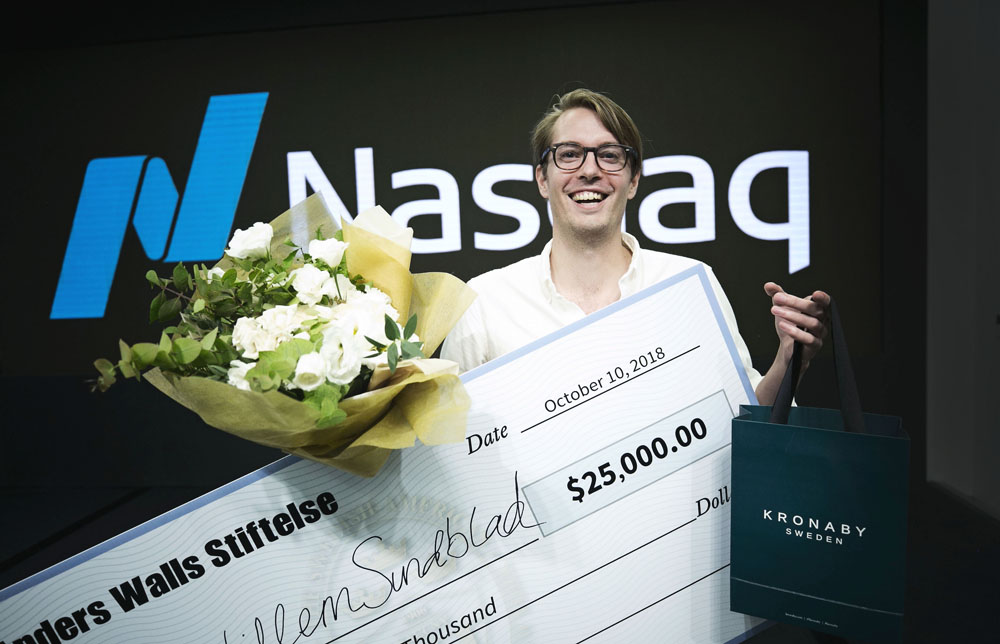
In October 2018, Sundblad accepted the Anders Wall Award for Exceptional Entrepreneurship at Innovate46 in New York. The event took place at Nasdaq MarketSite. The award came with $25,000, a bouquet, and the peculiar photographic challenge of holding a ceremonial cheque that appears to require its own transport arrangements.
The prize was designed to encourage Swedish entrepreneurs to enter the American market. Its criteria included demonstrated appeal in the United States and the potential to scale there. Sundblad’s selection put his factory-focused business into a wider story of Swedish founders crossing the Atlantic. In his response, he credited the work of Oden’s team.
He was also recognized on Forbes’ 30 Under 30 Europe list and became a contributor writing about manufacturing. His subjects included factory data, the relationship between information technology and operational technology, and the effects of automation on employees. These were the same practical disagreements his company had to navigate, carried into public view.
There is a useful consistency here. Sundblad’s public work keeps returning to the people responsible for production: what they know, what they can see, and what makes a tool worth using. The audience may move from an industry conference to a business publication. The underlying concern remains close to the machine.
The customer takes a seat at the table
In April 2024, Oden announced a $28.5 million Series B led by Nordstjernan Growth. Flat Capital and Recurring Capital Partners joined the round, alongside existing investors including Atomico and EQT Ventures. Another participant had a different relationship to the software: INX International was already an Oden customer.
Investment in Oden Technologies, led by Nordstjernan Growth. Customer INX International also participated.
That detail gives the financing a more interesting texture than the total alone. INX makes printing inks. Its involvement connected the capital round to a manufacturer already using Oden’s tools to improve batch consistency and throughput. It was also helping evaluate the product roadmap and pilot new offerings. The customer could speak about the product from the inconveniently useful position of having to operate it.
The investment supported continued work on Process AI, which serves process recommendations to machine operators. In his April 2024 Sourcery conversation, Sundblad discussed the quality-prediction problem behind the product, selling into manufacturing, and the challenge of operator turnover. The discussion kept the business grounded in what a working day on the line requires.
At the time of that interview, Oden reported that recommendations were used in more than 80 percent of runs on enabled lines, with line-speed improvements exceeding 40 percent at some customers. Those were company-reported results for particular deployments. The adoption figure is especially relevant to Sundblad’s argument: workers were choosing to use the guidance during production.
Process AI’s design reflects that emphasis. It delivers suggested settings for goals such as more output, lower costs, and better quality. A predictive quality model helps assess the consequences. For Sundblad, the route from factory data to business value runs through a person who has to decide what to do next.
Six years in the wire business’s conversation
Recognition in 2025 came from a different kind of audience. The Wire Association International named Sundblad the recipient of its President’s Award. He was completing his sixth year on its board, and the award recognized his contributions to the association and its programming.
He had been speaking regularly to members about manufacturing technology and front-line workforce challenges. At Interwire 2025, he spoke on the future of manufacturing and hosted a discussion with Southwire leaders about AI-driven process optimization. These are settings where a speaker can expect people in the room to know exactly how difficult implementation can be.
That sustained participation matters to the portrait. Wire and cable manufacturing is a specific industrial community, with its own companies, problems, and working relationships. Six years of board service suggests a different rhythm from the quick appearance of a founder making a technology pitch. Sundblad’s work had become part of an ongoing industry conversation.
The next problem is between departments
Oden’s current Forge product extends the effort into analysis and coordination. Its AI agents are intended to help staff investigate production problems, prepare reports, and connect workflows across tools. The company describes users ranging from front-line workers to plant managers and executives. Each needs a different answer from the same underlying operation.
The intention fits Sundblad’s long-running concern about how information travels. A report that arrives after the useful decision has passed has limited value. A finding trapped in one department can have a similar fate. Forge aims to shorten the work between asking a production question and getting something a team can act on.
On August 26, 2026, AssetWatch and Oden announced a partnership connecting equipment-condition monitoring with production intelligence. AssetWatch contributes information about machine condition; Oden contributes production context. The aim is to help maintenance and operations teams coordinate their decisions using a more complete picture of what equipment is doing.
Sundblad framed the issue plainly: maintenance should be connected to machine performance. It is another version of the problem that has followed him through the business. A useful fact exists somewhere. The person who needs it may be elsewhere, working to a different schedule, with a different view of the same machine.
The dinner that started Oden concerned waste. Years later, Sundblad’s work keeps arriving at the wasted distance between knowing and doing. A worker needs guidance before a production run goes wrong. An engineer needs an answer before a report becomes history. Two departments need a shared picture before their priorities collide. His family’s manufacturing inheritance has taken the form of software, with a familiar obligation attached: help the next person make the thing properly.