Nobody enrolls at a university because it has elegant accreditation software. No teenager tours a campus and asks to see the faculty-activity database. Yet behind every glossy prospectus is a small republic of spreadsheets, survey tools, shared drives, curriculum forms and dashboards. Watermark made a business of that republic. It sells the machinery colleges use to prove students learned something, professors did something, programs deserve to continue and accreditors should remain calm.
The Austin company says more than 1,500 institutions use its software. Its course-evaluation product alone handles more than 20 million surveys a year for 900 institutions and more than 1 million instructors and teaching assistants. The scale is notable because Watermark did not arrive as one clean-sheet startup. It is the result of a long consolidation: Taskstream, Tk20 and LiveText first came together, then Digital Measures, EvaluationKIT and SmartCatalog joined the cabinet. Aviso Retention arrived later, adding advising and predictive student-success tools.
That history explains both Watermark's advantage and its assignment. The company inherited products with loyal users and deep institutional memory. It also inherited the seams between them. Since taking over as chief executive in 2020, Erin Shy has pushed the company from a collection of campus utilities toward an Educational Impact Suite - one place to connect learning outcomes, student comments, faculty records, curriculum decisions, accreditation evidence and advising signals.
These are Watermark's current published figures. Older company releases cited more than 1,700 customers; the current website uses the more conservative “1,500+,” so that is the number used here.
The roll-up was the product strategy
Taskstream began in New York in 2000 around student-learning assessment. Tk20 followed in Austin in 2003 with software for teacher preparation and standards. EvaluationKIT started in Denver in 2007 because paper course evaluations were exactly as efficient as they sound. Taskstream and Tk20 merged in March 2017. LiveText joined that September. By October, the group served 1,000 institutions.
Taskstream, Tk20 and EvaluationKIT digitize assessment, teacher preparation and course feedback.
Taskstream, Tk20 and LiveText combine; Digital Measures, EvaluationKIT and SmartCatalog follow.
Aviso brings student-success workflows; Lightcast supplies labor-market context for program review.
Instructor Insights, Currents and Academic Momentum apply AI to comments, institutional queries and program health.
In January 2018, the combined business took the Watermark name. The metaphor was unusually apt: a watermark records how high the water has risen. Three months later, TCV acquired a controlling interest; Quad Partners, management and Exceed Capital Partners invested alongside it. The price was not disclosed. The capital funded an integration thesis, not a campus social network or another learning-management system.

“Our job is to ensure you never have to make them in the dark.”Erin Shy, CEO, on consequential campus decisions
The first thing to fail was the spreadsheet
Watermark's best sales pitch is not futuristic. It is the moment a committee realizes that its evidence lives in Excel files, Word documents, inboxes and, in one customer's memorable description, “paper files shoved in a box somewhere.” That system works until an accreditor asks for a longitudinal view, a faculty committee needs consistent reports in 52 formats, or an adviser needs to know which student is drifting now rather than after grades post.
The company's modules follow those failure points. Planning & Self-Study organizes outcomes, program review and accreditation evidence. Student Learning & Licensure captures rubrics, field experiences, ePortfolios and professional gateways. Faculty Success stores activities and runs reviews, promotion and tenure. Curriculum Strategy handles proposals, approvals and catalog publishing. Course Evaluations & Surveys automates feedback. Student Success & Engagement gives advisers alerts, risk signals and case-management tools. Assessment Projects samples and scores student work.
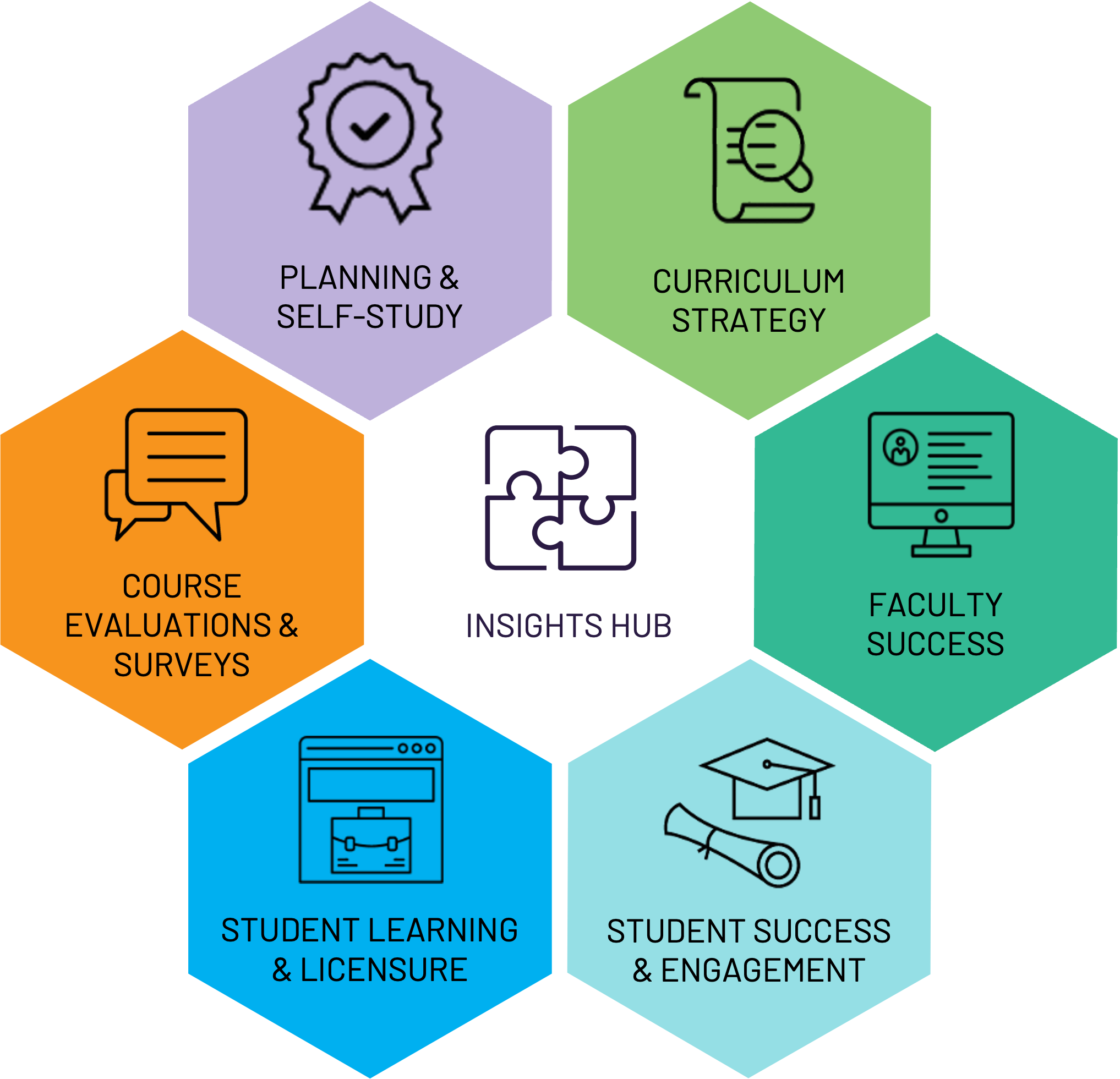
The useful difference from an LMS is position. Canvas, Brightspace or Blackboard manages the course. Watermark sits around and across it, pulling evidence into institutional workflows that outlive a semester. The company says more than 400 institutions already use Watermark with Canvas; an expanded 2026 Instructure partnership added clearer setup, joint support and deeper connections across assessment, feedback and advising.
What it costs - and what it returns
Watermark does not publish a menu. It sells enterprise subscriptions through demos and institution-specific quotes, with modules, integrations, implementation and AI add-ons shaping the contract. One public purchase offers a useful anchor. In 2024, College of DuPage approved a one-year Faculty Success extension for $30,741.80. The system supported evaluation and activity workflows for roughly 1,400 adjunct faculty. The previous year's cost was $26,732. This is one contract, not Watermark's universal price.
One year of Faculty Success at College of DuPage, covering workflows involving about 1,400 adjunct faculty. Public procurement makes a rare window; actual contracts vary.
Return is easier to describe in saved labor than in a campus-wide ROI percentage. Watermark says Texas State cut faculty activity reporting from four and a half months to 14 days. Garrett College reports roughly 50 percent less preparation time for self-study and strategic planning. At Roanoke-Chowan, course-evaluation response rose from the 30 percent range to 83 percent in one semester. Amarillo College reports survey response above 90 percent and retention at 68 percent after combining Watermark tools with a broader student-success effort.
Notice the caveat in that last example: software participated in the result; it did not single-handedly manufacture it. Better alerts matter only when an adviser can respond. Cleaner reports matter only when a committee reads them. The product can shorten the distance between evidence and action. The institution still has to walk it.
The new layer is conversation, not collection
By 2025, Watermark had enough accumulated workflow to add AI without inventing a new reason for customers to visit. Instructor Insights summarizes open-ended course comments, surfaces themes and suggests actions. In Planning & Self-Study, the Assessment Catalyst Toolpack synthesizes evidence and helps draft narratives. Faculty Success can import CV material. In 2026, Watermark announced Currents, a natural-language interface for asking questions across Watermark and student-information-system data, and Academic Momentum, which combines internal metrics, program documents and Lightcast labor-market signals into a program-health assessment.
This is a restrained version of education AI. It does not grade a freshman's philosophy paper or impersonate an adviser. It attacks the queue of administrative synthesis: read comments, reconcile documents, spot a weak program, draft the first report. Brian Robinson, Watermark's senior vice president of product, puts the aim neatly: free people to do “the more informed work they wish they had time for.”
There are boundaries. Instructor Insights is currently an add-on, available in English and restricted to US institutions. AI summaries still require human review, especially when student comments affect a professor's career. A connected suite also magnifies poor definitions. If two departments disagree on what “student success” means, the dashboard may reveal the fight; it cannot settle it.
The copyable part is boring on purpose
Watermark's method is useful even without Watermark. Start with the recurring decision, not the dashboard. Name the evidence it requires. Standardize how departments submit that evidence. Connect the LMS and SIS only after ownership and definitions are clear. Automate reminders and report distribution. Then measure cycle time, response rate and action taken - not the number of charts produced.
That approach is least convincing for a small institution with one simple process, little integration capacity or no staff owner. A specialist tool - even a disciplined spreadsheet - may be cheaper and easier. It also struggles when faculty see centralized reporting as surveillance, when historical records are too inconsistent to compare, or when an institution needs AI features outside the present US-English boundary. College of DuPage's board materials, notably, said the college was evaluating replacements while buying its one-year extension. Embedded workflows create value, but they also make switching a project.
Where Watermark sits in the market
Watermark competes on several fronts because its products cross several offices. Anthology and Ellucian offer broad higher-ed platforms. HelioCampus targets institutional analytics. Modern Campus works in curriculum and catalog management. Explorance and Qualtrics chase feedback. Interfolio serves faculty information and academic workflows. EAB and Civitas Learning work on student success. The oldest competitor remains the stack of shared drives, homegrown reports and heroic administrators who know which tab is correct.
Watermark's answer is not that every module is categorically better than every specialist. It is that the records become more valuable together. A student's course comment can inform faculty development. A rubric score can flow into an assessment plan. A labor-market shift can enter program review. An advising alert can sit beside current course performance. The suite earns its keep when those handoffs eliminate re-entry and reveal a decision earlier.
The company now faces the classic second act of a software roll-up. Buying the archive established distribution. Connecting it created the suite. Making it answer plain-English questions could create a new habit - provided customers trust the answers and clean the data underneath them. In higher education, that is not a small proviso. It is the work.
See the machinery
Watermark maintains a useful public trail for buyers who want to get past the pitch: product tours, implementation documentation, customer cases and a press archive. Start with the suite map, then watch a workflow close to the problem you already own.