The awkward thing about a duplicate invoice is how ordinary it looks. It has a supplier, a date, an amount. Nothing announces that the business has already paid. For an auditor working across subsidiaries and accounting systems, the task begins long before anyone can ask whether a payment looks suspicious. First, the records have to become comparable. Supervizor has built its business around that unglamorous prerequisite.
- Connect financial systems and standardize their transactions.
- Run more than 350 prebuilt controls across the data in scope.
- Rank exceptions, assign investigators and record what happened next.
Its proposition is straightforward: give finance and internal audit teams a repeatable way to examine the whole transaction population. Then help them decide where to spend their attention. The buyers are people responsible for financial accuracy, controls and compliance. Their scarce resource is the hour spent investigating something that matters.
Before intelligence, a common language
Consider a group with SAP in one business and Oracle in another. Similar economic events can arrive in different formats and account structures. A test that works neatly in one subsidiary can require fresh preparation in the next. Supervizor connects those systems and maps their records into a universal accounting model, drawing on a library of modelled accounting patterns.
The company markets this as removing data preparation. Its own implementation instructions contain a useful detail: customers validate the mapping of their charts of accounts. Less preparation still involves a judgment about whether the machine has understood the books. Less common systems may also require help connecting.
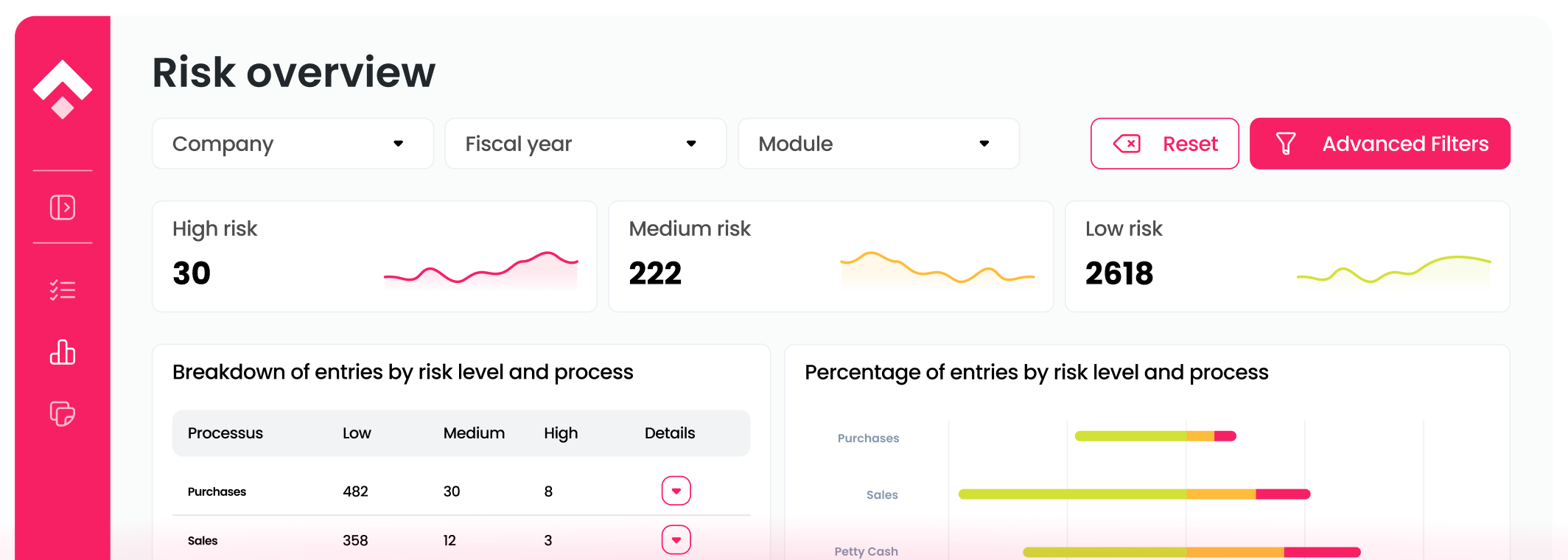
Once the data shares a language, the checks become reusable. The library covers areas including general ledger entries, supplier payments, receivables, expenses and treasury. Risk scoring orders the findings. The investigation workflow lets colleagues attach evidence, comment, obtain sign-off and preserve a record of resolution. This is software for carrying a suspicion through to an answer.
The people who knew the paperwork
Supervizor dates its beginnings to 2016. Founder and co-CEO Alban Clot previously worked in consulting on the quality of corporate financial processes. The company’s May 2024 funding announcement also identifies co-CEO Arnaud Merlet as a founder. Their product sits close to the work: accounting expertise translated into controls, with AI used to help recognize patterns and prioritize attention.
That background also appears in its hiring pitch, which explicitly welcomes people with audit and accounting experience. The careers page describes ownership, speed and trust as leadership principles. It is a telling recruitment choice for a software company: knowing why an entry looks wrong can matter as much as knowing how to process it.

Start with twenty company codes
BorgWarner’s published customer account supplies a useful sequence. Its audit team wanted to move more time toward advisory work. It deployed Supervizor’s purchasing-to-payment analytics across 20 company codes in SAP. Initial results came from a manual upload within days; an API connection followed within weeks.
The team then refined its risk indicators and excluded false-positive patterns. That detail deserves attention. Buying analytics did not end the work of deciding which transactions deserved an auditor. It gave the team a place to make those decisions repeatable. The account reports cash-recovery opportunities and ROI within six months of the license.
“needs to morph into an advisory function”
Michael McDonald, BorgWarner chief audit executive, on internal audit’s role
Michelin presents a different scale problem: 350 subsidiaries and heterogeneous systems. Supervizor’s case study reports 37% automation of financial controls, with implementation beginning in higher-impact purchasing and financial processes. The lesson a reader can copy is the sequence: choose consequential controls, validate the data, establish ownership, then widen coverage.
Reported in Supervizor’s Michelin case study. A customer outcome, not a platform-wide guarantee.
The invoice that pays for the test
Supervizor sells enterprise software through a demo-led process. A particularly concrete value argument comes from social housing group Arcade-VYV: in a published testimonial, its internal control team says finding duplicate payments almost reimburses the software’s cost. That is a customer assessment, not a transferable price or savings forecast. It does explain why recovered cash is a persuasive buying argument.
Investors backed the broader proposition with a $22 million round announced in May 2024, led by Orange Ventures. Supervizor said the money would support product development and international commercial expansion. That March, AICPA and CPA.com had selected it for their accelerator, putting the company among seven AI-focused participants.
Competition makes the positioning more interesting. MindBridge also analyzes full financial populations for risk. Caseware IDEA offers full-population testing and repeatable analytics. Supervizor’s particular pitch combines automatic standardization, packaged accounting controls and investigation management. Buyers should test those conveniences against their actual systems and staffing.
There is an organizational cost as well as a license. Someone must decide which checks matter, who reviews them and what counts as resolved. A useful pilot therefore measures the work after detection: how many findings survive review, how quickly an owner responds, and whether the underlying process changes. Those are proposed buying criteria, rather than published Supervizor performance figures. They keep a demonstration tied to the job an audit team actually needs to finish.
After the exception list
February 2026 brought Supervizor X, a rebuilt platform with revised navigation, transaction-level ownership and more visible control logic. Its newer AI Insights feature groups findings into patterns and suggests likely causes and actions. AI Xplore lets supported assistants query Supervizor findings through read-only access under existing permissions.
The direction is sensible: a longer exception list creates work unless someone can interpret it. Coverage depends on connected data, refresh schedules and the controls selected. An anomaly still needs investigation; an unconnected system remains outside the view. For a small organization with simple books, the machinery may be more than the problem requires.
The practical test is wonderfully plain. Take a financial process that already consumes time. Run the checks. Follow the findings through to a correction, a recovery or a defensible explanation. Supervizor earns its place when that path becomes shorter and more repeatable. The duplicate invoice is merely where the conversation starts.