In April 2022, Walter Woltosz arranged a small correction to a large building. The grand atrium at Auburn’s Brown-Kopel Student Achievement Center already bore his name and his wife Ginger’s. They had given $5 million to support the center’s construction and programming. The university had supplied the customary architectural thank-you. Most donors could have considered the paperwork finished.
Woltosz had noticed something else. At the building’s 2019 dedication, he heard that its conception belonged to engineering dean Chris Roberts. On April 8, 2022, the replacement name was revealed: the Christopher B. Roberts Grand Atrium. Roberts gasped when the drapes came back. Woltosz’s explanation ended with a cheerful administrative loophole: “Well, Chris, it’s not too late.”
The episode offers a useful entrance to Woltosz’s career. His name appears on software businesses, university facilities and film credits. Yet the interesting business often happens before the lettering goes up: someone has an idea, a piece of machinery misbehaves, a promising person needs backing. Woltosz pays attention to who can make the thing work.
Before the buildings, the dots and dashes
At 12, growing up in western New York, he learned Morse code to qualify for a ham radio license. It is an appealing beginning for a software entrepreneur: communication reduced to a strict little language, transmitted through equipment that has to cooperate. A radio does not reward a persuasive presentation. Either the signal gets through or it does not.
He joined the Air Force in 1963. Four years later, an education and commissioning program brought him to Auburn. A friend from his Strategic Air Command unit had spent a year there and helped put the university on his map. The institution that would eventually put his surname on buildings first entered the story through an ordinary recommendation from a buddy.
His bachelor’s degree in aerospace engineering came in 1969. He added a master’s in administrative science at the University of Alabama in Huntsville in 1976 and an Auburn master’s in aerospace engineering in 1977. Engineering and administration make an instructive pair. A calculation can tell you what is possible; a company still needs people, decisions and enough organization to deliver it.
His early employers included the Federal Aviation Administration and Northrop Services. At Northrop, his work involved computer programs for simulating and optimizing the space shuttle’s ascent trajectory. Rocket motor work also took him through Thiokol, the Air Force Rocket Propulsion Laboratory and United Technologies. These were assignments in which software described physical behavior long before a customer would have called the result an app.
A computer acquires a voice
In 1981, Walt and Ginger established Words+. Its computer-based communication systems would connect their work with Stephen Hawking. Equalizer and EZ Keys belong to this chapter of the story, along with a particularly memorable piece of publishing history: Hawking used the Words+ system while writing A Brief History of Time. A technical product had become part of the machinery behind a very public book.
The connection is easy to reduce to a famous name. The more revealing detail is the kind of work involved. Choosing words, composing sentences and getting a computer to speak require a chain of decisions that a user should barely have to notice. The engineer has to care about the small frictions. An elegant program that makes every sentence a chore would be an expensive form of punctuation.
Then came another company. In 1996, Walt and Ginger cofounded Simulations Plus, carrying his experience in simulation and modeling into a software business of their own. He remained chief executive until June 26, 2018. His chairmanship ended on December 17, 2024. Those dates describe a long period of responsibility, followed by a gradual change in the job rather than a single theatrical exit.
Across these businesses, the recurring ingredient is software that helps people work through complicated choices. The objects change: a trajectory, a sentence, a model. That continuity is an interpretation of the career rather than a claim that every project began with the same grand plan. Engineers, like everyone else, can discover the pattern after doing the work.
- 1969Auburn aerospace degree
- 1981Words+ founded with Ginger
- 1996Simulations Plus cofounded
- 2026Simulations Plus board service ends
The faulty reading that caught his attention
Years later, a young Alabama company gave Woltosz a different engineering problem to consider. Vulcan Line Tools made the Wave Timer, a device for measuring power-line sag, tension and temperature. During development, a Mississippi Power lineman got an incorrect reading. Cofounder Hayden Patteson adapted a tracking-loop algorithm from an Auburn engineering elective to help fix the code.
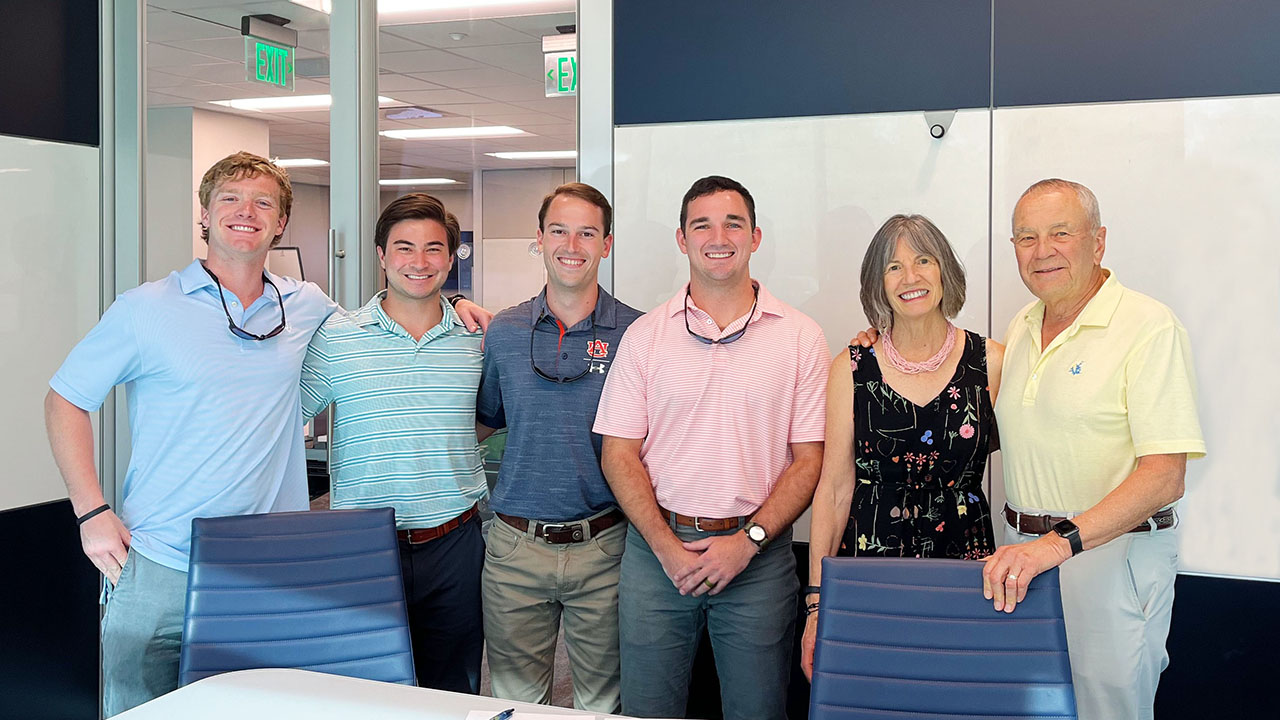
That response interested Woltosz. Professor David Bevly connected him with the team, whose founders included Zac Young, Patteson and Trey Sims. Walt and Ginger became investors. Young had once studied in a building carrying their surname; now the people behind the name were backing his business. It is a pleasingly short journey from campus furniture to a seat at the table.
Woltosz’s investment test was direct: “It’s always about people.” The faulty measurement mattered because it revealed how the founders responded when the product disappointed them. Their idea had encountered resistance from the physical world. They reached for something they had learned and tried again. An investor with a background in rocket calculations could appreciate the distinction between a polished demonstration and a working repair.
A gameday house changes its assignment
Another Woltosz purchase began with a perfectly understandable ambition: somewhere to stay for Auburn football. Walt and Ginger bought a Dutch Colonial Revival house, then learned that its architect and original owner was Frederick Child Biggin, the university’s first architecture dean. The house dated to 1927. Its history suggested a better use than a private calendar organized around home games.
They gave it to the architecture school. Dedicated as the Biggin-Woltosz House in September 2019, it became a setting for meetings, classes, seminars and exhibitions. One early exhibition involved the Front Porch Initiative. A domestic building had returned to teaching, with its rooms doing work its original architect might have recognized.
There is an agreeable lack of tidiness in this version of philanthropy. A purchase can change purpose when new information arrives. An engineer does not need to have specified the final use in advance to recognize a good adaptation. The house’s past became an input to the decision. Its future could include people who had never met the donors.
“It’s always about people.”
Walter Woltosz, on investing in founders
What a gift makes room for
Auburn’s graduate fellowship program adds another scale to the picture. Established in 2007, it has supported hundreds of students, with a gift from Walter and Virginia Woltosz helping sustain the program. Recipients of their fellowships are known as Woltosz Fellows. A building makes a gift visible from the pavement; a fellowship can be harder to see, even when it changes who gets to do the work inside.
There are more literal rooms, too. In 2019, the couple committed $10 million toward a new football performance center. The completed facility carries their name. Their support has also reached performing arts and architecture. The variety matters because it complicates the image of an engineer interested only in engineering. A university includes a good deal that will never fit inside a laboratory.
Their name also reaches the roof of the Tony and Libba Rane Culinary Science Center. The Walt and Ginger Woltosz Rooftop Terrace includes an edible garden run by horticulture faculty, staff and students. Produce goes to the restaurant downstairs and the rooftop lounge menu. A donor’s name over a space where students grow dinner has a practical charm. Here, at least, the institution can eat some of its homework.
In March 2024, the Alabama Senate confirmed Woltosz as an at-large Auburn trustee, with a term scheduled through March 20, 2031. It added formal responsibility to a relationship that had already included degrees, gifts and alumni service. Supporting a place and helping govern it involve different kinds of judgment. Both require thinking beyond the next unveiling.
Even the airplane needs a second take
By March 2026, Woltosz was also talking to Auburn students about entertainment. His credits include co-writing and co-directing Do Not Reply, producing Bound, and producing the stage play Alabama Boys with Michael O’Neill and Thom Gossom. Through Iron Compass Entertainment, he has pursued a film project about aviator Bessie Coleman. The interest in flight has found its way into another medium.
At the Business of Show Business event, he described experimenting with AI imagery for an old open-cockpit airplane. The generated aircraft took off backward. There is a neat occupational joke in an aerospace engineer having to explain the direction of departure to a computer. The anecdote also supplies a modest rule for using new tools: someone still has to look at the result.
October 2026 brought a separate change. Altaris affiliates completed their acquisition of Simulations Plus on October 6, and Woltosz’s board service ended at the closing. The company continued under its own name as a private business. Thirty years after its founding, his relationship with its governance had reached a definite boundary.
The various chapters leave a picture of someone who keeps finding occasions to apply his judgment: a student team debugging a device, an old house needing a public purpose, a screen airplane heading the wrong way. The atrium at Brown-Kopel remains a particularly good illustration. Having supplied the money, Woltosz looked again at the name. There was still a useful adjustment to make.