The class Whitney Williams wanted to take did not exist. At the University of Montana, she went looking for Native language instruction and found a gap in the curriculum. So she located a teacher at Blackfeet Community College willing to travel to Missoula. When the course failed to appear in the catalog, she put up fliers and found the students herself.
It is a useful opening scene for a career that can otherwise disappear into a thicket of impressive names. There was a subject worth studying, someone able to teach it, and people who might want to learn. The missing ingredient was organization. Williams supplied it. Long before founding williamsworks, she was already doing a recognizable version of the job.
Today her work reaches from Missoula to eastern Democratic Republic of Congo, with stops in philanthropy, political campaigns and film production. The settings change considerably. A university noticeboard has few of the complications of an international grant-making organization. Yet that early episode raises the question that keeps following her: what becomes possible when somebody takes responsibility for getting people together?
A family accustomed to knocking
Williams grew up in Helena, with part of her childhood spent in Washington as her parents’ work required. Her mother, Carol, became the first woman to serve as both majority and minority leader in the Montana Senate. Her father, Pat, served nine terms in Congress. Public service was a family occupation with a very large constituency.
On the campaign trail in Madison County in 2020, she recalled an adjustment to Washington life. People there did not wave. Her mother’s response was to encourage her to keep waving anyway. The story is small, faintly comic and more revealing than a statement about civic values. A friendly gesture could survive even when the other party had failed to read the instructions.
She also remembered her father’s belief that a neighbor might have the answer to a difficult problem. Those recollections suggest how she understands expertise: it can live nearby, outside the office where the decision is being made. Her later career would give her access to people with considerable institutional power. The upbringing supplied reasons to look beyond them.
The road show
Williams graduated from the University of Montana in 1994. Her political science studies sat alongside Native American and Wilderness Studies, an education that joined institutions to questions of land and community. She had already interned in the Clinton White House in 1993. Later she worked on Hillary Clinton’s It Takes a Village book tour and became the first lady’s trip director.
Travel operations offered a practical education in coordination. A public visit has a visible center and a considerable amount of work around its edges. Somebody must organize the movement that allows the public event to happen. Williams’s early professional life put her in precisely that territory, where relationships, timing and execution share the same itinerary.
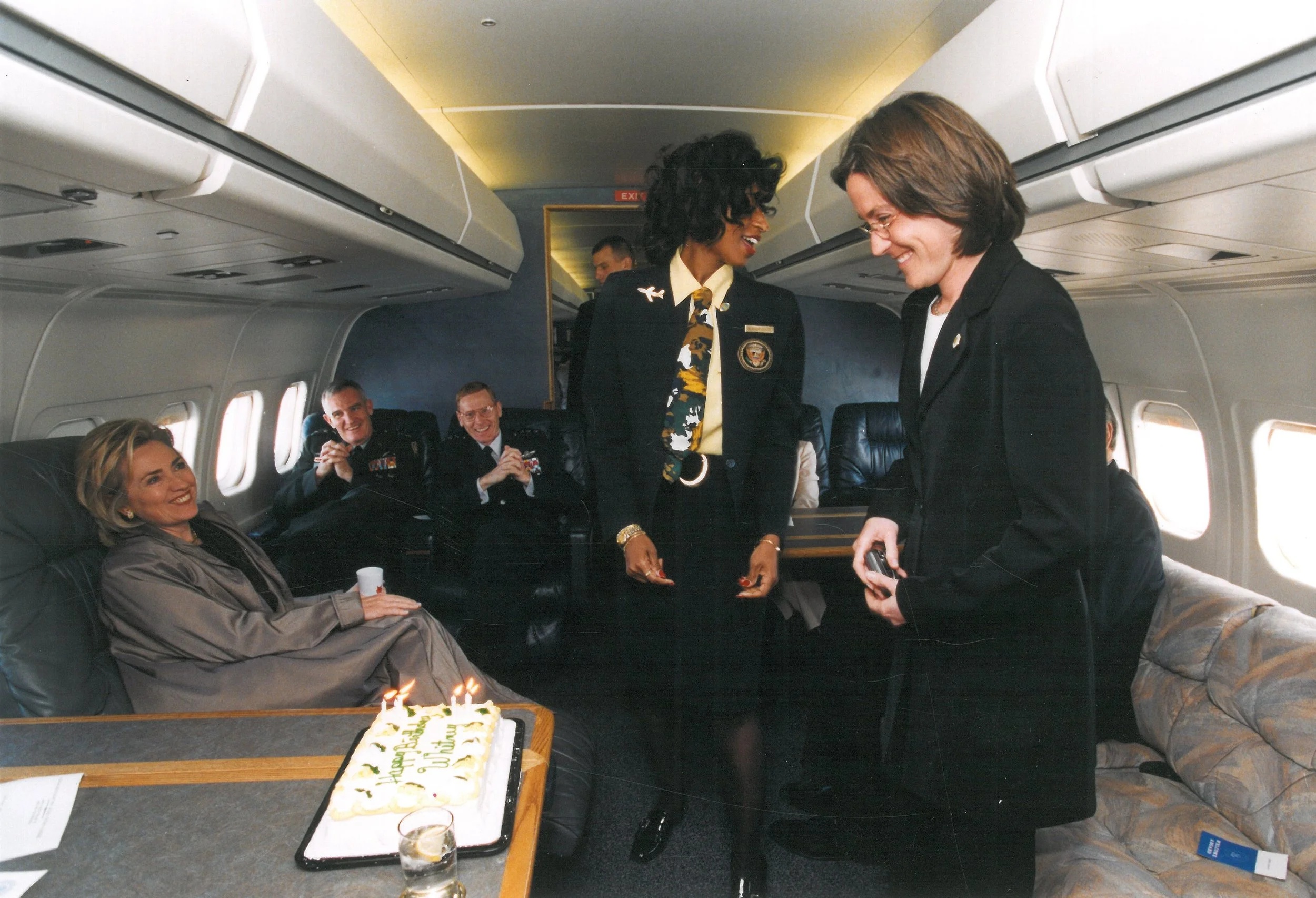
She moved on to Casey Family Programs, serving as vice president of external relations from 2001 to 2003. In 2003 she founded williamsworks. The company gave her a way to work across organizations rather than remain inside a single one. Its clients have included foundations, companies, artists, athletes and families seeking help with their public ambitions.
Looking back on the firm’s twentieth anniversary, Williams tied its beginnings to her parents’ emphasis on neighbors, family and public service. Her list of collaborators included Billie Jean King, the Miranda family, Pearl Jam and the ONE Campaign. The variety is part of the business: people arrive with different kinds of influence and need help deciding what useful work that influence can support.
Three years before the announcement
One consequential introduction took place on a tarmac in Mwanza, Tanzania. Williams later told Robin Wright that Ben Affleck was there through Bono’s ONE Campaign, which her consultancy was working with. A conversation about Congo grew into roughly three years of travel and learning. Eastern Congo Initiative followed in 2010.
The firm’s account of that work describes meetings with displaced families, officials, international organizations and local groups. It also describes the less photogenic requirements of starting an organization: a landscape analysis, a seed fund, staff recruitment and a governing structure. An introduction can be wonderfully quick. A functioning institution has a much longer shopping list.
- 01 Learning visits
- 02 Local relationships
- 03 Seed funding
- 04 Staff + governance
A sequence of work described in williamsworks’ account of the launch.
The distinction matters when a film star is involved. Attention can bring donors to a table. Decisions about leadership, grants and daily operations determine what happens after they leave it. Williams’s contribution lay in helping assemble those arrangements and the relationships around them. The celebrity connection explains how many people first encounter the story; it explains much less about how the organization runs.
In her conversation with Wright, Williams emphasized Congolese hiring and support for organizations working in North and South Kivu. She also acknowledged that there had been failures. That admission belongs beside the plans and partnerships. Working with local knowledge still requires judgment, and judgment remains fallible even when the people making it have traveled a very long way.
The campaign ended. The conversations didn’t.
In October 2019, Williams announced she was running for Montana governor. She entered the Democratic primary against Lieutenant Governor Mike Cooney, with farmer Buzz Mattelin as her running mate. The work placed her in a different relationship with the public. An adviser helps other people decide what to do. A candidate asks voters to let her make decisions for them.
Her argument drew on her business experience. She spoke about managing budgets, creating companies and jobs, and bringing a different perspective to state government. The connections accumulated through international work were part of what she offered. They also invited questions about where her loyalties and experience were rooted. Montana was both home and the electorate she had to persuade.
She lost the June 2020 primary. That outcome is an essential fact in a career often described through the things she helped establish. The campaign did, however, leave conversations unfinished. Among them were discussions with Native families about the cost and difficulty of searching for missing loved ones.
Grace Bulltail, whose niece was Kaysera Stops Pretty Places, had challenged Williams during the campaign to take the issue seriously. Williams subsequently heard similar accounts from other families. Relatives were organizing searches themselves and paying the expenses. The needs were immediate and concrete: transport, a place to stay, a working phone, the means to keep looking.
In 2021, Williams established the Snowbird Fund at Montana Community Foundation. She put in an initial $50,000. The fund’s design followed the practical problem families had described, offering support for community searches rather than requiring that every need fit neatly into an existing organization’s budget.
Nearly $70,000 awarded since the fund began in 2021.
Montana Community Foundation’s dated progress report.The foundation’s current program offers assistance of up to $1,000, with larger needs considered separately. Eligible uses include gas, meals, hotels, phone payments, search equipment and awareness campaigns. It is an unusually tangible list. Each item describes something a family might need to buy before it can continue the work.
By May 2025, the foundation reported more than 67 grants totaling nearly $70,000, with applications reviewed by an all-Indigenous committee. Those figures describe the fund’s progress at that point. The committee’s composition describes another part of the arrangement: who helps decide how the resources reach families. Williams had lost an election; she still had a way to act on something she had heard.
A different kind of credit
Her newer work carries her name into another set of institutions. Through Full Glow Creative, Williams supports artists and storytelling projects, including documentary production and executive producing. Her credits include the 2025 film musical Kiss of the Spider Woman. She is also listed among the producers of the Broadway revival of Gypsy starring Audra McDonald.
In 2026, the connection came closer to home. Tribeca’s program lists her as a producer and executive producer of Paving the Way, directed by Keelan Williams. The 21-minute documentary is set on the Flathead Indian Reservation and follows Indigenous youth and skateparks. Jeff Ament is credited with the music; writer Debra Magpie Earling is a consulting producer.
Those credits place artists and community figures beside a subject with its own local life. A skatepark is a place people use, before it becomes something an audience watches. For Williams, the film joins two continuing interests: supporting creative work and paying attention to communities in Montana. The screen offers another place to bring people together, with a different set of responsibilities attached.
Keep waving
Williams lives in Missoula with her English Shepherd, Seamus. Her board service includes Eastern Congo Initiative, Carol’s List and José Andrés’ Longer Tables Fund. Her working life continues to move among advocacy, philanthropy and the arts, while home supplies a recurring point of reference.
Asked by Robin Wright what advice she would give her younger self, she recommended finding good people and keeping them close: “get yourself a posse.” It is an informal answer from someone who has spent years arranging rather formal partnerships. It also allows for the pleasure of the company. A career built around other people ought to leave room to enjoy them.
“get yourself a posse”
Whitney Williams, speaking with Robin Wright, 2022
Return to that missing university class. The achievement was small enough to fit on a flier, and specific enough to require an actual teacher and actual students. Williams found both. Her later projects have much larger budgets, audiences and consequences. They keep returning to the work between an idea and the people who can give it a life.