The most revealing number in Wade Goins’s professional life may be 221. It is not a voltage, a frequency or a model designation. It is his extension on Polarity’s telephone line. On the company’s contact page, the president and chief executive is also the named technical-sales contact for customers across several American regions. The title sits upstairs; the extension stays close to the work.
That arrangement suits the kind of company Goins leads. Polarity does not sell an object whose purpose can be understood at a glance. It designs and manufactures high-voltage power supplies, microwave amplifiers, converters, inverters, tube test systems, solid-state modulators and electrical tethers for drones. Each noun brings its own difficult questions. How much power? At what frequency? Inside which enclosure? Cooled by air, liquid or conduction? What happens at altitude, under vibration or at an unpleasant temperature?
The answers become machines in Rancho Cordova, east of Sacramento. Polarity says its facility combines power-electronic, analog and digital circuit design with thermal and mechanical engineering. It can characterize products against temperature, altitude, vibration and shock. This is where a specification stops being a promise and begins having weight.
A catalog with consequences
High voltage is naturally theatrical. It suggests lightning, laboratory arcs and warning placards. The commercial work is more sober. Voltage must be shaped, converted and delivered without exceeding the limits of the surrounding system. A radar transmitter and a photovoltaic inverter may seem like distant relations, but both depend on disciplined power conversion. So does a tethered aircraft that must receive electricity through a cable while remaining aloft.
Polarity’s catalog traces that common problem across military, commercial, industrial and alternative-energy applications. There are traveling-wave-tube amplifiers and microwave power modules; high-voltage-to-low-voltage converters; test sets for microwave tubes; photovoltaic and AC inverters; high-power solid-state amplifiers. The product names are dense because the requirements are dense. In this corner of manufacturing, vagueness is not mysterious. It is merely expensive.
Goins’s own public writing adopts the grammar of the catalog. A 2021 post introduced a family of rack-mounted solid-state power amplifiers for radar, electronic warfare, communications and testing. It listed the unromantic details: a three-unit-high chassis, internal driver amplifier, Ethernet communication, forced-air or liquid cooling, and configurations reaching across bands from 2 to 40 gigahertz. The prose did not pose for a portrait. It pointed at the equipment.
A visual reading of four configurations Goins presented publicly. Longer bars show wider frequency coverage, not comparative performance.
Those specifications also reveal the compromises that hardware refuses to hide. Broader coverage, higher output, available space and heat removal pull in different directions. A company can advertise that it solves hard problems; its cooling options show where the hard problem actually lives. The 2026 line Goins announced continued the theme with rack and hub-mount enclosures and both conduction- and liquid-cooled designs.
The convention floor as office
There is another number on Goins’s LinkedIn profile: one article. Published in November 2015, it announced that he was heading to Drone World Expo in San Jose and invited readers to meet him there. Three sentences, no manifesto. Eight years later, he posted a photograph of the Polarity team at the International Microwave Symposium. Six colleagues stand behind a table of metal enclosures, wearing matching blue shirts beneath a banner that promises microwave power solutions.
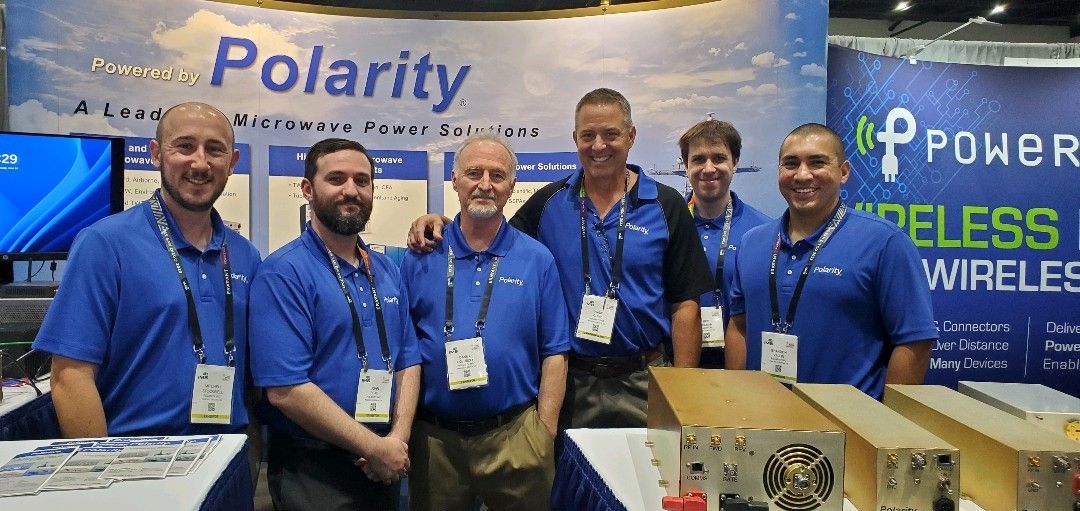
Trade shows endure in technical manufacturing for a sensible reason. A complicated product benefits from a conversation in which the buyer can keep asking, “What if?” What if the cooling method changes? What if the available volume shrinks? What if the system has to survive vibration? A booth allows a datasheet to acquire verbs. Engineers can point, qualify and amend. Executives can hear the objection before it is tidied into a procurement document.
Goins’s presence matters in that setting because his formal authority and his sales role overlap. The person receiving a difficult requirement is not many organizational layers away from the person responsible for the company. The engineering remains difficult, but the path to a decision can be shorter.
The 2015 event also captured Polarity at an interesting edge of its catalog. Electrical tether systems allow a drone to remain connected to ground power, trading unrestricted movement for endurance and continuous operation. It is an elegant reversal of the battery problem: instead of asking how much energy an aircraft can carry, ask how reliably the ground can send energy upward. For a company accustomed to converting and controlling power, the new market spoke a familiar language.
From sunlight to the end of a cable
The breadth of Polarity’s applications can look eccentric until one follows the electricity. Its green-power work includes high-efficiency photovoltaic inverters rated above 100 kilowatts of average power. The company also describes high-voltage inverters designed to charge and discharge stored-energy devices, and says its engineers work with the UL 1741 and IEEE 1547 requirements used around grid-connected energy equipment. On another page of the catalog, power travels not toward the grid but up a tether to an aircraft.
These products do not share a customer or a silhouette. They share a set of habits. Voltage arrives in one form and must leave in another. The conversion should waste as little energy as practical. Heat has to be managed. Controls have to make electrical behavior predictable. Protection cannot be decorative. The finished equipment has to coexist with a larger machine whose designers would prefer not to organize everything around the power supply.
This helps explain why Polarity presents custom work as a core capability rather than an exception. Its public product categories include airborne traveling-wave-tube power supplies, pulsed amplifiers, klystron transmitters, DC-to-DC converters and low-noise test equipment. A standard chassis may answer one requirement; another begins with an awkward combination of size, environment and output. The company’s supplier network is part of that answer, allowing a design effort in Rancho Cordova to move toward production when quantities rise.
For Goins, the range produces a peculiar executive brief. He must keep a coherent business around products that may never meet one another outside a capabilities list. The coherence is not the market label. It is the repeated act of taking unruly electrical requirements and giving them boundaries, connectors and a case.
A long view, told in short posts
Goins attended Pittsburg State University from 1983 to 1987. His profile lists basketball, pickleball, golf and gardening among activities and interests - a collection with more fresh air than one might expect beside a career in enclosed electronics.
Polarity was founded in 1999. Its history since then is easier to read through products than through corporate theater. The company moved among established microwave technologies, custom converters and test equipment while also addressing solar power and tethered aircraft. It describes a supplier base that can help scale manufacturing and a quality process that includes environmental characterization. The shape is that of a specialist firm willing to follow a power problem into a new application without pretending the underlying physics has changed.
Goins attends Pittsburg State University.
Polarity is founded to serve demand for high-voltage power systems.
Goins heads to Drone World Expo in San Jose.
He presents a broadband rack-mounted SSPA range.
The Polarity team exhibits at the International Microwave Symposium.
Goins announces a new SSPA line with multiple mounting and cooling choices.
There is restraint in the way Goins tells this story. His public profile is about the company. His updates are about the products. Even the trade-show photograph gives most of its space to the team and the equipment. A working style is visible in the repeated proximity: to customers, to specifications, to colleagues and to the physical object.
That may be the useful distinction between leadership in software folklore and leadership in specialist hardware. A software story can race toward scale while the object disappears into the cloud. Polarity’s objects stubbornly remain. They occupy rack units. They need fans, coolant, connectors and tolerances. They travel to test chambers. They stand on tables at conventions. A claim eventually meets an instrument.
The discipline behind the spark
The word “power” flatters almost any executive profile. Here it is literal, measured and occasionally dangerous. Goins’s job is attached to an enterprise that makes power usable for somebody else’s machine. That asks for imagination, but imagination under constraint: affordable enough to buy, reliable enough to trust, compact enough to install and documented enough to maintain.
Polarity’s recent amplifier announcements suggest continuity rather than reinvention. New enclosures and cooling choices extend a line; frequency ranges and output levels answer different installations. This is progress in the industrial sense, where an option added to a chassis can matter more than a fashionable adjective.
And so the extension number returns. It is a tiny piece of contact-page furniture, easy to overlook beside the exotic catalog. Yet it places Wade Goins exactly where his public record places him again and again: between the technical requirement and the commercial answer. The machines handle the voltage. His task is to keep the company close enough to the problem that the voltage behaves.