Before the factories, there were refrigerators. At Princeton, Wm. Polk Carey noticed that his small dorm-room fridge was something his classmates wanted. According to the company’s history, he bought more and rented them out, earning over $10,000 by the end of his sophomore year. The appliance was useful. Owning the appliance was optional. That distinction would eventually occupy millions of square feet.
Carey founded his namesake firm in 1973. Today, W. P. Carey is a publicly traded real estate investment trust, or REIT, buying properties that businesses need to keep operating. Its preferred scenery includes distribution centers, manufacturing plants and retail premises. These are buildings whose importance is easier to see on a production schedule than on a postcard.
- Sell the property, keep using it, put the proceeds to work.
- Expect long leases, rent increases and continuing property expenses.
- Tenant credit and the building’s usefulness both matter.
The factory stays. The money moves.
Consider Apotex. In April 2023, W. P. Carey paid $468 million for 11 pharmaceutical research and manufacturing facilities across four campuses in the Greater Toronto Area. The transaction helped finance SK Capital’s majority buyout of the drugmaker. Apotex stayed in the properties under a 20-year master lease, with fixed annual rent increases and rent paid in U.S. dollars.
That is a sale-leaseback. The owner sells its real estate and simultaneously becomes the tenant. Cash once tied up in walls and land becomes available for an acquisition, debt repayment or investment in the operating business. The factory does not have to move. Its balance-sheet role changes.
The price of that freedom is a recurring obligation. In a triple-net lease, the tenant generally pays property taxes, insurance and maintenance as well as rent. Selling the building does not make those expenses disappear. Nor is the purchase price free money: the business exchanges ownership and future property upside for cash today and a long commitment to pay.
W. P. Carey also funds build-to-suit developments for businesses that need a purpose-built facility, and buys properties with leases already in place. Carey Tenant Solutions supports existing tenants with expansions, redevelopment and energy projects. The common thread is capital attached to a building the occupier expects to keep using.
Mulch, medicine and the cost of moving
The underwriting question is wonderfully practical: how hard would it be for this tenant to leave? GardenCore offers an answer measured in acreage. W. P. Carey acquired 43 manufacturing facilities across 24 states and leased them back for 20 years, with fixed annual increases. The lawn-and-garden products business had been acquired by Pacific Avenue Capital Partners in a carveout from CRH.
The properties have specialized zoning, substantial land and installed mulching, bagging and packaging equipment. Replacing that arrangement is more complicated than finding another office with decent coffee. Operational importance gives the landlord a reason to expect the relationship to last. It still has to judge whether the business can afford the rent.
This is where the firm fits among net lease landlords such as Realty Income, NNN REIT and Broadstone Net Lease. W. P. Carey emphasizes corporate sale-leasebacks, industrial properties and a long-established European business alongside North America. Its expertise combines property assessment with tenant credit analysis and the legal work of transactions spanning jurisdictions. A handsome building alone is insufficient collateral for a weak business plan.
“We instead focus on the just-below investment grade credit space.”Jason Fox / Nareit interview / 2019
The office lesson cost shareholders income
Long leases can create a comforting illusion: that time itself removes risk. W. P. Carey’s office retreat shows the limitation. In September 2023, it announced an accelerated exit from office properties. It spun 59 buildings into Net Lease Office Properties that November and established a sale program for 87 others.
The underlying problem was deteriorating office fundamentals. Management’s explanation focused on what happens when a lease ends: downtime, carrying costs, capital spending and the rent obtainable from the next tenant. The contract could keep delivering income while the economics of replacing it became less attractive.
The change carried a visible cost. The quarterly dividend fell from $1.071 to $0.860 in late 2023, a 19.7% reduction. The company attributed the reset to its office exit and a lower payout ratio. Its history records completion of the strategic exit in 2024. “Investing for the Long Run” still required changing the portfolio before the long run arrived.
Twenty-five years later, look up
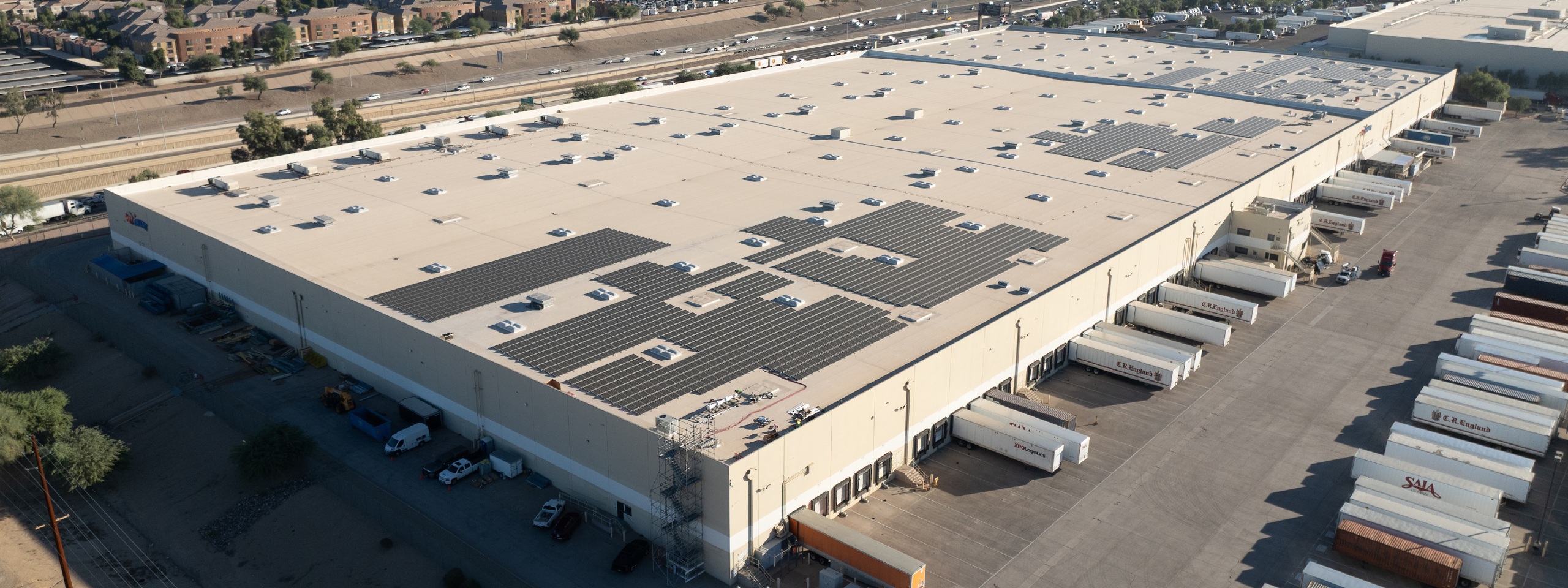
The other side of long ownership is the chance to do a second useful thing. W. P. Carey bought PetSmart’s 620,000-square-foot Arizona distribution facility in a 2001 sale-leaseback. A subsequent rooftop solar project became operational in 2026. Under a power purchase agreement, PetSmart gets fixed energy pricing while the landlord supplies the solar infrastructure.
The system is expected to produce about 1.9 million kilowatt-hours annually and offset roughly 20% of the building’s power consumption. Those are projected operating benefits, rather than a reason to assume every warehouse roof works. The building becomes a platform for another agreement between parties that already know one another.
The company’s cultural shorthand is its founder’s “Doing Good While Doing Well.” Its practical expression includes tenant energy projects and the CareyForward employee volunteering program. Both sit alongside the central commercial task: keep the tenant, property and capital working together.
Ask what the cash will earn
For an owner considering the same move, the useful lesson is to price the whole exchange. Compare the proceeds with the rent schedule, repair obligations, renewal terms and returns expected from reinvesting the cash. A business expecting to leave soon is a poor match for a lease lasting a decade or longer. So is a tenant whose cash flow cannot support the commitment.
The scale suggests plenty of companies find the exchange worthwhile. At June 30, 2026, W. P. Carey reported 1,748 net lease properties, 384 tenants and 98.5% occupancy. In September it reported visibility into over $1.9 billion of 2026 investment volume, including roughly $1.4 billion already completed. The idea behind the refrigerators remains recognizable: someone needs to use the asset; someone else can own it. The hard part is agreeing on the next twenty years.