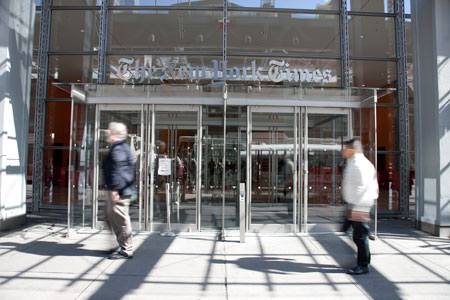
In March 2009, when New York finance had considerably more anxiety than credit, Jason Fox helped arrange a $225 million transaction involving The New York Times headquarters. Lenders declined to finance it. W. P. Carey and two affiliated funds supplied the money themselves. For an investor whose business depends on collecting rent for years, it was an unusually conspicuous way to demonstrate patience.
Fox later described the conviction behind that decision. The newspaper business was under pressure; so was Manhattan office space. A building could look alarming in the headlines and still merit a careful investment. The distinction required work, money, and a willingness to look unfashionable.
He became W. P. Carey’s chief executive in January 2018. Years later, the company accelerated its departure from office property. Put those decisions side by side and a more interesting portrait emerges: an executive whose long view still leaves room to change the contents of the portfolio. Loyalty to a method need not mean permanent attachment to a building.
Before the lease, the lesson
Fox’s early working life involved mathematics and physics at The Hotchkiss School in Connecticut, where he also coached boys’ soccer. He had graduated magna cum laude from Notre Dame with a degree in civil engineering and environmental science. Before advising businesses on their buildings, he had been helping students work through problems with answers that could be checked.
Soccer supplies another continuous line through his life. He captained Notre Dame’s team and later became a director of the U.S. Soccer Foundation. The foundation’s biography records that he still enjoyed playing. His connection to the game extends from taking the field to coaching and, eventually, supporting an organization that brings the sport into more communities.
He moved into consulting and mergers-and-acquisitions advisory work at Spectrem Group in San Francisco, then earned an MBA at Harvard Business School. A recruiting encounter with founder Bill Carey brought the firm to his attention. He joined in 2002. Teaching, engineering, sport, advisory work: the route contained rather more variety than the standard executive biography can comfortably accommodate.

Learning a business one transaction at a time
At W. P. Carey, Fox developed through the investment operation. He became co-head of global investments in 2012 and head of global investments in 2015, with responsibility for sourcing, negotiating, and structuring acquisitions in North America and Europe. His preparation for the chief executive’s chair included the detailed work that makes an investment possible before anyone announces it.
The company specializes in long-term net leases, including sale-leasebacks. In a sale-leaseback, a business sells its property and continues occupying it as a tenant. The seller releases capital tied up in real estate; the buyer receives a contractual rental stream. A factory can keep making the same goods on Monday even though its ownership changed on Friday.
That continuity gives the transaction its appeal and creates its central question: how dependable will the occupier be over time? Buildings are tangible. Future rent requires a judgment about the business inside them. Fox’s investment responsibilities put him at the meeting point of property, corporate finance, and negotiation. A convincing façade alone cannot settle the arithmetic.
- 01Sell the buildingThe business receives capital from the property buyer.
- 02Stay putThe business leases the property and continues using it.
- 03Collect the rentThe owner receives rent under the agreed lease.
The work of making a company simpler
One substantial step came in August 2022, when W. P. Carey completed its merger with CPA:18 in a transaction initially valued at approximately $2.7 billion. The deal concluded the company’s exit from the non-traded REIT business. A company that had managed investment programs for others was becoming easier to understand as an owner of its own rental portfolio.
The transaction also brought assets to sort through. After planned disposals, it was expected to add about $2 billion of real estate, including net-leased properties and a portfolio of operating self-storage facilities. Simplification, in this case, involved acquiring a collection of properties and then deciding how the pieces should fit.
There is a practical distinction between collecting rent under a long lease and owning an operating property whose income depends more directly on day-to-day business activity. Both can produce returns, but they ask different things of an owner. For Fox, reshaping the company meant making choices about the kinds of earnings shareholders would receive, as well as the amount.
By 2025, asset sales were helping finance new investments. Fox’s annual letter described a company building growth from its investment activity, existing leases, and balance sheet. The apparent simplicity at the end of that process had required years of transactions. A tidy cupboard can conceal a formidable afternoon’s work.
An office exit with consequences
In September 2023, W. P. Carey laid out an accelerated exit from office property. The plan had two parts: spin off most of the office portfolio into Net Lease Office Properties, then sell the office assets remaining on W. P. Carey’s balance sheet. It was a change in what the company would own and in how shareholders would hold part of their investment.
The spin-off was completed on November 1, 2023, transferring 59 office properties. Shareholders received one NLOP share for every 15 W. P. Carey shares. Fox also became NLOP’s chairman, trustee, and chief executive. His responsibilities therefore included the separate vehicle created to manage the office assets.
The original strategy also reset the intended dividend payout ratio to approximately 70% to 75% of adjusted funds from operations. That detail belongs beside the property decisions. Portfolio changes reach investors through earnings and distributions; they are more consequential than a revised description on a company website.
Fox’s 2024 letter framed the following stage around a stronger balance sheet, funding flexibility, and future earnings and dividend growth. The office exit established a new starting point. The test would be whether the remaining business could turn that starting point into results.
The rent clause earns its keep
Fox’s discussion of inflation in 2022 offers a useful look at his business in miniature. At the time, he said 99% of existing leases contained rent increases, with 58% of that portion tied to inflation. Those were figures for that period, but the underlying idea remains central: a long lease can contain a mechanism for changing the rent.
That mechanism deserves attention because time is expensive. A lease that runs for years must account for a world in which prices, funding costs, and the tenant’s business can all move. An inflation link or fixed increase is negotiated into the contract long before it becomes a line in an earnings release.
He also emphasized diversification and underwriting. A portfolio spread across industries and geographies offers several places to look for investments, while tenant analysis addresses the chance that rent will actually arrive. These are related disciplines. A scheduled increase is useful only when the occupier can pay it.
The 2025 results showed how internal growth and new investment can work together. W. P. Carey reported $2.1 billion of investment volume, 2.4% contractual same-store rent growth, and 5.7% growth in adjusted funds from operations per share. AFFO is the company’s adjusted measure of operating performance. Its per-share movement helps reveal whether a larger portfolio is also doing more for each share.
A balance sheet needs somewhere to go
In early 2026, Fox described a market in which steadier interest rates had helped bring buyers’ and sellers’ expectations closer together. The company was looking primarily at manufacturing, logistics, and selected retail properties in the United States and Europe. The point of financial capacity was to have money available when a suitable transaction appeared.
His discussion of the previous year had been more cautious. In 2025, he spoke about funding acquisitions through sales of non-core operating assets, particularly legacy self-storage properties, while acknowledging uncertainty around interest rates, inflation, and tariffs. Public guidance gives those judgments a number; changing conditions require the number to be revisited.
By July 28, 2026, W. P. Carey had completed $1.3 billion of year-to-date investments. It raised its full-year investment assumption to $1.7 billion to $2.1 billion. The June-end portfolio contained 1,748 net-lease properties covering approximately 188 million square feet. These are company measurements, and they describe the scale of the decisions now arriving at Fox’s desk.
Second-quarter AFFO was $1.34 per diluted share. The company raised and narrowed its full-year AFFO guidance to $5.19 to $5.27 per diluted share. Those projections were expectations, with the remainder of the year still to come. The difference between a completed deal and an anticipated one remains essential, however briskly a presentation moves between them.
“Investment activity remains strong”
Jason Fox · September 10, 2026
The next problem is always specific
The September 10, 2026 business update supplied a less abstract example of the work ahead. W. P. Carey reported approximately $1.4 billion of investments completed that year and visibility into more than $1.9 billion when expected transactions and scheduled capital projects were included. Fox said investment activity remained strong.
The same update addressed Hellweg, a tenant whose rent outlook had required attention. Binding agreements had been signed to re-tenant nine stores representing 64% of its current annualized base rent. Other locations were being negotiated or prepared for sale. New rent on the signed agreements was expected to start between late 2026 and mid-2027.
That timetable brings the story back to patience, with a qualification. Waiting has value when someone is also doing the work: arranging replacement tenants, negotiating leases, selling properties, and finding capital for the next investment. The long run contains a surprising number of immediate chores.
Alongside his corporate roles, Fox serves as a W. P. Carey Foundation trustee and advises real estate programs at Notre Dame and Johns Hopkins. Education remains part of his professional life. The former teacher now operates at a different scale, with outcomes measured across properties, tenants, and reporting periods. The assignment keeps changing. The need to show the working survives.
Continue the conversation
- W. P. Carey: Jason Fox’s biography ↗
- Jason Fox on LinkedIn ↗
- U.S. Soccer Foundation biography ↗
- The 2019 career conversation ↗
- Watch: Fox on inflation and net leases ↗
- 2025 CEO letter and results ↗
- July 2026 financial results ↗
- September 2026 business update ↗
- W. P. Carey on YouTube ↗
- Company on X ↗
- Company on Facebook ↗