
The comment that started a company
Vu Van arrived in the United States in 2009 sure of one thing: her English was good. She had been among the top English students in Vietnam, and she was headed to Stanford for a joint MBA and master's in education. Then she opened her mouth in a classroom full of native speakers and watched her words land somewhere short of the room.
The moment she returns to most is a small one. She offered an idea in class and it slid past unnoticed. A few minutes later a classmate said almost the same thing, and the room lit up. The difference was not the idea. It was that this time people could understand the person saying it. For a student who had crossed an ocean to learn, being unheard because of an accent was its own kind of lesson.
She had a strong vocabulary and a strong resume - roles in supply chain and operations that took her through Singapore and Denmark, a stint at Maersk, and a Six Sigma black belt. What she did not have was a reliable way to fix the gap between what she knew and what people heard. Pronunciation was the wall, and there was no good tool to climb it.
My opinions in class were often disregarded because professors couldn't understand what I was saying.
An expert, approached by accident
After Stanford, Vu spent time in strategy consulting - Booz & Company and Strategy&, inside the PwC network - focused on the education sector and how online learning companies grew. But the pronunciation problem never left her. She decided to build the tool she had wanted, and for that she needed someone who understood speech at the level of the sound itself.
She approached Xavier Anguera, a respected speech-recognition scientist, without fully realizing how prominent he was in the field. By her own account, it was her urgency more than any pitch deck that moved him. He agreed to build it with her. In 2015 they launched ELSA - short for English Language Speech Assistant - a phone app that listens to how you speak and tells you, sound by sound, where your pronunciation drifts.
Ignorance is a bliss, and it's OK to show to others our weakness.
What ELSA actually does
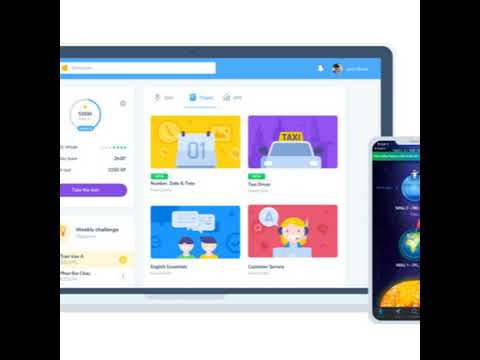
Most language apps grade vocabulary and grammar. ELSA is built around the harder, more personal problem of the spoken word. Its engine detects pronunciation at the level of individual phonemes and gives instant feedback on how a learner sounds, how fluent they are, and how their intonation rises and falls. It practices real situations - a job interview, a presentation, small talk - and recognizes a wide range of English accents rather than insisting on one.
The target is enormous. Roughly 1.5 billion people are learning English as a second language, and most of them will never sit with a private pronunciation coach. Vu's argument is that AI can hand each of them something close to one, cheaply and at any hour. That framing - a personal coach that never tires of you - is what turned a founder's frustration into a market.
Scaling by the round
ELSA grew the way ambitious startups do: one round at a time. A pre-Series A of about $3.2M in 2018, a $7M Series A in 2019 backed by Silicon Valley investors, a $15M Series B in 2021, and a $23M Series C in 2023 - roughly $60M in all, from backers including Gradient Ventures, Google's AI fund, along with Vietnam Investments Group and UOB. With the Series C came ELSA AI Tutor, a conversational tutor built on generative AI that lets learners hold a real exchange rather than repeat drills.
Along the way the company built out offices across Vietnam, India, Portugal, Japan and Indonesia, and the user base climbed into the tens of millions across roughly 190 countries, with more than a billion exercises completed. In early 2025 the company brought on a new chief technology officer, Akshaya Aradhya, as it pushed further into AI tutoring.
Hire a very strong team, who are much smarter than you. You don't build your company alone.
The founder underneath the numbers
Vu is unusually candid about the cost of running a company. She has said plainly that being the CEO is lonely, and she talks about failure not as a slogan but as a working condition - the only real failure, in her telling, is deciding to stop trying. She keeps a line from John F. Kennedy close: those who dare to fail miserably can achieve greatly.
That mix of nerve and humility runs through her story. She left a stable corporate path to chase a question she couldn't answer yet. She admitted, publicly, the exact weakness she was ashamed of, and made it the product. And she keeps Vietnam close - she co-founded Vietseeds, a scholarship fund for underprivileged Vietnamese students, tying her own success back to the classrooms she came from.
The recognition has followed. She has been named a World Economic Forum Technology Pioneer and invited to Davos, selected as an Endeavor entrepreneur, and included on Inc.'s 2024 Female Founders 250 and among lists of top San Francisco CEOs and women leading AI in education. Forbes has cited ELSA among companies using AI to change the world. But the through-line is simpler than any award: a person who was hard to hear decided that being underestimated was fuel, and built something so that fewer people would be dismissed for how they sound.
Six lines that explain her
Vu Van, on camera

Frequently asked
Who is Vu Van?
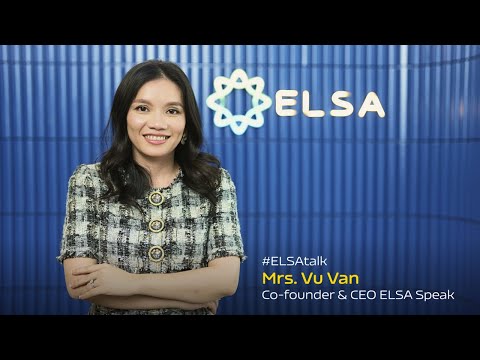
Vu Van is the Vietnamese-born co-founder and CEO of ELSA, an AI-powered app that helps non-native speakers improve their English pronunciation, fluency and intonation.
What does ELSA stand for?
ELSA stands for English Language Speech Assistant. It uses AI to give learners real-time, phoneme-level feedback on how they speak.
Why did she start ELSA?
As a Stanford graduate student she struggled to be understood despite strong English skills, and felt her ideas were dismissed because of her accent. She built ELSA so others could be heard.
Who co-founded ELSA with her?
She co-founded ELSA with Xavier Anguera, a speech-recognition scientist she approached to build the pronunciation technology behind the app.
How big is ELSA today?
ELSA has grown to tens of millions of users across roughly 190 countries, delivered over a billion exercises, and raised about $60M in funding, including a $23M Series C in 2023.