The pocket-sized voice coach for a billion people who already speak English - just not the way the room expects.
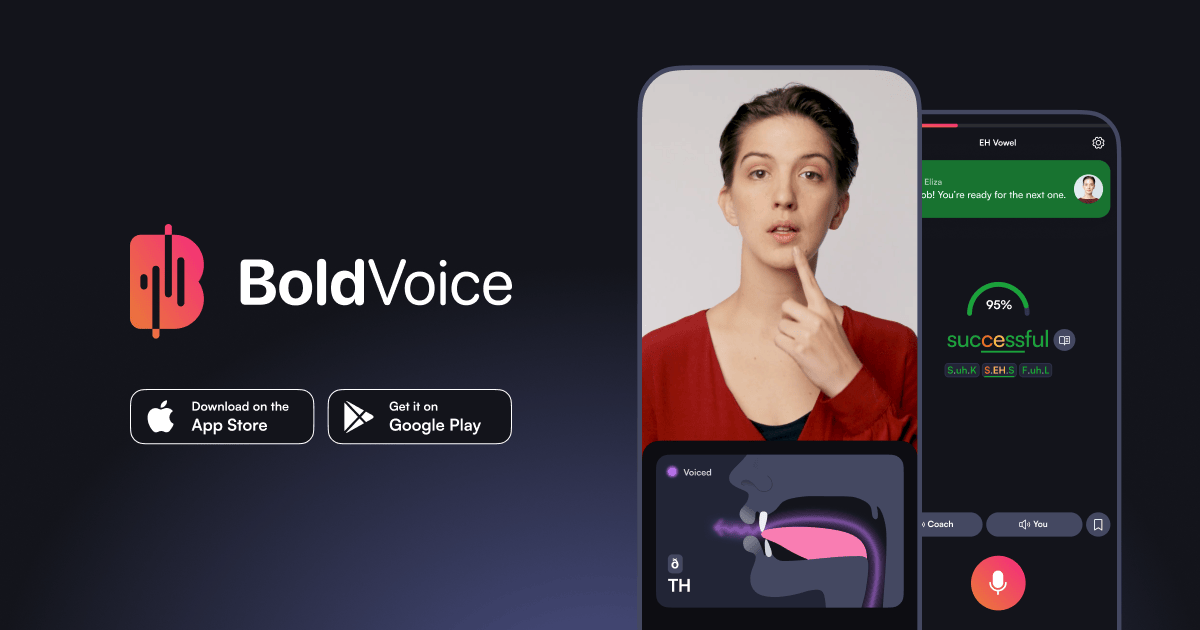
Above: BoldVoice's app, caught mid-lesson. The phone on the right just told someone their "EH" vowel was 95% successful - which is more encouragement than most of us got in years of language class.
Open BoldVoice on a Tuesday night and a coach is waiting. You say a sentence out loud. Before you finish exhaling, the app has listened at the level of individual sounds, marked the syllable that gave you away, and shown you - with a cartoon cross-section of a mouth - exactly where to put your tongue. No appointment. No $250 hourly rate. No raised eyebrow.
This is BoldVoice in 2026: a New York company of roughly a handful of people that has quietly become the top-rated accent app in its category, with more than five million downloads in over 150 countries and north of $10 million in recurring revenue. It is the rare consumer AI product that people actually pay for, renew, and recommend to their colleagues.
The premise is deceptively narrow: help non-native English speakers be understood. The implications are not narrow at all. Being understood is the difference between getting the idea credited to you and watching it get repeated, more clearly, by someone else.
There are roughly 1.5 billion English learners on the planet. Most of them are not trying to pass as American. They are trying to give the presentation without being asked, twice, "sorry, what?" They are trying to leave a voicemail without rehearsing it. They are trying to make sure the brilliant thing they just said actually lands.
The uncomfortable truth BoldVoice was built on is that accent shapes perception. Studies and lived experience both say the same thing: a strong accent can quietly nudge how listeners rate a speaker's competence - regardless of what the speaker actually knows. That is not a flaw in the speaker. It is a friction in the listener. But the cost lands on the speaker anyway.
Traditional accent coaching exists, and it works. It also costs $200 to $300 an hour, requires scheduling around a human, and is geographically lucky if you happen to live near a great one. For a software engineer in Bangalore or a physician in São Paulo, the best coaches were, for all practical purposes, imaginary. That is the gap BoldVoice walked into.
Anada Lakra came to the United States from Albania to attend Yale. She did not need a market report to understand accent bias; she had a lived dataset. Alongside co-founder Ilya Usorov, she made a bet that sounds obvious only in hindsight: that speech AI had finally gotten good enough to hear pronunciation the way an expert coach does - sound by sound - and that the expertise of the world's best coaches could be captured on video and handed to anyone with a phone.
Albania to Yale to founder. Built the coach she wishes she'd had when she arrived in the U.S.
The technical half of the bet - that proprietary speech models could grade accents in real time.
They took the idea through Y Combinator in 2021. The wager was not that AI would replace human coaches. It was the opposite: pair the AI with real Hollywood dialect coaches - the kind who train actors for Netflix, HBO and Marvel - and let the machine handle the relentless, patient, instant feedback that no human can provide at 11pm for $15 a month.
BoldVoice is a subscription app on iOS, Android and the web. You record yourself speaking; its speech models score you at the phoneme level and tell you which sounds slipped. Video lessons from named coaches like Ron Carlos and Eliza Simpson teach the mechanics. The curriculum adapts to your native language, because the corrections a Spanish speaker needs are not the corrections a Mandarin speaker needs.
Proprietary speech models score pronunciation sound-by-sound and flag the exact syllable to fix.
Video lessons from dialect coaches who train screen actors - delivered to anyone, anywhere.
Lessons adapt to your native accent and your goals, from job interviews to daily clarity.
Practice real situations - including interview simulations - before they actually count.
The pricing is the quiet revolution. A year of BoldVoice runs roughly the cost of a single hour with a private coach. For users who want the human touch, the company also offers 1:1 classes. But the core promise is that high-quality coaching no longer has to be a luxury good.
Anada Lakra and Ilya Usorov found BoldVoice and go through Y Combinator. TechCrunch covers the pre-seed.
The app climbs to the top of its category - 4.8 stars, 70,000+ reviews - and spreads by word of mouth among professionals.
Downloads cross 5,000,000 across 150+ countries; annual recurring revenue passes $10M with a tiny team.
Matrix leads the round, joined by Flybridge, Xfund, Corazon Capital, Alumni Ventures, Umami Capital and Y Combinator.
It is easy to claim traction. It is harder to cross $10 million in recurring revenue with a team you could seat at one restaurant table. BoldVoice did both, which is why investors who see a thousand pitches a year wrote the checks.
Figures are illustrative estimates based on typical $200-$300/hour coaching rates versus BoldVoice's published annual pricing.
The user base skews toward ambitious professionals - engineers, doctors, founders - including employees at companies like Google, Meta, ByteDance and Microsoft. These are people who already cleared the language bar. They came to BoldVoice for the last 10% that decides whether a meeting goes their way.
It would be easy to read an accent app as a machine for sanding people down into one flat, corporate American voice. BoldVoice frames it differently, and the distinction matters. The goal is not to take your accent away. The goal is to make sure your accent never gets in the way of your idea.
That framing is why the company exists in the first place. Its founders did not study accent bias in a seminar. They paid for it in misread meetings and repeated sentences. Building the tool was, in a sense, the most efficient form of revenge: turn a personal frustration into infrastructure for 1.5 billion people.
Work is global and increasingly voice-first. Video calls, voice notes, AI assistants that you talk to out loud - the spoken word is doing more labor than ever. In that world, clarity is not vanity; it is leverage. The market for being understood is, conservatively, everyone who speaks English as a second language and wants a seat at a bigger table.
BoldVoice's fresh $21 million gives it the runway to widen from a great accent app into something closer to a general communication coach. The technology that grades a vowel can, in principle, grade pacing, filler words, and confidence. The same loop - speak, get instant feedback, improve - is a template that extends well past pronunciation.
So come back to that Tuesday night. The phone lights up, the coach is ready, the cartoon mouth shows you where the tongue goes. A sentence you would once have rehearsed and dreaded now just gets said - clearly, the first time. The accent is still there. It was never the thing standing in the way. BoldVoice's bet is that, with the right coach in your pocket, it never has to be again.
Profile compiled from public reporting and BoldVoice's own materials. Figures such as downloads, ARR and funding reflect publicly reported numbers as of 2026 and may be approximate.