A phone company becomes a different sort of business when people start using it to pay for dinner. Vodafone Fiji has spent years crossing that line. Its M-PAiSA wallet handled more than FJ$6 billion in transactions in the financial year ended June 2025, according to reporting on ATH’s annual results. That is money moving through the service, rather than sales booked by the telecom. Even with that distinction, it is a striking measure of how far a mobile operator can travel from selling calls.
Today, the company sells connectivity, handles payments, runs an online marketplace and offers streaming entertainment. Its reach includes households, tourists, merchants and corporate IT departments. The unifying idea is practical: once a customer has a connection, find the next everyday task that connection can make easier. In Fiji, that can mean paying a bill, receiving money from abroad or putting credit on a bus card.
M-PAiSA transaction value in FY2025
Payment throughput, not Vodafone Fiji revenue.
The checkout changed the habit
M-PAiSA launched in June 2010. Within weeks, the Reserve Bank of Fiji reported 50,000 sign-ups. Registration, however, is only the beginning of a financial product’s life. The interesting question is what makes someone keep using it after the first transfer.
A 2020 UNCDF study offers a small, revealing window. Manish Kumar, a warehouse manager in Nadi, had been sceptical before a friend persuaded him to open an account. He split his salary between conventional savings and M-PAiSA, then used the wallet for bills, phone credit and his daughter’s university allowance. QR shopping payments helped turn it into a daily habit.
Another interviewee, chemistry student Elsie Ravasau, used the app to budget for shopping and rent. Merchant payments meant she could carry less cash. These were two users, not a representative survey, but their experiences identify an important change: a wallet becomes more useful when the money can stay digital until the moment it is spent.
“I use it for everything!”
Elsie Ravasau, M-PAiSA user
Interviewed by UNCDF, 2020
Vodafone introduced M-PAiSA QR payments in October 2019. It subsequently connected the wallet to Fiji’s National Payment System on October 14, 2024, enabling transfers between participating banks and wallets. Those additions widened the places money could go. They also made the service harder to describe as a simple airtime accessory.
The red logo stayed. The ownership changed.
The international name can obscure a local ownership story. Vodafone Fiji dates its operations to 1994, when cellular service began through a joint venture involving Fiji’s telecom business. In 2014, Vodafone Group sold its entire 49 percent stake to the Fiji National Provident Fund for FJ$160 million. The Vodafone branding continued through a Partner Market arrangement.
ATH now lists the ownership as 51 percent ATH and 49 percent FNPF. The 2014 payment bought an existing shareholding; it was not a startup funding round or a fresh network budget. Brand, ownership and investment are separate pieces of this company’s history.
Its current company profile reports more than 889,000 subscribers and network reach covering 96 percent of Fiji’s population. Subscribers should not be read as a count of unique people, and population coverage does not mean every patch of land has service. The figures nevertheless describe a substantial distribution base on which to build additional businesses.
A phone bill with several businesses attached
The core trade remains familiar: prepaid bundles, postpaid plans, mobile voice, data, broadband and devices. Enterprise customers can also buy cloud and cybersecurity services. Vodafone’s business catalogue includes implementation and administration of Microsoft Active Directory, alongside tools from vendors such as Oracle, AWS and Fortinet. Its expertise here combines network operation with installing and managing other companies’ technology.
Digital payments add another source of income. Customers pay according to transaction type, rather than simply paying to open an app. The published M-PAiSA tariff schedule lists customer QR payments at zero charge. The National Payment System page lists a FJ$0.50 fee for wallet-to-bank transfers, with outgoing limits of FJ$1,000 per transaction and FJ$2,000 a day. Those terms make the product’s economics more concrete than a large transaction total.
Different transactions, different charges. Published terms checked September 8, 2026.
Then there is Vodafone Play, launched in January 2025. Its original proposition included English and Hindi films, children’s programming and local television. Customers could pay through mobile credit, M-PAiSA or a postpaid bill. For someone without a credit card, the payment method is part of the product: access to entertainment starts before the play button.
The structure grew more formal in April 2025, when M-PAiSA moved into wholly owned Digital Financial Services. ATH’s annual report describes a regulatory requirement for separate operation under central-bank oversight. The same report records VitiKart’s Asian Telecom Awards recognition and Vodafone’s ISO 27001:2022 certification. Selling more digital services brings more obligations to manage them.
The parcel still has to leave Fiji
VitiKart, Vodafone’s marketplace, pushes the company into another part of commercial life: helping merchants sell online. A shop can gain an online storefront and still face a stubborn obstacle after receiving an order. Someone has to move the goods. International shipping introduces cost, customs and the anxiety of promising delivery to a distant buyer.
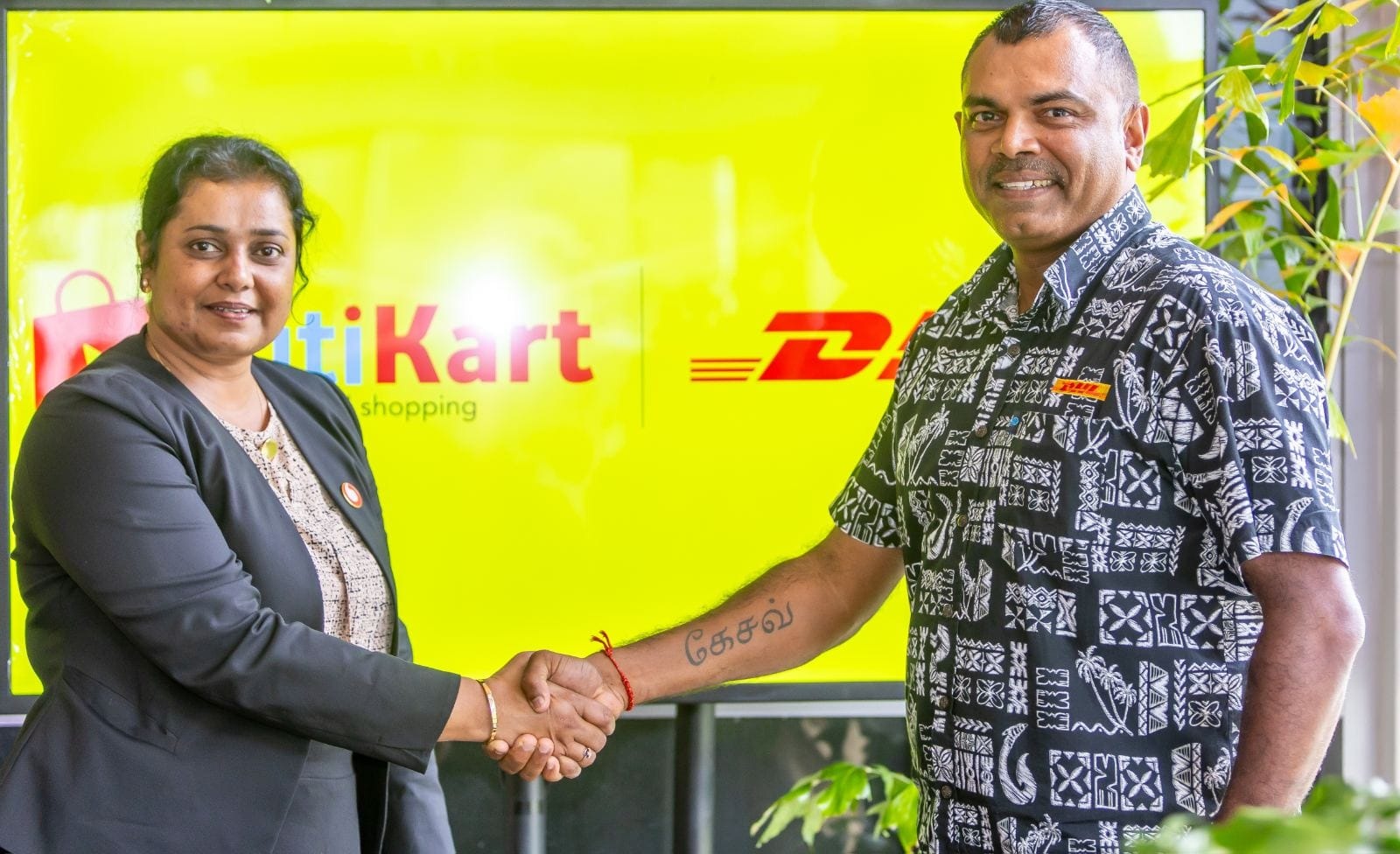
On July 9, 2025, Vodafone announced a VitiKart partnership with DHL to integrate international shipping. The announcement explicitly identified those obstacles for micro, small and medium enterprises. The commercial idea is sensible: make fulfillment easier alongside ordering and payment. A working checkout alone cannot deliver a parcel to Sydney.
Vodafone faces alternatives in each of these markets. Digicel Fiji’s MyCash also offers QR payments, remittances and bill payments. Telecom Fiji sells fixed broadband and shares the ATH parent. Vodafone’s distinguishing feature is the combination of connectivity, payments and commerce around an established local customer base. Customers still have reason to compare individual services on coverage, price and acceptance.
When the bus-card terminal went quiet
A business woven into daily routines gets judged during interruptions. In November 2024, Vodafone acknowledged an outage affecting data and M-PAiSA in the Central Division. Its restoration notice offered affected users an extra 24 hours before their data expired. Losing connectivity had also disrupted access to a financial service.
A separate 2025 eTransport notice described intermittent failures at bus-card top-up terminals. Vodafone identified network connectivity at the agents’ POS terminals as the affected component. It restored service, enabled offline top-ups and began training agents to use that capability. It also announced infrastructure upgrades and additional redundancy.
This is the most useful operational lesson in the story. When a service supports an essential journey, the fallback belongs inside the product. An offline capability that agents cannot operate is only half a repair. Training matters as much as the software change, and a customer needing bus credit is unlikely to care which technical component failed.
5G in town, a post office further out
Vodafone’s commercial 5G launch on September 15, 2025 introduced another investment cycle. The company cited more than FJ$100 million in network upgrades, a broader figure than an isolated 5G project price. Initial deployment focused on Suva, Nadi, Lautoka and Denarau, with expansion scheduled through 2028. At the same time, Vodafone committed to upgrading older network areas to 4G.
Suva, Nadi, Lautoka, Denarau
Initial commercial rollout
Nasinu, Lami, Labasa, Savusavu
Expansion scheduled at launch
Further townships
Later phases in the announced plan
For a customer, the relevant test is more specific than whether Fiji has 5G. Vodafone’s prepaid broadband conditions require coverage, an appropriate data SIM and a compatible router or pocket Wi-Fi set to the correct network mode. The rollout announcement is a timetable, not proof that every planned location already has service.
Other places need a different approach. Vodafone became an authorized Starlink reseller in 2024, offering another route to business connectivity. And on January 5, 2026, Post Fiji rejoined the M-PAiSA agent network. Post offices brought physical cash-in, cash-out and QR-payment access closer to rural and maritime customers, ahead of back-to-school assistance payments.
That last development punctures the idea that digital finance makes counters disappear. People still need ways to deposit and withdraw cash, establish trust and get help. The nearest trained person can be as consequential as the newest radio technology.
The useful part to copy
Vodafone’s community work follows a related pattern. The Vodafone ATH Fiji Foundation combines grants with technology and partner organizations. Its 2025 World of Difference application sought digital skills for work with charities and community groups, offering full-time and part-time participation. The practical emphasis is on people who can help others use the tools.
Another company can borrow the sequence visible here: start with an existing customer task, notice where it becomes inconvenient, then address that obstacle. Merchant acceptance made a wallet useful for shopping. Shipping support gave an online sale somewhere to go. Offline top-ups helped protect a commute.
The conditions matter. A wallet needs places to spend and withdraw. A marketplace needs reliable delivery. Faster broadband needs compatible equipment and usable coverage. Vodafone Fiji’s most persuasive proposition sits in those ordinary details: making the next transaction easier enough that a customer comes back tomorrow.
Explore the services. Hear the people.
Vodafone Fiji website ↗ · M-PAiSA guide ↗ · Company news ↗
LinkedIn · X · Instagram · Facebook · TikTok
▶ Watch: Shailendra Prasad discusses M-PAiSA Social Plug · 2020▶ Watch: M-PAiSA for businesses Vodafone Fiji · 2020