Long before Vishaal Hariprasad learned to quantify cyber risk, he learned to look up. Planes on their way to and from LaGuardia passed over his grandfather’s walk-up in the South Bronx. To a boy growing up among Caribbean families, the roar overhead sounded less like noise than instruction. He imagined becoming an astronaut. He worked backward from that ambition and found two plausible launchpads: the Naval Academy and the Air Force Academy.
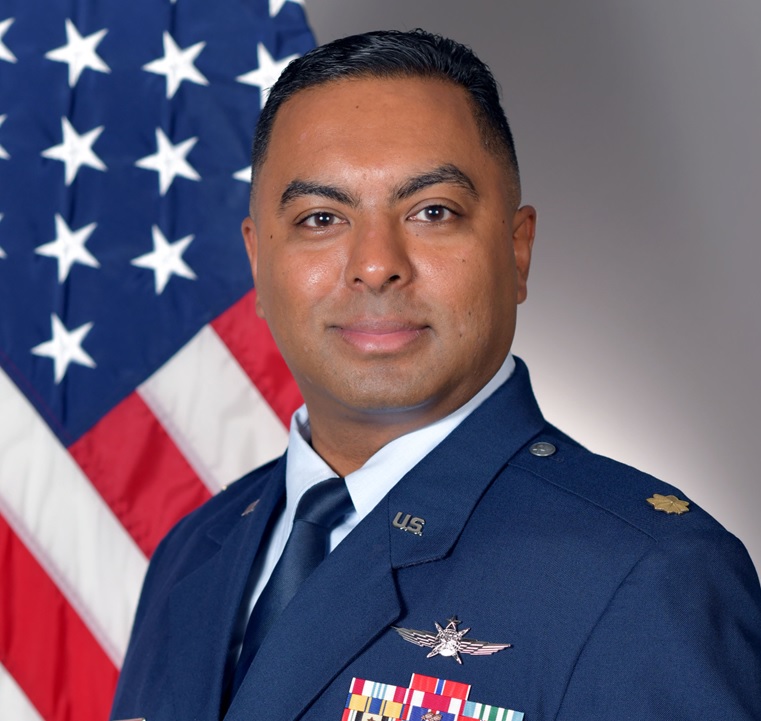
The Air Force won. Hariprasad entered in one of the first academy classes after September 11, studied mathematics, and began his service in communications. The astronaut plan quietly left the flight schedule, but its habits remained: systems thinking, precision, and a preference for problems with serious consequences. His career would keep moving between things people can see and the infrastructure they notice only when it fails.
That pattern also belonged to his family. Hariprasad was the first American-born member of a Guyanese immigrant household in which effort was ordinary rather than ornamental. His father started as a hospital cook, rose to lead revenue-cycle management, and studied at night through a bachelor’s degree, two master’s degrees, and a doctorate. His mother worked while pursuing an associate’s degree. Ambition came without stage lighting. Everyone had a shift in the morning.
01 / Signal acquiredThe connective tissue nobody applauds
His first assignment put him on an Army base in South Korea. Communications work could be bureaucratic, but the mission underneath it was immediate. Units on the peninsula had to be ready if conflict began overnight. Hariprasad saw that radios, networks, and enterprise systems were not support scenery. They were the tissue that allowed every other part of an operation to move.
The lesson sharpened at Fort Meade and the National Security Agency, where his work shifted toward cybersecurity and cyber warfare. In Iraq, his team used cyber intelligence to identify people planting improvised explosive devices and locate them. The work helped save lives and earned him a Bronze Star from the 36th Infantry Division. The 3rd Armored Cavalry awarded him combat spurs, making an Air Force officer one of the uncommon members of its cavalry tradition.
“Behind every cyber operation, there’s a human factor at play.”Vishaal Hariprasad
For Hariprasad, the line between digital action and physical consequence was never theoretical. Software could reveal an adversary, interrupt an operation, or protect a patrol. It could also mislead anyone who treated the technical layer as the whole story. Cybersecurity was about machines, but risk belonged to people.
V7, a pile of paper, and the upgrade
The nickname came from a less cinematic theater of operations. As a new lieutenant in Korea, Hariprasad was assigned enough paperwork to make a filing cabinet reconsider its career. Colleagues started calling him V7. When a commander visited and found the new officer powering through the backlog, they decided he was hardheaded enough to deserve an upgrade. V8 stuck.
It is an efficient nickname for a man whose surname is regularly mispronounced and an accidental summary of how he works. He pushes. He finishes. He also offers one important clarification: despite sharing a name with the vegetable drink, he does not like Bloody Marys.
- 2000sAir Force Academy and cyber operations
- 2012Co-founds Morta Security
- 2014Palo Alto Networks and Unit 42
- 2016Defense Innovation Unit and Arceo
- 2019-nowResilience integrates security and insurance
The expensive education of a second company
After active duty, Hariprasad planned to pursue a doctorate in mathematics and eventually return to the NSA. Then he met Raj Shah. Together they founded Morta Security in 2012 to help businesses defend against cyber threats. Palo Alto Networks bought the stealth startup in early 2014, bringing in a team experienced in protecting national infrastructure. Hariprasad stayed, worked as an architect in threat intelligence, and helped launch the Cyber Threat Alliance at Unit 42.
Silicon Valley then met the Pentagon. In 2016, Hariprasad became a founding partner at the Defense Innovation Unit Experimental in Mountain View, part of an effort to help the military adopt commercial technology at something closer to commercial speed. His professional map now covered the operator, the vendor, the intelligence community, and the buyer. The missing territory was money.
Hariprasad and Shah founded their next company in 2016 under the name Arceo. The original plan was to sell software to insurance companies, using security data to improve underwriting and encourage better cyber hygiene. It was sensible on a whiteboard. In practice, the startup and its customers moved on different clocks.
About a year and a half in, Hariprasad concluded that established insurers were good at selling policies but unlikely to invent a new approach to a new risk on the startup’s timetable. In 2019, he made the founder decision that reads neatly only in retrospect. He told the board the company would change course. He called customers with two- and three-year agreements and returned the money attached to future years. The technology came back in-house. Arceo would build an insurance operation on top of it and become Resilience.
“Our job is to figure out how to shape the future of the digital world.”Vishaal Hariprasad
The pivot put security software and cyber insurance inside one operating model. In 2023, Resilience raised a $100 million Series D led by Intact Ventures, taking disclosed funding above $225 million. The larger achievement was conceptual: security teams could discuss controls, finance teams could discuss potential loss, and underwriters could discuss coverage without pretending they were solving three unrelated problems.
The model bears traces of his military career. Resilience’s Risk Operations Center is designed more like an Air Operations Center than a conventional security operations center. Instead of merely watching alerts arrive, it brings different disciplines together to decide which effects matter. It is joint planning for a balance sheet.
The headline is AI. The loss is human.
By 2026, the cyber conversation had acquired a new object of fascination: autonomous attacks powered by artificial intelligence. Hariprasad’s response was characteristically grounded in observed loss. In the first half of the year, Resilience recorded no incurred losses from AI-specific vectors such as prompt injection, model exploitation, or agentic misuse. Yet 85.3 percent of incurred losses across its portfolio stemmed from attacks exploiting human error through phishing, social engineering, or transfer fraud. The comparable share two years earlier was 17.7 percent.
Where incurred losses began
Share tied to attacks exploiting human error, Resilience portfolio
AI mattered, but often as an amplifier for familiar deception rather than a novel species of loss. Ransomware still accounted for 73 percent of incurred losses in that period, even though it represented only 5.8 percent of claims. The numbers reward a certain sobriety. A rare event can be ruinously expensive. A glamorous threat can distract from an ordinary weak point. Preparation has to survive the news cycle.
Hariprasad’s public argument is economic. Cybercriminals choose targets, invest labor, and pursue returns. A defender’s job includes making the victim less attractive, limiting the payout, and preparing the organization to continue operating after a hit. Insurance then becomes more than reimbursement. Properly connected to security work, it creates a price signal and a reason to improve before the claim.
04 / OwnershipThe office cleanup he still talks about
For a career decorated with military honors, an acquisition, patents, and venture rounds, Hariprasad’s favorite Resilience memory is disarmingly domestic. One day, roughly 60 to 70 employees came together to clean the company’s San Francisco office. What stayed with him was not the tidier room. It was the sight of people treating the place as theirs.
The anecdote reveals the community ethic beneath the systems language. He still engages with Indo-Caribbean communities in the Bronx and South Florida. He has served on the Council on Foreign Relations task force that examined U.S. strategy in cyberspace and participates in the Aspen US Cybersecurity Group. During the 2025-26 academic year, he joined the Hoover Institution as a Veteran Fellow. Meanwhile, he continues in the Air Force Reserve as a lieutenant colonel and cyber effects operations officer.
His personal site compresses the geography to “BX → SF” and the identity to three words: learner, builder, operator. The economy of that description suits him. The childhood dream was flight, but the adult work has been about load-bearing connections: between a unit and its mission, intelligence and action, security and finance, a policy and the behavior it rewards.
Hariprasad wants cyber risk to become less exotic. Property owners understand fire, mitigation, and coverage without turning every conversation into theater. Digital businesses should be able to reach a similar practical fluency. Threats will change. Vulnerabilities will be exploited. The durable advantage is an organization that knows what matters, what it might cost, and what it will do next.
The planes still make for a better opening scene than an actuarial model. Yet they belong to the same story. Both are complex systems made trustworthy by thousands of small decisions, most of them invisible from the ground. Hariprasad did not become the astronaut he imagined beneath the LaGuardia flight path. He became a translator for another kind of uncertain atmosphere.