Cybersecurity marketing has a vocabulary problem. Its favourite words are large enough to shelter whole departments: resilience, posture, surface, orchestration. In careless hands they turn into fog. Kaushik Sen’s answer is to return to the system underneath. Before he was UpGuard’s Chief Marketing Officer, he was a software engineer, a solution architect inside financial institutions, and the co-founder and operating chief of a regulated fintech. He learned the nouns by living with the verbs.
That history gives his present job an uncommon shape. Sen is not merely translating a technical product for a commercial audience. He has occupied both rooms. He knows the whiteboard where dependencies multiply and the meeting where somebody must explain why those dependencies matter. His career is a long exercise in crossing that corridor without dropping the truth on the way.
The engineer learns where trust lives
Sen studied at the University of New South Wales, earning a Bachelor of Engineering in Software Engineering with First Class Honours and a Master of Commerce. The pairing now reads like a preview: how a thing works, followed by how an organisation decides what the thing is worth.
His early career placed him close to the plumbing of finance. He worked in consulting and became a solution architect for major financial institutions, including AMP. Contact-centre architecture exposed him to application security, network security and third-party assessments. He also served on a working group for SuperStream, the national standard built to move Australian superannuation information and payments electronically.
It is difficult to emerge from that work believing systems are tidy. A retirement payment may look like a number on a screen, but behind it sits a procession of software, institutions, rules and hand-offs. Reliability is collective. So is failure. Years later, those same structural instincts would appear in Sen’s description of cyber risk: what matters is not just the network you own but the companies, tools and connections upon which it quietly depends.
When I joined UpGuard, we had a simple thesis: the biggest risk in cybersecurity isn't inside your network. It's everyone you're connected to.
Kaushik Sen, 2026A spaceship built for retirement money
In 2016, Sen co-founded Spaceship with Andrew Sellen, Paul Bennetts and Dave Kuhn. The Sydney startup’s original proposition was pleasingly cheeky for the superannuation business: invest where the world is going, not where it has been. It offered a mobile-first view of retirement investing, with a portfolio oriented toward technology companies and an app designed to make ownership visible.
Sen served as Chief Operating Officer. The work moved him from designing parts of financial systems to helping operate the whole proposition: product, regulation, trust, customers and the untidy negotiations between them. Spaceship raised a $1.6 million seed round in 2016 and grew. Sen’s UpGuard biography says he helped scale the platform beyond 200,000 customers. Company filings also record him as a director of Spaceship Capital from August 2017 until May 2018.
There is a useful connection folded into the cap table. UpGuard co-founders Mike Baukes and Alan Sharp-Paul were named among Spaceship’s early investors. The Australian technology scene is not a ballroom of strangers. It is more like a long dinner where people periodically swap seats, ideas and risk.
Marketing from the engine room
By 2019, Sen was UpGuard’s Vice President of Marketing. In 2020, he became CMO. The transition can look like a leap only if marketing is mistaken for decoration. At an enterprise cybersecurity company, the difficult work is epistemic: What is true? What can be measured? What can a customer act upon? Which promise survives contact with the product?
Sen’s technical writing supplies an answer. His archive ranges across vendor risk, security ratings, cloud configuration, vulnerability management, regulations, the deep web and the design of Amazon S3. The subjects shift, but the method is stable. Define the machinery. Separate adjacent concepts. Explain the operational consequence. Give the reader a next move.
A former colleague, Dave Kuhn, caught this habit early. He described Sen as someone with “a way of breaking down complex problems into simple, elegant solutions,” pairing intellect with uncommon sense. It is a recommendation for an architect, but it doubles neatly as a job description for a good technical marketer.
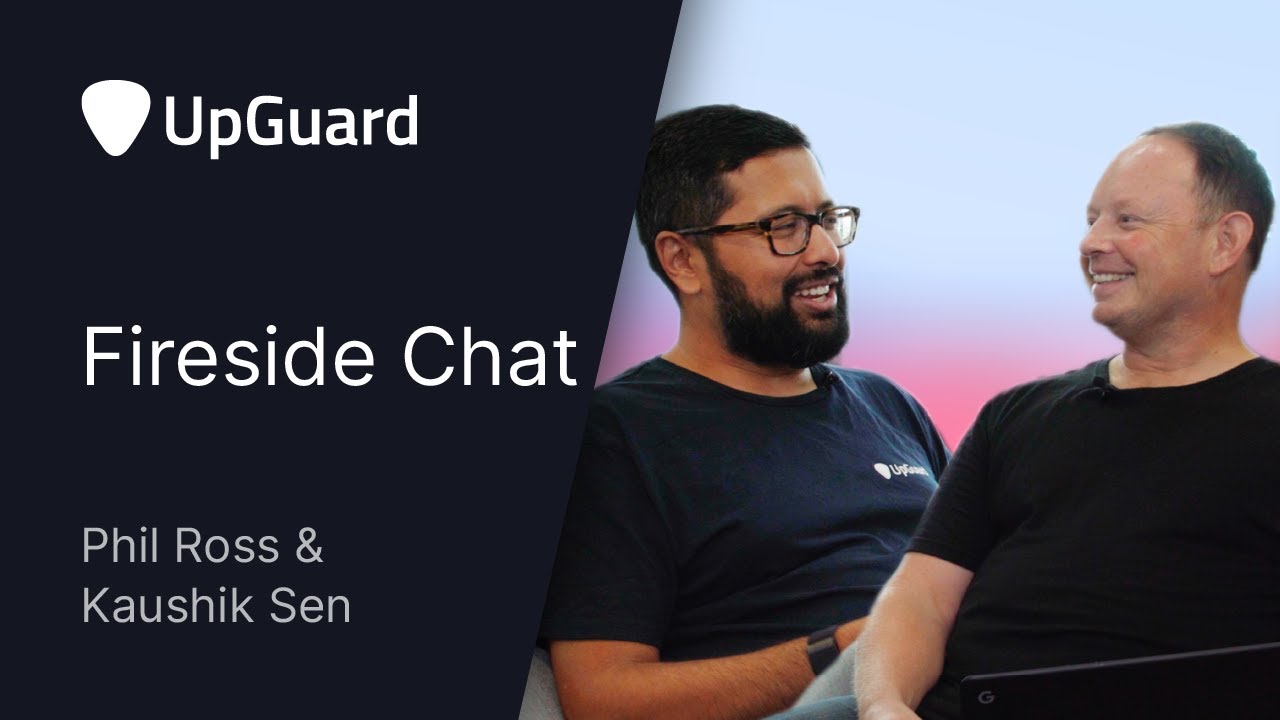
The public conversations follow the same pattern. In a 2020 panel, Sen brought together security leaders from biotechnology, banking and consulting to discuss third-party risk. In a 2022 fireside chat with UpGuard CISO Phil Ross, the pair moved from energy-sector regulation to practical vendor assessments and three concrete security tips. Sen often acts less like the oracle onstage and more like the person making sure the right question reaches the right practitioner.
Every connection is an open question
The perimeter once offered corporate security a comforting picture: important things inside, suspicious things outside, a stout line between them. Modern companies have ruined the drawing. Their critical work now passes through vendors, cloud platforms, SaaS accounts, contractors and integrations. The line has become a mesh.
Sen’s phrase for the result is “connected risk.” Every vendor, SaaS tool and integration is, as he puts it, an open question. This is not an argument against connection. It is an argument for seeing the price of connection clearly enough to manage it. A supplier’s weak control can become your exposure; an unknown application can become your unlabelled door.
This framing also reveals why a static score is insufficient. Security teams need visibility, but a view that produces no action becomes expensive scenery. In Sen’s compressed formulation, CISOs need to “see it, fix it, and prove it.” The first verb belongs to detection. The second belongs to operations. The third belongs to governance, customers and boards. Together they form a loop rather than a report.
CISOs aren't just asking “what's our exposure?” anymore. They need to see it, fix it, and prove it.
Kaushik Sen on the next phase of cyber-risk operationsThe AI-sized queue
That loop became more urgent in February 2026, when UpGuard announced a $75 million Series C led by Springcoast Partners. The company said the minority investment would expand its AI-powered cyber-risk posture platform, scale its global go-to-market operation and support strategic acquisitions. UpGuard reported more than 2,000 customers, use by 50,000 organisations across more than 90 countries, and a platform processing over 100 billion risk signals each day.
Sen’s response was revealingly free of victory-lap varnish. The funding felt “a bit surreal,” he wrote, then turned immediately to the constraint: AI is producing more cyber risk than any security team can assess by hand. A week later UpGuard introduced Risk Automations, designed to connect discoveries with remediation across more than 100 tools. The ambition is not merely to add artificial intelligence to another dashboard. It is to shorten the distance between finding and fixing.
There is an honest tension here. Automation promises relief from the queue, while cybersecurity still demands evidence, judgment and accountability. Sen’s three verbs preserve that tension. Machines may help see and fix at speed. Organisations must still prove what happened. The engineer in the marketer has not disappeared; he has simply acquired a larger audience.
The career beneath the title
Sen’s career is tempting to package as reinvention: engineer becomes founder becomes CMO. A better reading is continuity. Financial architecture taught him that unseen dependencies carry real consequences. Spaceship taught him that people entrust complicated systems with deeply personal assets. UpGuard gave him a language and a market for the same structural concern: trust has to survive the network of things we cannot inspect alone.
His useful trick is not technical fluency by itself. Plenty of fluent people communicate with the warmth of a checksum. It is the combination of fluency and reduction: preserving the load-bearing facts while removing the fog. “Every integration is an open question” works because it turns an architectural condition into a sentence a board member can carry into the next room.
That may be the most stealable lesson in the story. In a complex business, marketing earns trust when it behaves like good engineering. It names the system, respects the constraints and makes the next action obvious. Sen arrived at the megaphone by way of the machinery. The order matters.