In Las Vegas in July 2022, Vinzenz Bichler had a component to explain and a shoe in mind. After an NBA Launchpad presentation, he demonstrated Betterguards technology to San Antonio Spurs executive R. C. Buford. The photograph of that encounter captures a familiar occupation for an engineer who becomes a founder: making a small object intelligible to somebody whose world is considerably larger.
Bichler was thinking about where his invention belonged. He wanted it built into a sneaker. He also hoped, one day, to make his pitch to Stephen Curry. A shoe is an unusually demanding piece of real estate. It already contains somebody’s foot, years of design decisions, and a brand’s opinion of itself. Persuading it to accommodate another idea takes more than a clever drawing.
His route to that conversation had passed through university research, startup grants, a production site in Brandenburg, and a change in his own job. Betterguards had begun in Berlin. By the time Bichler reached the NBA’s summer gathering, the venture had acquired the machinery, partners, and colleagues necessary to take an invention beyond the person who first imagined it.
Before the sneaker, the seminar room
Bichler’s education gave him a practical vocabulary for that journey. He completed a diploma in plastics engineering at Rosenheim and a master’s in biomedical engineering at TU Berlin. Those disciplines put materials and movement in the same conversation. His interests outside the classroom included football and snowboarding, activities in which equipment has to work while the wearer is busy doing something else.
The university’s early Betterguards team listing places him alongside Max Müseler, Timo Stumper, Alexander Fischer, and Marko Kieroth. Müseler also had a biomedical engineering background; Stumper’s was in bionics. Fischer brought business experience, and Kieroth mechanical engineering. Professor Kraft served as mentor. The idea had several kinds of expertise around it before it had a company around it.
TU Berlin’s founding workshop and an ESF scholarship supported the project in 2012-2013. An EXIST startup grant followed in 2013-2014. Betterguards emerged as a university spin-off in 2014. Its business model won the Canvas Model category of the Berlin-Brandenburg business plan competition that year. An invention now had to answer questions about customers, money, and production, subjects that rarely yield to a laboratory demonstration alone.
The early business was conceived as a component supplier. Manufacturers could incorporate its adaptors into their own products. That choice put Bichler in a particular kind of entrepreneurship: his idea needed to become useful inside someone else’s design. For a founder, there is a certain discipline in accepting that the customer may never see the part carrying all your enthusiasm.
A factory is an argument you can walk through
By December 2018, Betterguards was opening a production site at the technology park in Hennigsdorf, Brandenburg. Its company base remained at the Charlottenburg Innovation Centre in Berlin. Production was described as semi-automated. The venture then had nine employees. The distances involved were modest compared with a transatlantic flight, but the distance between university project and repeatable manufacture was the important one.
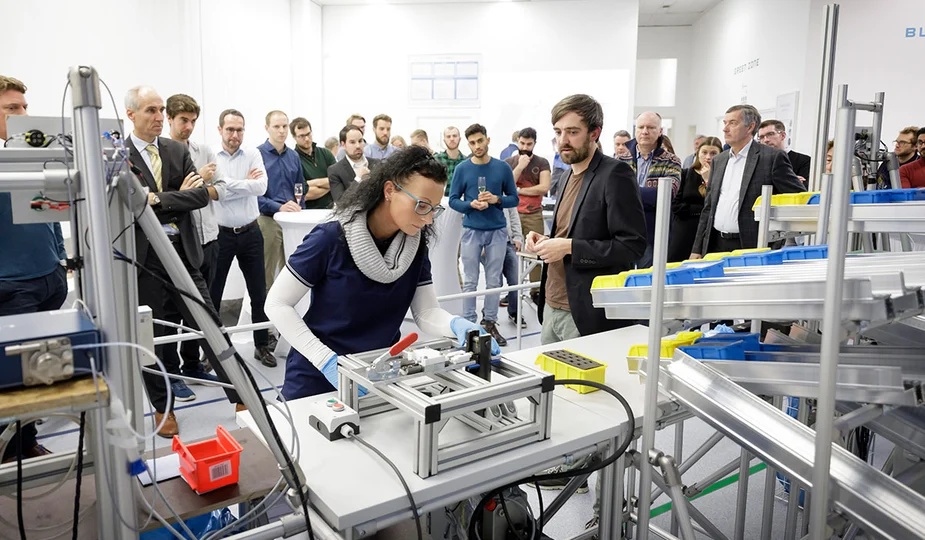
A photograph from the opening shows visitors gathered around a workstation, watching a demonstration. There are rails, containers, fixtures, and people leaning in. It is an agreeable antidote to the startup photograph in which everybody stands beside a wall bearing a slogan. Here, the company has something that needs making.
In May 2019, SHS joined a financing round alongside existing investors Brandenburg Kapital and Die BrückenKöpfe. The announced purpose included expanding and fully automating production in Brandenburg and continuing technology development. Betterguards then reported 14 permanent employees, as well as interns and working students. Money was being directed toward the capacity to manufacture, an undertaking with a rather less convenient undo button than a presentation slide.
The founders’ advice in an EXIST publication was correspondingly practical: begin working on follow-on financing or substantial revenue at least six months before funding ends. That is the sort of counsel that fits poorly on a motivational poster and very well on a calendar. Their account also described two financing rounds as enabling continued research and development. Keeping a technical project moving required an additional kind of timing.
The founder changes seats
In August 2020, Jocelyn Robiot became CEO. Bichler moved from that position to CTO and remained in management. Robiot had spent 16 years at adidas, including responsibility for global marketing. The appointment brought a different working history into a business that wanted to reach sportswear markets beyond its German base.
Bichler welcomed Robiot’s experience and spoke about developing his idea with the team for international applications. The company was also seeking investors with knowledge of ingredient branding, mass production, and global scaling. Each phrase identifies a separate job. A component can have excellent engineering and still need a manufacturer, a commercial agreement, and a reason for a consumer to recognize its name.
The handover makes Bichler’s career more interesting than a procession of chief-executive titles. He had founded the venture and led it, then took on responsibility for its technology while another executive assumed the CEO role. A founding idea does not lose its author when the organization gains another leader. In this case, the changes in title show how many kinds of work the idea had come to require.
- 2014University spin-off
- 2018Hennigsdorf production
- 2020CEO to CTO
- 2022NBA Launchpad
- 2026Farewell to Betterguards
A small part meets a large supply chain
Betterguards subsequently announced a strategic partnership with footwear-components specialist framas. The two businesses would work on development, and framas would supply components for the Betterguards system. Bichler welcomed the partner’s involvement from the start of new projects and the production options it could provide.
Framas brought an established world of shoe lasts, heel components, soles, molding, and manufacturing sites. Its network included production in Indonesia and Vietnam and service centers in several other markets. For Bichler, integration was becoming a question of working with people who knew how shoes are actually built. The idea of placing a component inside footwear was encountering the industrial infrastructure that could make such placement routine.
There is something pleasingly literal about this part of his story. A partnership is often announced as though the signature itself has manufactured the product. Here the substance was components, development work, and access to production expertise. The company’s ambitions were being translated into the tolerances and decisions of an existing supply chain.
Five companies, one basketball invitation
On January 6, 2022, the NBA named Betterguards among the five companies selected for its inaugural Launchpad program. Hundreds of submissions had arrived from 25 countries. The selected businesses would spend six months on research and development projects with league and team advisers, with access to events and the NBA’s wider network.
For Bichler, the invitation placed his engineering venture within a basketball conversation. Summer League in Las Vegas provided the occasion to show its progress. He discussed integrating the component into sneakers and said he had been talking with shoe companies. He did not name those businesses. His attention was on an object a player already wore.
He argued that building the component directly into the sneaker was the most sensible route. The sentence is useful because it contains a design preference rather than a promise of universal adoption. His hoped-for conversation with Curry was still an aspiration. What had happened was concrete enough: a Berlin founder had reached an NBA program, presented his work, and demonstrated it to an executive from the Spurs.
That moment brings the early component-supplier idea back into view. The audience had changed, and so had the venue. The underlying commercial question remained recognizable: where could this piece of engineering fit into a product somebody wanted to use? Eight years after the company’s founding, the question still led Bichler toward the shoe.
“Direct integration (of the belt in the sneaker) makes the best sense.”Vinzenz Bichler · Las Vegas, July 2022
companies selected for the first NBA Launchpad cohort, from submissions across 25 countries.
Even the laces get a say
A later patent publication gives that interest an unexpectedly ordinary focus. The US application titled “Adaptive lacing device,” published on April 30, 2026, names Bichler as inventor and Betterguards Technology GmbH as applicant. It was filed in August 2021. Its subject is a fastening system that changes its response according to the speed of movement.
In the described design, an adaptor allows a lacing element to yield during slower movement and locks it during faster movement. The intended result is a shoe fastening that adjusts without repeated manual intervention. It remains a patent application, a description of an invention rather than evidence that a particular retail shoe contains it.
The appeal is easy to understand without imagining a product launch. Laces are among the most familiar bits of engineering we use: pull, tighten, tie, repeat. Bichler’s application treats that familiar routine as a design question. The mechanism is intended to respond to what happens inside the shoe. After years of thinking about adaptable components, he was still looking for places where adaptation could be useful.
The chapter closes, the idea travels
On July 13, 2026, Bichler announced that his Betterguards chapter had ended after more than a decade. His farewell thanked the people involved and expressed pride in the technology and team they had built. It was a departure framed around a shared undertaking.
The arc runs from a university group to a production line, from the CEO’s chair to technical leadership, and from Berlin to a demonstration in Las Vegas. Around Bichler stand co-founders, a university mentor, investors, manufacturing partners, and sports executives. Their presence gives the story its scale. The invention acquired a life in organizations and products, where the original idea had to meet other people’s knowledge.
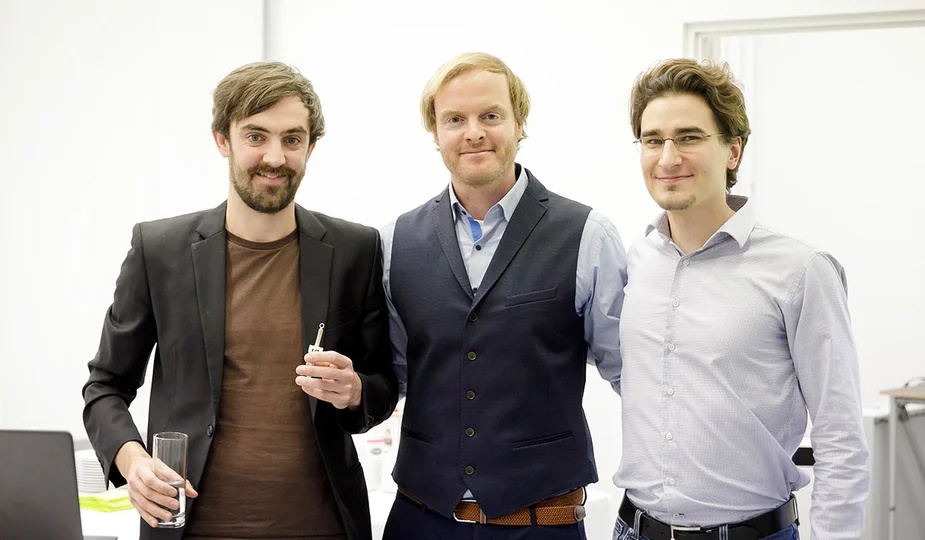
Look again at the founders’ photograph from the production opening. Bichler stands between Stumper and Müseler. One colleague holds a small component; there are glasses in hand and machinery nearby. Celebration and unfinished work share the frame. It is a fitting picture for this career: an engineer with an idea, standing among the people who helped give it somewhere to go.