After the deal with Amazon, Vincenzo Di Nicola went back to school. He had helped build GoPago, a San Francisco mobile-payments startup whose technology caught the retailer’s attention in 2013. His next destination included the classrooms of his former high school in Teramo, where he taught computer science for free. Silicon Valley had given him something useful to bring home. He intended to unpack it.
There is a familiar itinerary for Italian engineers: a good education, a flight abroad, a career elsewhere. Di Nicola followed it through Bologna, California, Microsoft and entrepreneurship, then added a return leg. He co-founded the digital-asset company Conio, moved into public-sector technology and now leads the Artificial Intelligence fund at CDP Venture Capital. Alongside those jobs runs a smaller, stubbornly persistent undertaking: persuading young Italians that they can build things too.
The two scales belong together. Investment funds need companies worth backing. Companies need people prepared to attempt difficult work. Di Nicola has spent years attending to both ends of that arrangement, sometimes with capital, sometimes with a programming assignment. A classroom offers rather fewer opportunities to hide behind an impressive job title.
A public education, with a return address
He grew up in the Teramo countryside in Abruzzo and finished at the Liceo Scientifico Albert Einstein in 1998. His parents worked in public service: his mother spent 34 years at the telegraph service and the post-office counter; his father spent 33 at the municipal registry. A study trip offered to the children of postal employees helped him learn English. The state was woven into the ordinary machinery of his childhood.
That background helps explain why he talks about education as something owed a response. His route continued through computer engineering at the University of Bologna, study and research at the University of California San Diego, and a master’s in computer science at Stanford. He graduated from Bologna with honours. Moving between those institutions gave him a practical comparison of what Italian students knew and what they believed they could do.
His conclusion was encouraging and slightly irritating: the foundations could be strong, while confidence lagged behind. It is an inconvenient diagnosis for anyone waiting for an entirely new education system before trying anything. He began the Premio Di Nicola in 2008, putting a recurring mathematics competition in front of students in Abruzzo. The proposition was simple enough to test: give people a demanding problem and a reason to have a go.
- 2007Stanford master’s
and Microsoft - 2009Co-founds
GoPago - 2015Co-founds
Conio - 2021Announces
INPS role - 2024Leads CDP’s
AI fund
The queue that became a company
Before Conio, there was the problem of buying something without spending the interesting part of your evening waiting to pay. GoPago connected ordering and payment on a phone with the business serving the customer. People could browse, order and pay before arriving to collect. Cafés and restaurants were a natural setting for the idea. A shorter queue is a modest promise, but one that customers understand without a presentation.
Di Nicola co-founded the business in 2009 and served as its chief technology officer. JPMorgan Chase invested in 2012. By December 2013, GoPago had reached a transaction that involved Amazon taking on technology and engineers. The commercial point-of-sale business went to DoubleBeam. The distinction matters: the tidy phrase “sold his startup to Amazon” leaves out the separate destinations of the technology, people and operating business.
Before entrepreneurship, he had interned at Yahoo and led a real-time behavioural-targeting team at Microsoft, working in Redmond and Beijing. Those experiences put him inside organisations with very different demands from a young payments company. One detail survives the corporate résumé: he uses the phrase “bleed purple”, a reference to Yahoo’s colour and its influence on how he thinks about products and workplace culture.
A founder’s exit invites people to count the money. Di Nicola’s subsequent choices raise a more useful question: what experience can travel? Engineering methods, contacts and expectations can move across an ocean. Whether they take root depends on somebody doing the less photogenic work of explaining them, repeating them and making them useful in another setting.
History has a place in the luggage
His interests extend to history and numismatics, the study and collection of coins. That combination sits comfortably beside a career in digital money: the engineer concerned with new ways to exchange value is also interested in its older forms. For him, the past keeps turning up in the middle of work aimed at the future.

After obtaining American citizenship, he visited the San Francisco grave of Carlo Camillo di Rudio, an Italian whose life crossed the Risorgimento and the American West. A photograph shows Di Nicola there with the Italian tricolour and an American flag. It is a rather personal addition to the usual archive of startup photographs. The history enthusiast had found a predecessor whose life also crossed the Atlantic.
Back in Teramo, that interest became a teaching project. Students at the Einstein school built a platform for “I ragazzi del ’99 - La Grande Guerra”, using social media to tell the First World War a century after the events. On 7 July 2015, President Sergio Mattarella received a school delegation at the Quirinale. Programming had supplied a route into history, and the students had made something that travelled beyond an exercise book.
Three keys, and a very human problem
In 2015, Di Nicola co-founded Conio with Christian Miccoli, whose career included ING Direct and CheBanca. Their backgrounds brought engineering and banking into the same venture. Conio addressed a difficulty with cryptocurrency that has little glamour and considerable importance: how people keep control of digital assets, recover access and use a wallet without becoming specialists in the machinery underneath it.
The company developed a multi-signature custody system using two of three private keys to authorise access. Its patent history includes a recovery-related US patent confirmed in January 2020. The design makes recovery part of the system rather than an afterthought. For an ordinary user, the question of what happens after a mistake can matter as much as what happens when everything works.
Conio launched its wallet in Italy in November 2017. Banking integration followed, including Hype in March 2020 and a Banca Generali investment later that year. These are company milestones, achieved by a wider organisation; they also show the institutional setting in which Di Nicola’s second startup developed. Digital money had to make sense to banks as well as to the people holding it.
A complaint, followed by an application
His next turn brought him into the institution he had publicly criticised. In 2020, Di Nicola wrote sharply about INPS’s technology problems. He subsequently applied through a public selection process and announced his appointment as head of technological innovation and digital transformation in January 2021. Having an opinion about a public service had led to responsibility for improving it.
He brought an appetite for cooperation across organisational boundaries. The team’s work included an open-source release in March 2021, developed with INPS’s technology directorate and supported by Developers Italia. Publishing code made it available for other people to inspect, reuse and improve. His argument for opening the work was memorably compact: “soldi pubblici == codice pubblico” - public money, public code.
“soldi pubblici == codice pubblico”
Vincenzo Di Nicola / public money, public code
AI also appeared in a decidedly everyday setting: classifying and routing incoming emails. INPS described that work in April 2022 as part of making services simpler and more responsive to citizens. There is a useful corrective here for anyone whose idea of artificial intelligence consists entirely of talking machines. An incoming message reaching the right office is a perfectly respectable ambition.
Di Nicola’s account of his first hundred days included thanks to outside developers whose contributions had been incorporated. He also described a bug report from Alberto Gardenal that arrived through Instagram with a suggested solution. The detail fits his preference for opening institutions to outside competence. Sometimes the person who can help is already there, waiting for somebody to read the message.
The long investment starts in a classroom
By October 2024, he was leading CDP Venture Capital’s Artificial Intelligence fund, which backs work in AI, cybersecurity and quantum technologies. The role brings his experience of building companies into decisions about supporting other founders. The fund’s remit stretches from early-stage businesses to later development, with links to research and technology transfer. His stated ambition includes helping Italian startups expand internationally.
The teaching continues through another institution. He is president and a founding member of ./cogita ETS, a nonprofit offering practical computer-science courses. Its motto, “Do the right think”, makes a small grammatical joke in service of a serious aim: encouraging people to use their own judgment. The organisation describes courses grounded in practical experience and contemporary tools.
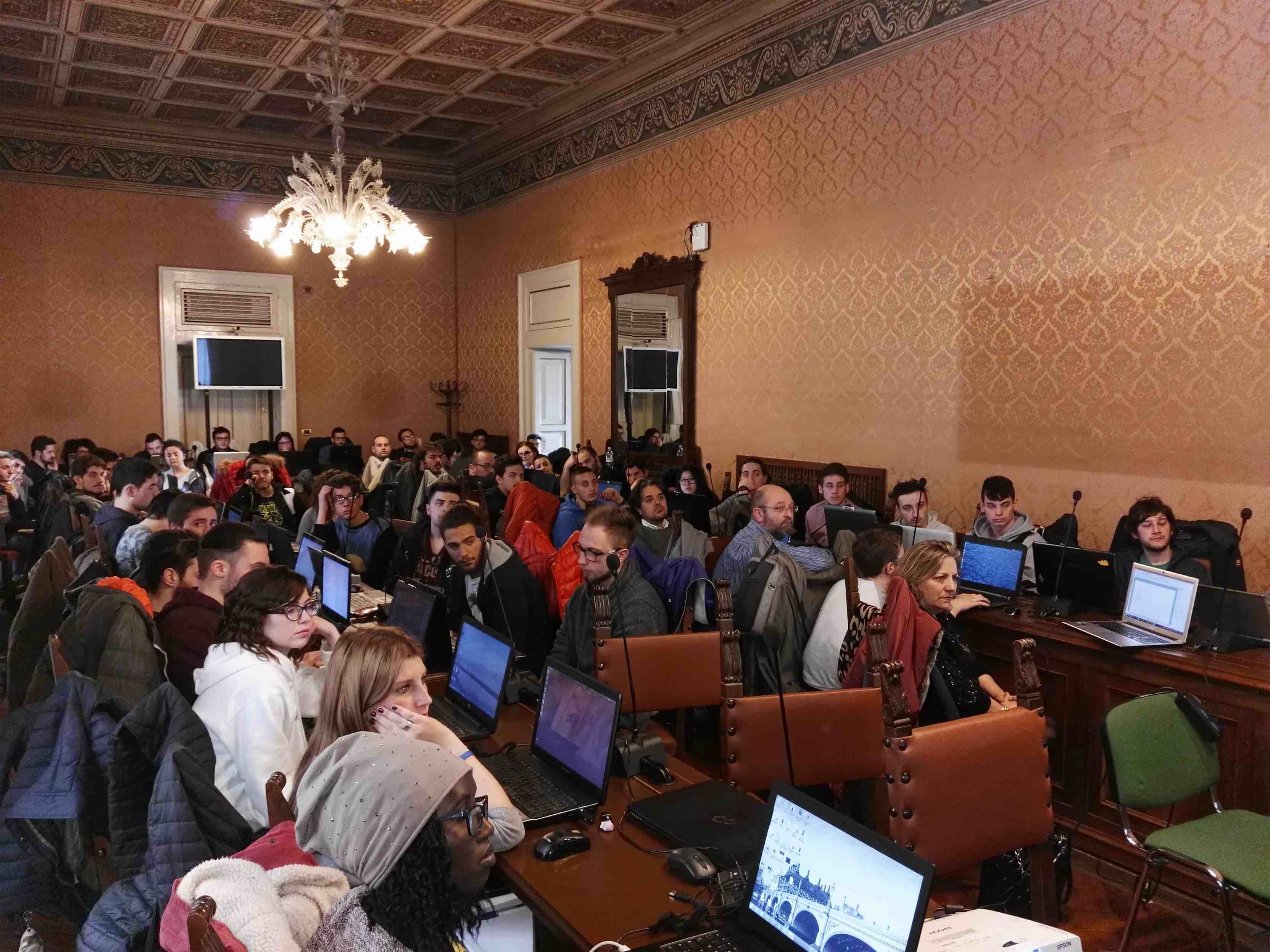
In May 2026, Di Nicola announced the mathematics prize’s eighteenth edition, scheduled for 6 June in both Teramo and Pescara. The competition website advertised a €2,500 total prize pool and a sixty-minute test. Eighteen editions give the undertaking a different texture from a founder dropping by a school to dispense advice. It has become a commitment that returns with the calendar.
His public life has acquired formal honours too: a knighthood in the Order of Merit of the Italian Republic, an Italian Navy reserve-officer commission, and recognition as an Ambassador of Abruzzo in the World in December 2025. Yet the school competition remains an unusually clear expression of what he wants to pass on. A student gets a problem, some time and the chance to discover an ability. Di Nicola has built a career across countries and institutions. He keeps leaving that same invitation on a desk back home.
Read, watch, follow
- Personal essays ↗
- LinkedIn ↗
- X / @vincenzo ↗
- Medium / engineering writing ↗
- The mathematics prize ↗
- ./cogita / courses and community ↗
- Conio / company and patents ↗
- CDP / Artificial Intelligence fund ↗
- Watch / public service and talent ↗
- Watch / GoPago conversation ↗
- Read / the return to teaching ↗
- Read / the GoPago transaction ↗
- Read / public service and open innovation ↗
- Listen / regional finance and AI, July 2026 ↗
Photographs: Italiani di Frontiera and ./cogita.