A model can deliver an answer in a fraction of a second. Explaining why anyone should trust it can take considerably longer. Vikas Tyagi has built a business in that interval: the awkward stretch between a machine producing a result and an institution being willing to stand behind it.
Tyagi is the founder and CEO of Solytics Partners, the New York-based firm he started in 2019. Its work brings together quantitative analytics, software and the daily obligations of financial institutions. Model validation, financial crime screening and AI governance are its territory. These are subjects that tend to acquire glamour only when somebody neglects them.
His route into entrepreneurship passed through the machinery of financial analytics. Before Solytics, he led the quantitative analytics practice of an S&P Global subsidiary, helping build business across the United States and Europe. Starting his own firm meant carrying that experience into a different problem: how to make specialist knowledge work repeatedly, inside an institution's ordinary processes.
The education of a practical quant
Tyagi studied technology at CCSHAU and management at the Shailesh J. Mehta School of Management at IIT Bombay. His management studies ran from 2002 to 2004. The combination gives his career a useful point of departure: technical training followed by an education in how organizations make decisions, allocate resources and get work done.
By the time he appeared on the Risk Americas programme in 2023, his career in analytics covered nearly two decades and work with financial institutions across the US, Europe and Asia. The geographic range matters. A financial model may travel easily as software; the expectations around it come with local accents, organizational histories and different people asking the questions.
Leading a quantitative practice also puts a person close to the difference between an elegant calculation and a usable service. A client has a deadline, an existing system and colleagues who will inherit the result. The commercial question is whether the work can survive all three. Tyagi's subsequent business sits squarely in that practical territory.
When the tools fall behind the rules
The founding problem was familiar to people inside risk and compliance teams: requirements were getting more demanding while the tools remained expensive, slow to implement and dependent on specialists. Tyagi has described institutions left with fragmented, manual work despite the money and effort spent on their systems.
Solytics was his response to that mismatch. The ambition was to make risk and compliance tools configurable and usable across an organization, with less implementation friction. There is a particular kind of entrepreneurial opportunity here. It begins with watching capable people spend too much of their time getting disconnected processes to cooperate.
A policy can be approved in a meeting. Getting that policy to govern thousands of decisions is another undertaking. Someone must establish ownership, define a review, keep the evidence and notice when conditions change. This is where the subject becomes less abstract. An institution needs a way for its intentions to turn into work that actually happens.
For Tyagi, the opportunity includes the unglamorous handoffs: the transition from development to validation, from a screening alert to a review, from a decision to a record of how it was reached. The most impressive demonstration in the room still needs a sensible life after the meeting ends.
“If a model can’t be explained, measured or stress-tested, it shouldn’t be in production.”
Vikas Tyagi · January 2026
Three products, three different jobs
By December 2024, Tyagi was explaining a model risk portfolio with three distinct parts. NIMBUS Uno covered model development, validation and monitoring. MoDeVa supplied testing and monitoring libraries. MRM Vault handled governance and model inventory. The names are less revealing than the division of labour.
Building a model, challenging its behaviour and keeping track of its approvals are related activities, each with its own responsibilities. Treating them as separate jobs makes the business easier to understand. It also explains why a founder with a quantitative services background would care about the connections between them.
Solytics also developed an anti-money-laundering portfolio, including screening, transaction monitoring and threshold optimization. This widened the practical setting of Tyagi's work. A model's performance and an investigator's workload belong to different conversations, but both depend on what happens after a system raises its hand and says it has found something.
Build, validate, monitor
Test and explain
Inventory and workflows
A familiar face across the table
There is a warmer register in Tyagi's account of professional relationships. When Ritesh Agarwal joined Solytics as an adviser in 2023, Tyagi welcomed him as a friend and colleague. “It's fortuitous to cross paths with old pals again,” he wrote. Agarwal, co-founder and chairman of Xcelyst, was joining to support growth in the UK and Europe.
It is a small detail, and a revealing change of vocabulary. Enterprise technology announcements usually sound as though they have passed through several committees before breakfast. Here was a founder pleased to be working with someone he already knew. The business arrangement came with a history between the people involved.
A former colleague, Arvind Kumar Subramanian, offers another glimpse of Tyagi at work. His recommendation describes a manager who brought a team together around a common goal, communicated clearly and simplified tasks. He specifically recalls Tyagi's composure under pressure. That is one colleague's assessment, and it points to a human skill beneath the technical résumé.
The same theme appears in the people Solytics brings into its orbit. In June 2025, it appointed financial crime specialist Sunil Kavishwar to its advisory board. His background included the Central Bank of the UAE, First Abu Dhabi Bank, EY and Accenture. Building the organization involved adding experience from the institutions and regulatory settings its technology was meant to serve.
Taking the argument into the room
Tyagi's public working life includes a steady circuit of industry discussions. In September 2023, he and Alberto Ramirez represented Solytics at a New York gathering of chief data and analytics officers, where generative technologies and data democratization were on the agenda. That October, he was also scheduled to represent the firm at the ACAMS assembly in Las Vegas with its AML and financial crime lead, Shalini V.
The audiences differed. Data executives, financial crime specialists and model risk teams bring their own priorities. A founder selling across those groups has to make the same underlying business legible in several professional languages. The conference diary gives a concrete picture of that work, beyond the title on a company page.
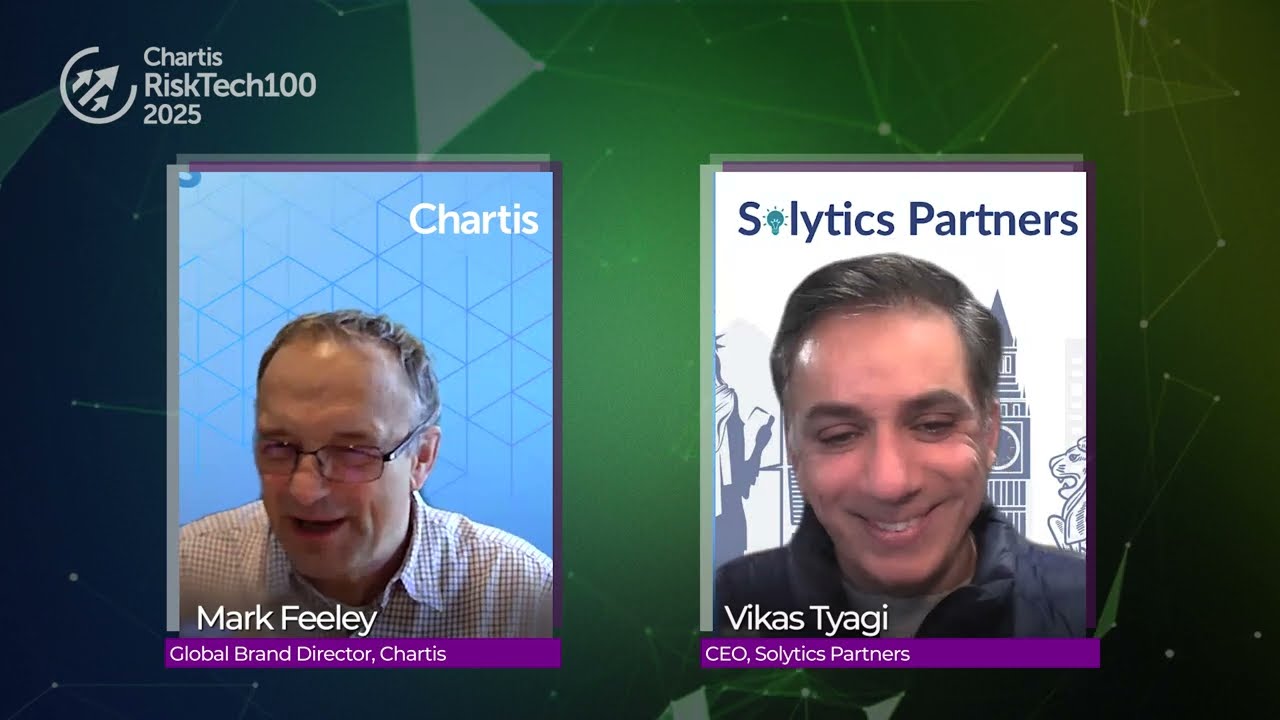
In the Mumbai MRM Conclave discussion published in February 2025, Tyagi joined Agus Sudjianto and banking risk leaders Karthik Pashupathy and Anant Saxena, with Prithvi Chandrasekhar moderating. Their subject was international convergence in model risk management and the challenges facing Indian global capability centres. In May, the Risk Americas programme paired Tyagi with Ramirez for a session on technology and the model risk ecosystem.
The Mumbai discussion brought the cross-border part of his career into focus. Its agenda included regulatory alignment, model inventories, validation and monitoring, alongside the place of Indian capability centres in international banking. These are coordination problems as much as mathematical ones. A team can do sophisticated work in one location while responsibility for approving and using it sits elsewhere. The conversation concerned how those arrangements hold together as institutions expand. For Tyagi, it was another setting in which the calculation was only part of the job.
Following an alert to its conclusion
In January 2026, Solytics announced the acquisition of Arachnys, a London-based financial crime technology firm. Arachnys brought investigations, entity research, adverse media capabilities and evidence capture into the business. Its Navigator and Surveillance platforms extended the work beyond screening and monitoring.
Tyagi described the acquisition as a way to connect complementary capabilities. His existing business supplied analytics, screening and monitoring; Arachnys added research and investigation workflows. The direction was consistent with the founding concern about fragmentation: bring more of the work into a connected process.
The distinction is easy to picture. A warning starts a question. An investigation has to decide what the warning means and preserve the reasoning. Software that notices a concern and software that helps someone examine it are neighbours with plenty to discuss. Bringing them together gave Tyagi a broader proposition to take to financial institutions.
The next question is about control
During 2026, the company's AI work became more explicit about governing generative systems and agents alongside established models. In April, Solytics announced its placement as a Category Leader in the Chartis AI Governance quadrant. The product discussion now included agent registration, autonomy controls and decision boundaries.
For Tyagi, this extends a familiar set of concerns into a new class of technology. As software gains more room to act, institutions need to decide what that room includes, who can approve it and how its actions will be reviewed. A clever system still needs someone to answer for its behaviour.
In August, Solytics reported an AI governance platform award at the CRO Leadership Summit in Mumbai. In September came three ET Enterprise AI awards, covering an AI security and trust layer, fintech applications and an agentic AI application. These were company recognitions, reflecting the team's work across applications and controls.
Tyagi's story runs from quantitative expertise to the organization of expertise: building a firm, assembling colleagues and connecting tools that once left people to bridge the gaps. The question at its centre remains wonderfully stubborn. A machine has given an answer. Who is prepared to put their name to it?
Continue the conversation
Company website Vikas on LinkedIn The founding conversation 2023 Chartis interview 2024 Chartis interview Mumbai panel discussion The Arachnys announcement