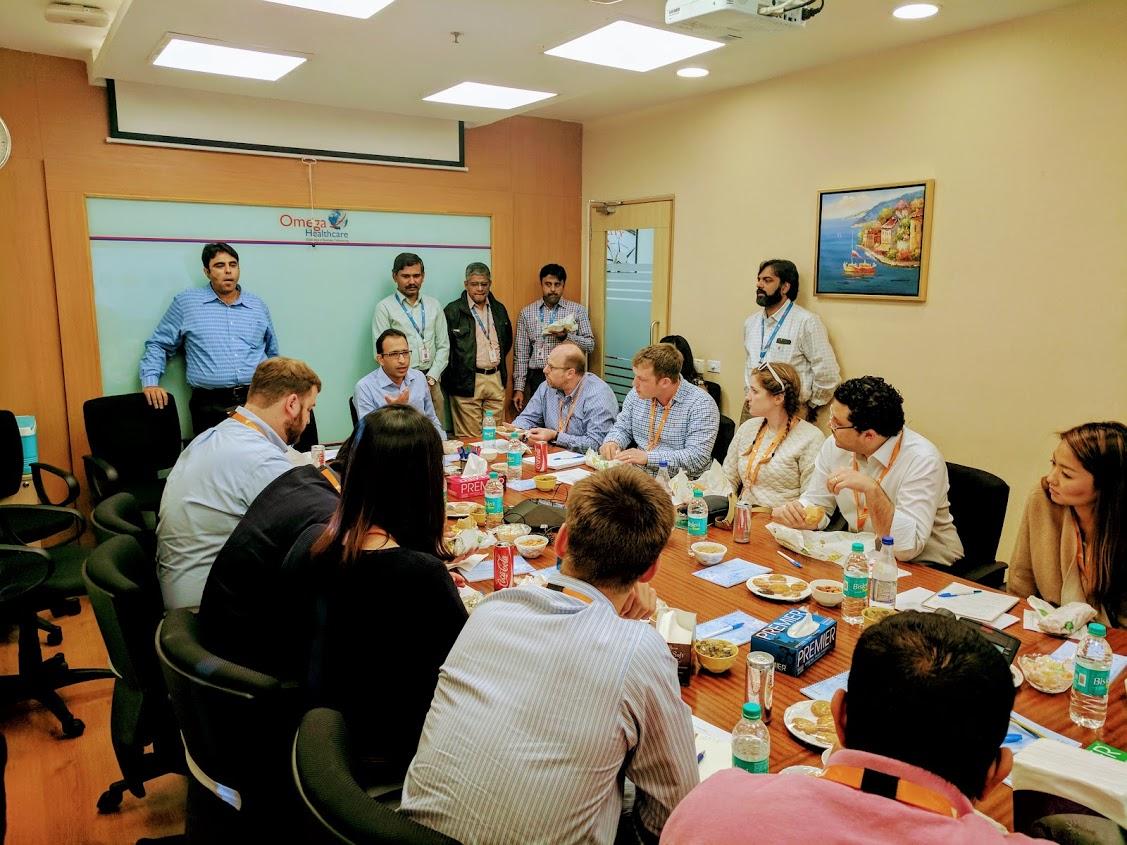
There are drinks on the conference table, notebooks between plates, and rather more people than the room appears to have been designed for. In a photograph from Darden’s 2017 study visit to India, Jitendra Gupta is talking with students about Integra Connect. The setting is wonderfully ordinary. Nobody has arranged the future into a dramatic silhouette. People have come to hear how a business works, and the room looks like a place where work actually happens.
Gupta was already president of global operations at Integra Connect. Years later, when he moved to ConcertAI, his responsibilities at Integra would be described with a number: 3,000 professionals. Technology, operations, analytics and data curation sat within that remit. It is a useful place to begin understanding the current co-founder and CEO of Waterlabs AI. Before his public pitch concerned digital agents, his job involved a very large number of human beings.
Three thousand people, one operating problem
A workforce of that size makes the word “execution” less abstract. Different specialties have to move together. Someone’s output becomes somebody else’s starting point. Decisions made in one function arrive in another as instructions, dependencies or, on an unfortunate afternoon, a queue. The number tells us the scale of Gupta’s responsibility; the mix of functions tells us why simply counting people would never describe the whole job.
This is the operational backdrop to his present interest in automation. His career connects consulting, global delivery, product work and executive management. Read in that order, the move into AI has a recognizable continuity. The tools change, but coordinating people and processes remains central. A demonstration can compress a difficult task into a few pleasing seconds. Running an organization requires the task to work again tomorrow, with the rest of the organization attached.
Engineering, then the business of getting things done
Gupta’s education spans IIT Bombay and the University of Virginia’s Darden School of Business. He earned bachelor’s and master’s degrees in technology at IIT Bombay, followed by an MBA at Darden, where he belongs to the class of 2008. The combination puts engineering and management in the same biography. Neither qualification explains a person by itself, but together they make the later movement between products, consulting and operations easier to follow.
His earlier employers included GE, Deloitte and Optum. At GE, he acquired a Lean and Six Sigma Black Belt certification. His professional biography also credits him with three product patents. Those are concrete pieces of a career that predates the current enthusiasm for AI agents. They place product development and process improvement alongside the executive titles, rather than leaving the impression that his working life began when artificial intelligence became fashionable.
A colleague’s recollection of a Deloitte engagement gives that history some texture. Anuj Kapadia describes Gupta managing several workstreams and a team spread across ten countries, while developing analytical frameworks under a compressed deadline. The striking detail is geographical: ten countries, one engagement. Even before the large operating roles, the work required bringing dispersed contributors into a shared result. A calendar invitation is optimistic enough in one time zone; ten countries give optimism a proper examination.
Another colleague, Bindu Kapoor, emphasizes his attention to detail, analytical ability and commitment to targets without sacrificing delivery quality. These are colleagues’ assessments, rather than a personality diagnosis. Together, however, they offer a consistent picture of the working professional: someone judged on whether a complicated assignment held together. The anecdotes have very little ceremonial glamour. They concern priorities, deadlines and delivery, which is precisely what gives them their value.
The classroom kept reappearing
The 2017 Darden visit brought students into contact with alumni running businesses in India. Gupta’s appearance belonged to that exchange between education and practice. He had left the MBA classroom years earlier; now students were hearing from him as an operating executive. The photograph catches that reversal without requiring a podium. He is part of a discussion around a crowded table, with the mechanics of a real company available for inspection.
In 2019, he appeared in another Darden conversation, this time a Global Innovators Roundtable on artificial intelligence in Asia. His contribution concerned Europe’s contracting workforce and the possibility that AI could fill roles left open as the labor pool shrank. It was a demographic argument about the availability of people. That predates his Waterlabs appointment by several years and shows that his public interest in AI and work has a longer history than his current title.
- 2008Darden MBA
- 2017Integra leadership
- 2023ConcertAI India
- 2025Waterlabs AI
India gets a managing director
In February 2023, ConcertAI announced Gupta as its first managing director of India. The appointment put him on the executive leadership team, with responsibility for expanding India’s role in global operations. His remit brought together data operations, software engineering and product management. The brief also included aligning processes with the company’s financial goals and working culture. It was an organizational assignment as much as a technical one.
The word “first” matters here because the company was giving the India operation a dedicated managing director. For Gupta, the transition followed his global operations presidency at Integra Connect. Both roles required connecting specialized work to a wider business. The title changed, but the recurring task was familiar: make several different functions behave like parts of the same organization. That is less photogenic than a product launch and considerably harder to demonstrate in a short video.
Putting a condition on the invoice
By July 2025, Gupta was introducing himself as Waterlabs AI’s co-founder and CEO. His opening description paired digital agents with human expertise and set out two business objectives: reducing administrative work and accelerating cash flow. The pairing deserves attention. He was describing a company built around automation while retaining a place for people’s knowledge. Coming after his earlier operations roles, that emphasis fits the professional history without requiring a sudden conversion story.
Waterlabs’ leadership includes founder president Kamal Raj and chief revenue officer Daphne Oberlander. Its public presence spans India and the United States; Gupta lists Bengaluru as his base. The arrangement gives his current role a cross-border setting, familiar from earlier chapters of his career. His remit now includes the commercial proposition itself: what the company asks customers to believe, what it offers to deliver, and how those promises are expressed.
In a January 2026 recruitment post, he took aim at AI demonstrations that struggle when deployed in actual workflows. He described Waterlabs’ HIMER platform and an engagement model tied to outcomes. The commercial claim was direct: customers would incur no cost until measurable value had been delivered. That is Gupta’s stated offer, rather than an independently established finding about every customer engagement. Its significance lies in the condition he chose to put in public.
“There is no cost to the client until we deliver measurable value.”
Jitendra Gupta, January 2026
For a reader following his career, the offer brings the earlier chapters into focus. A manager of complex operations becomes a founder selling improvement in those operations, with the invoice attached to a result. It also raises a useful question for any such engagement: what counts as value? Customers and vendors would need to agree on the measurement. The persuasive force of the promise rests on that agreement, rather than on how confidently the software is introduced.
The same post was also a hiring appeal. Gupta was seeking sales professionals based anywhere in the United States, asking for relationships with prospective customers and an ability to sell the platform. It is a revealing combination of messages: a criticism of impressive demonstrations, a statement of commercial terms, and a request for people who can take those terms into the market. The founder’s job includes finding the customers willing to test the argument. Selling the work becomes another part of organizing the work.
The agent still needs an accountable adult
Gupta’s public argument developed another condition in February 2026: governance. Writing about infrastructure and the risks surrounding automation, he argued that oversight should be built into AI from the beginning. He described governance as embedded in Waterlabs’ AI operating system. Again, this was his account of the platform. As a statement of priorities, it adds accountability to the earlier focus on speed, reduced administrative effort and cash flow.
For a business buyer, the two conditions invite different conversations. A measurable result concerns the value of the work completed. Oversight concerns how the work is carried out and who remains answerable for it. Gupta has put both into his public account of Waterlabs. The combination makes his pitch more specific than a general enthusiasm for automation: customers are being asked to consider the commercial arrangement and the operating controls together.
There is a coherent progression across these appearances. In 2017, he was explaining an operating business to students. In 2019, he was considering AI against changes in the workforce. In 2023, he took responsibility for expanding an India operation. In 2025 and 2026, he was making the case for agents inside working processes, then insisting on measurable value and oversight. The through line is the organization around the technology.
Return to the conference table and the biography becomes easier to picture. Plates occupy space that might otherwise hold a laptop. People lean into the conversation. The future, when it eventually arrives, will have to find room among all these existing demands. Gupta’s current proposition asks AI to earn its place there: do useful work, make the result measurable, and keep responsibility in view. The demo can have its applause. The working day still needs to run.