Kunal Vankadara remembers reviewing marketing material “one by one.” It is a small phrase for a large category of work: the patient inspection of things other people have already finished. Somebody writes the promise. Somebody designs the advertisement. Then somebody with legal training has to decide whether the promise survives contact with the small print. Vankadara had spent enough time doing the checking to wonder why so much of it still depended on a person.
The reaction he later described was straightforward: “this should be automated.” From that observation came part of the rationale for Haast, the enterprise compliance company he co-founded with Liam King and Jason Watling. Vankadara is its CEO. The ambition begins with work that rarely gets a launch party: reviewing content, identifying problems and making sure the approved version is the one the world actually sees.
There is a dry joke inside this career change. Legal training teaches a person to notice what could go wrong. Entrepreneurship asks that person to proceed anyway. Vankadara has taken both occupations seriously enough to build a business where they meet.
Economics, law and a solar racing team
Before Haast, there was the Australian National University in Canberra. Vankadara’s education brought together economics and law; the university’s Summer 2020 graduation program lists him for a Bachelor of Economics and a Bachelor of Laws with Honours. The combination suits the problem he would later choose. A compliance decision has rules on one side and consequences for a business on the other. Someone has to understand both.
His university activities were less narrowly legal than the degrees might suggest. From 2016 to 2019, he worked on the business team at ANU Solar Racing. In 2017, he was a senior resident at the university. These are the kinds of entries that disappear beneath a founder’s latest funding announcement, although they make the earlier picture more interesting: a student involved in a technical team’s business work and in the practical responsibilities of university life.
In 2019, he and Brigid Horneman-Wren appeared together in College of Law representatives’ reports. One report recorded students’ concerns about the gap between law-school assessments and working practice. Writing an answer to a problem question, the report observed, did not necessarily translate into writing a useful memo of advice. The point was modest and concrete. Knowing the material and making it useful were separate tasks.
That distinction offers a useful way into his later work. Haast operates in the distance between what a rule says and how people apply it during an ordinary working day. The university report was about education, rather than software, but the practical question is familiar: what happens when the formal process meets the person expected to use it?
The review survived the reviewer
Vankadara’s professional route included Australian government policy work and management consulting, including BCG. His legal background remained central to how he explained the company. Repetitive junior legal work had supplied an experience of the problem from the receiving end. Consulting and policy added different settings in which to see how organizations make decisions, coordinate people and implement requirements.
At Haast, that experience is paired with King’s technical background. King studied mathematics, statistics and advanced machine learning and worked on large IT transformation projects at Deloitte. Watling brought another direct encounter with compliance friction: the founding team’s origin account includes his experience of inefficient reviews during a telecommunications secondment. The founders had met at ANU. Their eventual company combined the legal and operational problem with the technical means to attempt a solution.
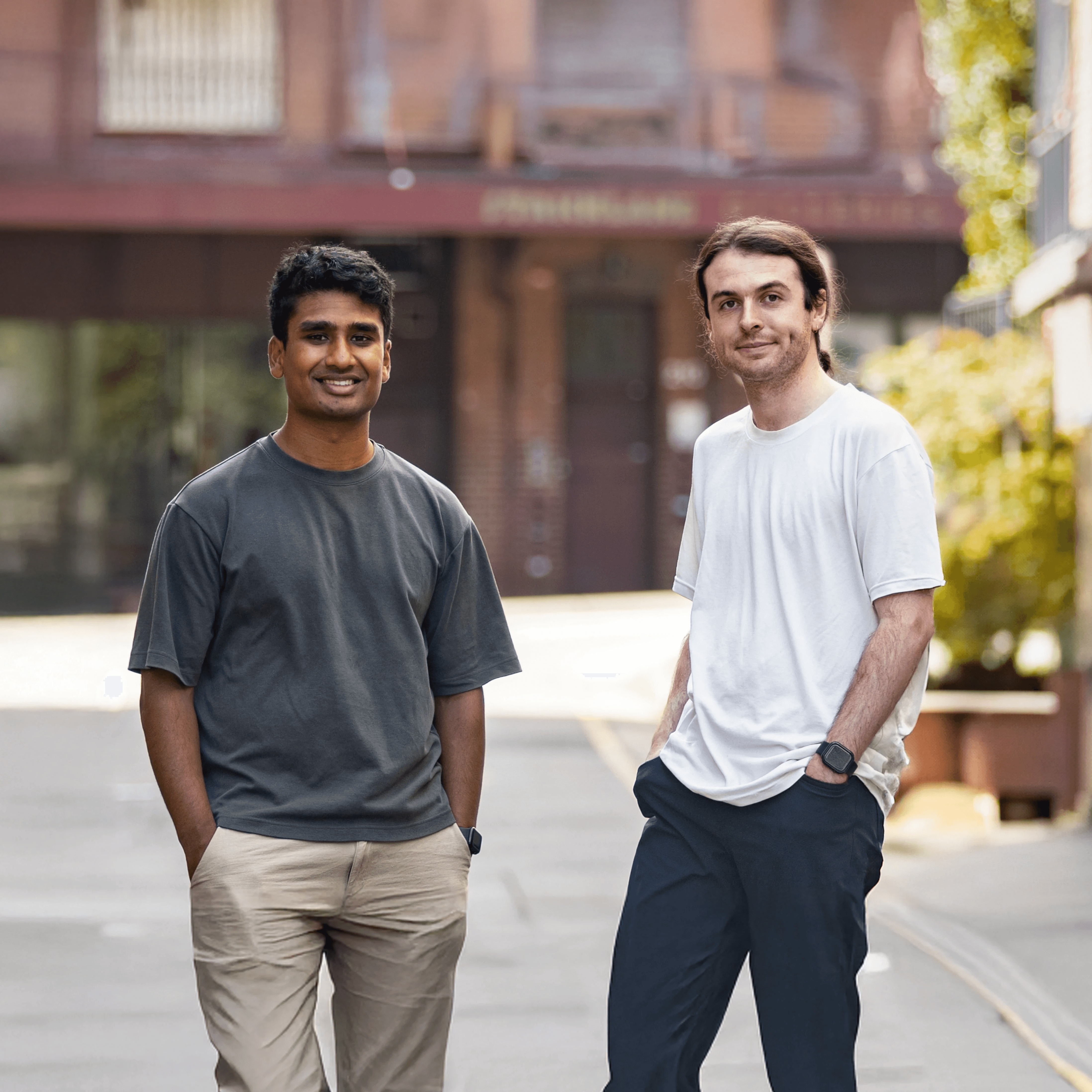
The company’s current account dates its founding to 2023. Its starting territory was marketing and content compliance: work in which a sentence can be attractive, accurate in isolation and still unsuitable for the context in which a business intends to use it. An old offer can remain visible. A distributor can publish an altered version. An approval can become a historical document rather faster than its author expected.
Vankadara’s interest is in that continuing obligation. Creating an asset is a moment; being responsible for it lasts longer. Haast’s stated mission is to remove manual work from this process and release people for more skilled tasks. It is an ambition with an unusually tangible unit of value: a stretch of someone’s afternoon returned.
A pitch with somewhere to go
In February 2024, Haast won the insurtechLIVE pitch contest against four other companies. The prize included a place in an Insurtech Australia delegation to Europe and a mentoring program. For Vankadara, the value was access: an opportunity to get in front of insurers and explain the product without first persuading every prospective buyer to arrange a demonstration.
That is a useful detail in a founder’s story. Enterprise software can address an expensive problem and still struggle to obtain the meeting in which anyone discovers this. A pitch competition compresses the introduction. The speaker has to make the issue recognizable before the audience reaches for its next coffee.
Two months later, Haast won the Australian round of the Zurich Innovation Championship. It would present to executives in Switzerland alongside other local winners. The global competition had drawn more than 3,300 applications. The Australian result placed the company in a setting where people responsible for large insurance operations could examine its proposal.
These were business-development milestones as well as prizes. Vankadara was taking an experience from legal work and putting it before the organizations that might pay to change it. The work now included making the problem legible to strangers, in a few minutes, with enough precision to earn the next conversation.
When the draft gets ahead of the desk
By May 2025, Haast had announced a A$6 million seed round led by Airtree, with participation from defy.vc, Aura Ventures and Black Sheep Capital. Its named customers included Telstra, Zurich Australia & New Zealand, Future Super and Aviva. The money was intended for team growth, product development and expansion into the United States.
The company said its platform could automate up to 80 percent of manual marketing and content review and get compliant content live up to three times faster. Those were Haast’s performance claims, rather than a guarantee for every customer. They describe the problem in the units a buyer would recognize: how much checking remains and how long a campaign waits.
In a June 2026 podcast conversation with Thomas Fox, Vankadara explained why the old arrangement had become harder to sustain. Manual review had been manageable when content arrived in slower campaign cycles. Digital channels, personalization and inexpensive AI-assisted production increased the quantity of material without making each individual check disappear. The bottleneck migrated toward the people expected to approve it.
His argument gives the enthusiasm for content generation an awkward companion. Each additional version may be cheap to produce, but it still says something on the organization’s behalf. A company can acquire a remarkable ability to speak and discover that its ability to check what it is saying has barely changed.
What a company means by careful
Vankadara’s proposed answer depends on an organization teaching the system its appetite for risk. Written requirements are only part of the working problem. Reviewers also apply internal policies and judgment. The useful task for AI, as he describes it, is first-line review that reflects those distinctions, with difficult cases routed to people.
The choice of where the software appears matters, too. In his public discussion of adoption, Vankadara has argued for checks inside existing workflows. Requiring a busy lawyer to remember another interface, formulate a prompt and evaluate an answer adds a task to the day. His test for a prospective tool is rather less theatrical than a polished demonstration.
“The question I’d push teams to ask is: what happens when someone is busy?”
Kunal Vankadara, June 2026
That question treats distraction and workload as design conditions. A process that works only when everyone remembers the extra step has a demanding view of office life. Vankadara wants the review to arrive where the work already happens. The ambition makes the software less conspicuous, while leaving the responsibility for important decisions recognizable.
The distance from Sydney to New York
On April 9, 2026, Haast announced a US$12 million Series A led by Peak XV Partners. DST Global Partners, Airtree, Aura Ventures and Black Sheep Capital also participated. The company identified New York as its headquarters, with additional offices in San Francisco and Sydney. The expansion proposed at the seed stage had become part of its operating geography.
Alongside the round, Haast reported 4.5 times revenue growth over 12 months and zero customer churn. Those figures were the company’s account of its progress. Its stated plans included further product development, scaling automated workflows and expanding its enterprise footprint. Vankadara’s task had broadened from recognizing a repeated chore to building an organization capable of selling, implementing and supporting a system across markets.
By August, his writing on bank marketing returned to the original mismatch. Banks had invested in faster content production while review capacity lagged. He urged organizations to inventory their channels, measure the gap between output and review, and treat turnaround time as a business concern. The CEO’s argument still began with the work on the desk.
There is something appealingly specific about that persistence. Vankadara’s story starts with the person checking the promise, then follows the question of how much of that person’s day needs to be spent checking it again. The funding rounds have grown larger. The geography has widened. The practical ambition remains small enough to recognize: finish the review, make the decision, and have time left for something else.