Every backup business begins with a modest confession: people make mistakes, machines fail, and software cannot be trusted with the only copy. Vijay Krishna has spent his career arranging the second one. Long before the office moved into a browser tab, he worked in the bluntly physical world of storage - RAID systems, servers, original-equipment manufacturers, and the expensive business of keeping information available when a drive did not cooperate.
Krishna now runs SysCloud, the company he founded in 2010. Its software protects data held inside cloud applications, including Google Workspace and Microsoft 365. The machinery changed from arrays of disks to APIs and SaaS dashboards. The worry did not. A deleted account is still deleted. A corrupted file remains inconveniently corrupt. An administrator still needs to know what happened, which policy applied, and whether Tuesday can be put back the way it was on Monday.
This is a founder story with very little costume jewelry. There is no consumer gadget, no velvet-rope launch, no attempt to make backup sound like a lifestyle. Krishna's public vocabulary is made of control, compliance, policies, recovery and reports. It is the language of someone who would prefer the fire extinguisher to work and feels no need for it to trend.
01 / The first machine roomA career with one recurring subject
Krishna studied computer science at the University of Tennessee, Knoxville, from 1992 to 1994. His profile also records a research scholarship and an internship at Cray, a name that evokes the era when computing power looked like furniture and came with its own climate. He later spent 1998 through 2003 at LSI Corporation, working in the company's RAID business and serving the Japanese market.
RAID is an acronym only an engineer could love: redundant array of independent disks. Its larger idea is easier on the ear. Do not let one failure erase the work. Krishna's professional biography credits his years in Japan with more than $50 million in OEM deals. The number matters, but the setting matters more. He learned the technical and commercial sides of resilience at the same time. Reliability had to survive a specification sheet, a sales cycle and a customer's procurement department.
After LSI came a role at the Brocade Offshore Development Center at HCL. Then, in 2007, Krishna founded MasterSys Tech in India. The company provided storage expertise and support. A 2009 agreement made MasterSys a local service partner for Promise Technology, giving customers and resellers in India access to trained engineers and replacement support. Krishna described the point in practical terms: an integrated support experience that would improve service and strengthen customer loyalty.
“Customers want a single pane of glass to backup and secure their data across all cloud applications.”Vijay Krishna, 2014
The phrase “single pane of glass” has endured enough enterprise-software presentations to qualify for a pension. In Krishna's case, it contains the whole product strategy. Customers did not want one policy editor for every application, one report for every vendor, and a scavenger hunt whenever something vanished. They wanted one place to look.
The operating idea
02 / The cloud arrivesThe old problem gets a new address
SysCloud's first public chapter centered on Google Apps, the suite later renamed Google Workspace. Businesses and schools were moving mail and documents out of server closets and into Google's infrastructure. Migration solved one class of maintenance problems, but it encouraged a dangerous bit of optimism. If Google operated the servers, many customers assumed Google also preserved every version of every decision forever.
Krishna built around the gap between platform availability and customer recoverability. The provider keeps its service running. The customer still has to protect against accidental deletion, bad permissions, a removed user, unwanted encryption, or a retention requirement the original application was not designed to meet. SysCloud made copies, then made those copies searchable and restorable.
The company announced a $2.5 million financing round in November 2014 involving Inventus Capital Partners and KAE Capital. The plan was not merely to sell more Google backup. Krishna discussed extending the same control layer to Office 365, Box, Dropbox, Salesforce, NetSuite, Zendesk, ServiceNow, JIRA and Workday. Some of those names changed, consolidated or acquired capital letters in unexpected places. The thesis remained tidy: companies would use more clouds, and administrators would dislike managing each one differently.
That year also brought an institutional milestone. SysCloud announced completion of SOC 1 and SOC 2 examinations. Krishna's explanation was almost austere: clients relied on the company to protect critical information, so stringent procedures and controls mattered. Backup vendors sell trust in an unusually literal container. They hold the copy a customer needs precisely when the original cannot be trusted.
03 / The quiet expansionFrom a copy to a control system
Once a backup exists, customers inevitably ask it to do more. Can it reveal who shared a document? Can it preserve records for a legal hold? Can it expose a compliance gap? Can it spot an unusual change before the problem spreads? The second copy becomes a useful vantage point because it contains history, and history is where anomalies become visible.
SysCloud's product expanded along that logic. Backup and restore remained the foundation. Around it came security monitoring, data-loss controls, audit tools, retention policies, eDiscovery and ransomware recovery. The supported application shelf widened beyond Google's suite to Microsoft 365 and other business SaaS products. Krishna's early promise of consistent controls became more relevant with every new subscription an IT department adopted.
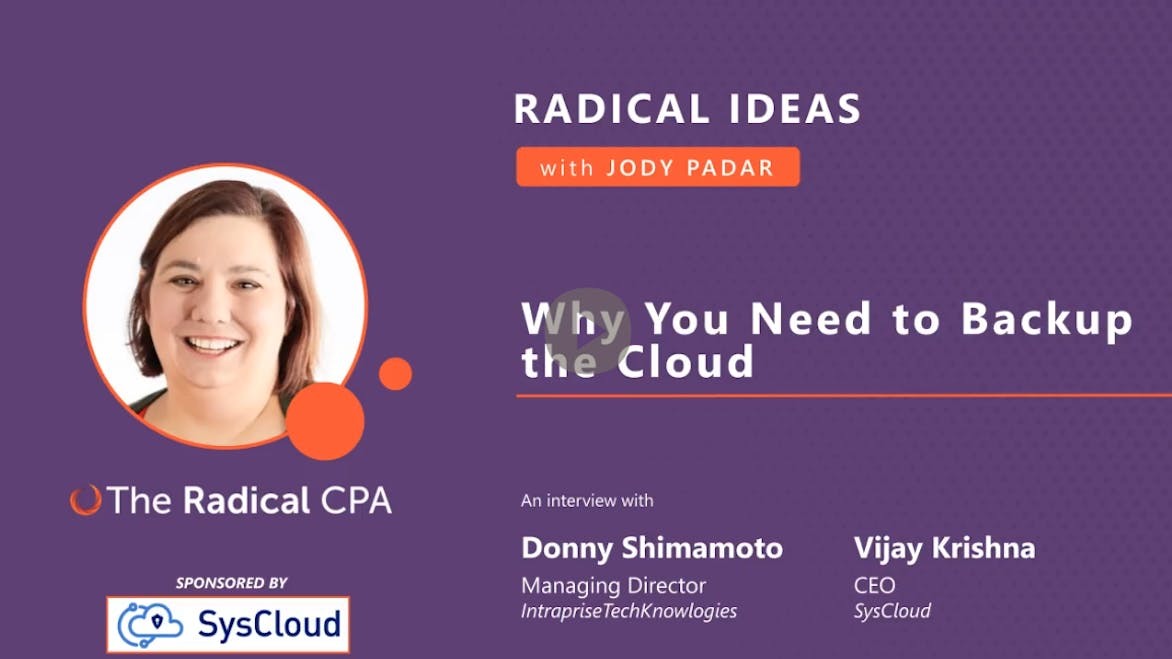
The 2025 conversation with accounting technology leaders made the shared-responsibility problem unusually concrete. An accounting firm can conduct its business in cloud applications and still need a separate plan for the information inside them. Moving the ledger into SaaS removes a server from the office. It does not remove the firm's obligation to retain and recover client work.
“SysCloud considers the Europe region a key future market for our continued growth.”Vijay Krishna, 2024
04 / The operating patternWhat a builder can borrow
Krishna's path offers a useful lesson because it is built on continuity rather than reinvention. He did not abandon storage when the market moved to cloud software. He translated its obligation. The disk array became an API integration. The replacement drive became a point-in-time restore. The list of protected assets grew from blocks and volumes to messages, documents, calendars and application records.
The first borrowable move is to follow a failure mode across technology shifts. Products age quickly; a deleted file remains persuasive. The second is to begin with a narrow platform and learn the unpleasant edges. Backup is full of them: permissions, version histories, identity changes, retention windows, throttled APIs, and the tense minutes when a customer discovers that “restore” is a verb with several meanings.
The third is to keep the control surface stable while the integrations multiply. This is harder than its diagram suggests. Every SaaS vendor models users and data differently. A unified dashboard must respect those differences without turning into a museum of vendor-specific switches. Krishna's “single pane” phrase is less about visual neatness than operational economy. One team can learn one recovery habit.
Finally, there is value in choosing a problem whose importance rises quietly. SaaS adoption adds convenience one application at a time. It also scatters an organization's memory one application at a time. The backup bill can look optional right up to the moment it looks obvious. This gives the category a sober sales motion: explain the responsibility, prove the restore, and remain available.
05 / The next geographyEurope and the long promise
In 2024, Krishna called Europe an important future market for SysCloud. The company had established data centers in the United Kingdom and Germany, positioning its service around regional data protection and compliance expectations. This was another version of the same translation work: a general promise, adapted to local rules and infrastructure.
His public record does not dwell on private life or founder mythology. It is unusually work-shaped. Computer science. Storage. Backup. Disaster recovery. A service company, then a software company. Quotes about controls. Articles about permissions and retention. Even his appearance in a webinar is built around a question that would ruin a lively dinner party and improve an audit: who is responsible for the cloud data?
That narrowness is revealing. Krishna has stayed with the problem long enough to watch storage leave the building, applications leave the desktop, and business records distribute themselves across a collection of browser tabs. SysCloud is his answer to the resulting mess: keep another copy, make it intelligible, and place recovery behind one door.
There will always be more fashionable corners of software. Backup has the social life of a smoke detector. Nobody invites it to perform. Everyone is pleased when it works. Krishna's career suggests that an infrastructure founder can build patiently by respecting this bargain. The product may sit behind the work, but the promise is visible whenever the work disappears.