Victor Guardiola has a shelf problem. His drink is sparkling, made with fruit juice, and rooted in Mexican agua fresca. A buyer might put it beside sparkling water, soda, or products gathered under a Hispanic label. Each decision changes the neighbors, the competition, and the explanation a stranger needs before reaching for a can. Before Guardiola can sell the drink, he sometimes has to sell the idea that it belongs in the room.
He has been working on that explanation since college. Today he is the Austin-based co-founder and CEO of Bawi Agua Fresca, a company whose cans carry Spanish names and illustrations drawn from Mexican visual culture. In September 2026, he described the business's position as a “Goldilocks Zone.” Consumers had helped settle the question: they were treating Bawi as an alternative to soda. The shelf was teaching the founder how to describe his own invention.
It is a useful place to begin with Guardiola because his story is full of supposedly settled categories that proved negotiable. Who gets into a university. Who gets a meeting with an investor. Which flavors can travel beyond the audience presumed to own them. His career so far has involved walking up to these little administrative borders and asking somebody to move the rope.
A year to get to Austin
Born in Monterrey, Mexico, Guardiola moved to Texas as a small child and grew up in Portland, near Corpus Christi. Austin eventually became the destination, although the University of Texas was initially out of reach. His high school grades did not secure admission. The route he chose was community college, with a one-year agreement with his father: transfer into UT or return home to South Texas.
He earned the grades and made the transfer. At Moody College of Communication, he studied public relations; he graduated in 2020. A degree in explaining things would prove rather practical for someone planning to introduce a drink that retail buyers could not immediately file away.
In a later account of those student years, he emphasized consumer psychology and the relationship between a brand and its audience. The questions were concrete. What does the customer recognize? What makes an unfamiliar product worth trying? A food and beverage entrepreneurship practicum, led by Marissa Epstein, gave him a setting in which to test a business rather than merely admire the idea of one.
Jordan Hicks, a friend and eventual co-founder, proposed bottled agua fresca. Guardiola brought the concept into the class. The work required research into consumers and the market, making the pair examine assumptions they might otherwise have carried straight into an expensive mistake. There is a certain mercy in discovering that an idea needs changing while the assignment is still due on Friday.
The equipment was on sale
The partnership had a prehistory. Before Bawi, Guardiola and Hicks tried building websites for food truck owners through a small marketing venture. It did not go far. Later, Hicks worked at Kate's Real Food while Guardiola was trying to launch caffeinated mints. Their common interest was becoming a livelihood in consumer products; the particular product was still under discussion.
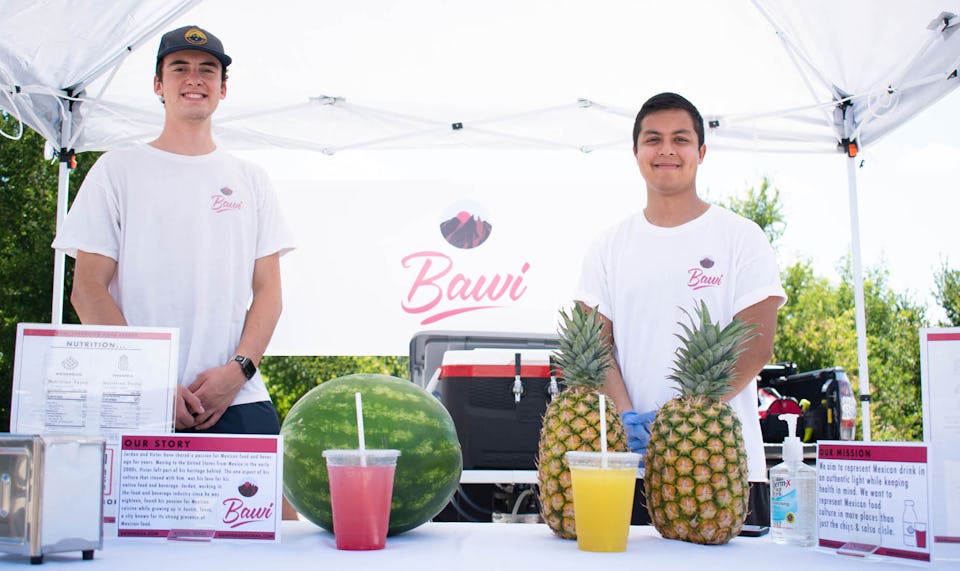
They began experimenting with ready-to-drink agua fresca in the summer of 2019. An early piece of equipment was a small SodaStream bought at a Bed Bath & Beyond liquidation sale. A national beverage business can begin with rather domestic machinery. At that stage, a machine's chief qualification is that its owner can afford it.
They eventually had to make two things work together: the taste people remembered and the sparkling format they were developing. During their 2022 design conversation, the founders described a project that was taking shape through repeated experiments, alongside the much larger task of giving the drink an identity. The expensive version of the business was still ahead. First came the version that could be tested.
At farmers markets, customers supplied something no pitch deck could: a decision involving their own money. Guardiola has returned to that point when discussing the early company. Selling a drink provides a different kind of answer from asking a friend whether an idea sounds promising. Encouragement is plentiful. Repeat purchases require an actual thirst.
A can that speaks two languages
Guardiola's cultural argument is easy to see on the packaging. La Piña. El Limón. La Maracuyá. La Guayaba. The names are allowed to remain Spanish, even when the intended customer may never have ordered an agua fresca before. The invitation is in the fruit, the color, and the drink itself.
The Working Assembly developed the visual identity with references to Mexican street art and fruit stands. Lotería, the illustrated card game, helped inform the packaging and custom artwork. English and Spanish appear together. The result gives a shopper several ways into the product without requiring Guardiola to translate his upbringing into something anonymous.
“The bold flavors are nostalgic for me, and delicious for all.”
Victor Guardiola, 2022
That sentence gets at his commercial ambition. Familiarity for one customer can be discovery for another. A culture need not become everybody's childhood to become something people enjoy. The company's early website even offered Spanglish alongside English and Spanish, treating the movement between languages as an everyday pleasure.
The design work reached beyond the label to the website and shopping experience. Bawi received BevNET's 2022 packaging recognition. For Guardiola, the can was already doing part of the explanatory work he would later describe to other founders: giving an unfamiliar offering enough clarity and character to earn a first look.
The first check had to come from somewhere
The look could travel faster than the business could afford to. Commercial production required capital, and Guardiola did not begin with a circle of friends and relatives ready to fund it. In his June 2026 account, he recalled spending a year pitching to raise the initial $150,000. A drink could be persuasive at a market stand and still leave its maker far from financing a production run.
His early backers included Austin restaurant operators Patrick Terry of P. Terry's and Mike Rypka of Torchy's Tacos. These were people who understood selling food and drink. Their involvement mattered as money and as a signal to other prospective investors. A new founder's problem is often getting somebody credible to be first.
In interviews with retailer Bristol Farms, the founders explained that Bawi's funding relationships grew through cold emails and introductions. Their advice to other entrepreneurs was correspondingly practical: start building relationships early, learn from experienced operators, and establish the financial foundations of the business. Even a very handsome can eventually needs an accountant.
By November 2024, Bawi had secured a $3.5 million seed round led by Brand Foundry Ventures, with Rocanā Ventures, Amity Supply, and other investors participating. The money was intended for operations, sales, and hiring. The change in scale was considerable, but the uses were ordinary: people, production, and the ability to get the product into more hands.
More places, closer together
The first commercial production run arrived in April 2022. By the time Guardiola and Hicks appeared on Good Intention in October 2023, the conversation included reaching retailers such as Sprouts. The work had changed from proving that people would buy the drink to learning how to keep it moving through stores.
In August 2026, Guardiola described Bawi as available in 44 states while concentrating its efforts in Texas and California. Those two statements can coexist. Distribution tells you where a product can be found; concentration tells you where a small team is putting its effort. More pins on a map do not automatically make a stronger business.
Food service became central to the plan. The drink could accompany a meal or work as a mixer, giving restaurants and cafés several reasons to carry it. Guardiola described examining the accounts where Bawi sold particularly well, then using that evidence to decide where to focus. Expansion became a matter of repeating something that was already working.
A bigger business, year by year
The figures make the change tangible. In June 2026, Guardiola reported sales of $370,000 in 2024 and $1.2 million in 2025. He also described a $4 million target for 2026. That June, Bawi also closed a $6 million funding round. Capital raised and drinks sold are different measures, but together they show how far the enterprise had moved from a market stall.
Somebody else needs the introduction
Recognition arrived along the way. The co-founders were included in Forbes' 2025 North American 30 Under 30 list for food and drink. Guardiola's public response dwelled on his family and on what the recognition might mean to people from similar backgrounds. He wanted such accomplishments to feel more ordinary for the people coming after him.
He has made advising other founders part of his work, offering help with fundraising, market strategy, and consequential business decisions. His personal website includes accounts from entrepreneurs he has supported, including founders of Carne Shabu, Pistakio, and Stitch Lab. The recurring subjects are introductions, clearer plans, and confidence about taking the next step.
There is also a quieter version of Guardiola outside the business. Asked about childhood memories, he chose riding bikes around Portland, fishing with his father, and spending time outdoors. He described wanting more time away from screens. For someone whose career has depended on sending messages, that is an understandable ambition.
Meanwhile, the shelf question persists. It asks how much of himself Guardiola must explain before a buyer sees the opportunity. His answer has become more precise with every market, meeting, and order. Keep the Spanish. Learn where customers reach. Make the next conversation easier. There are still cans to move.