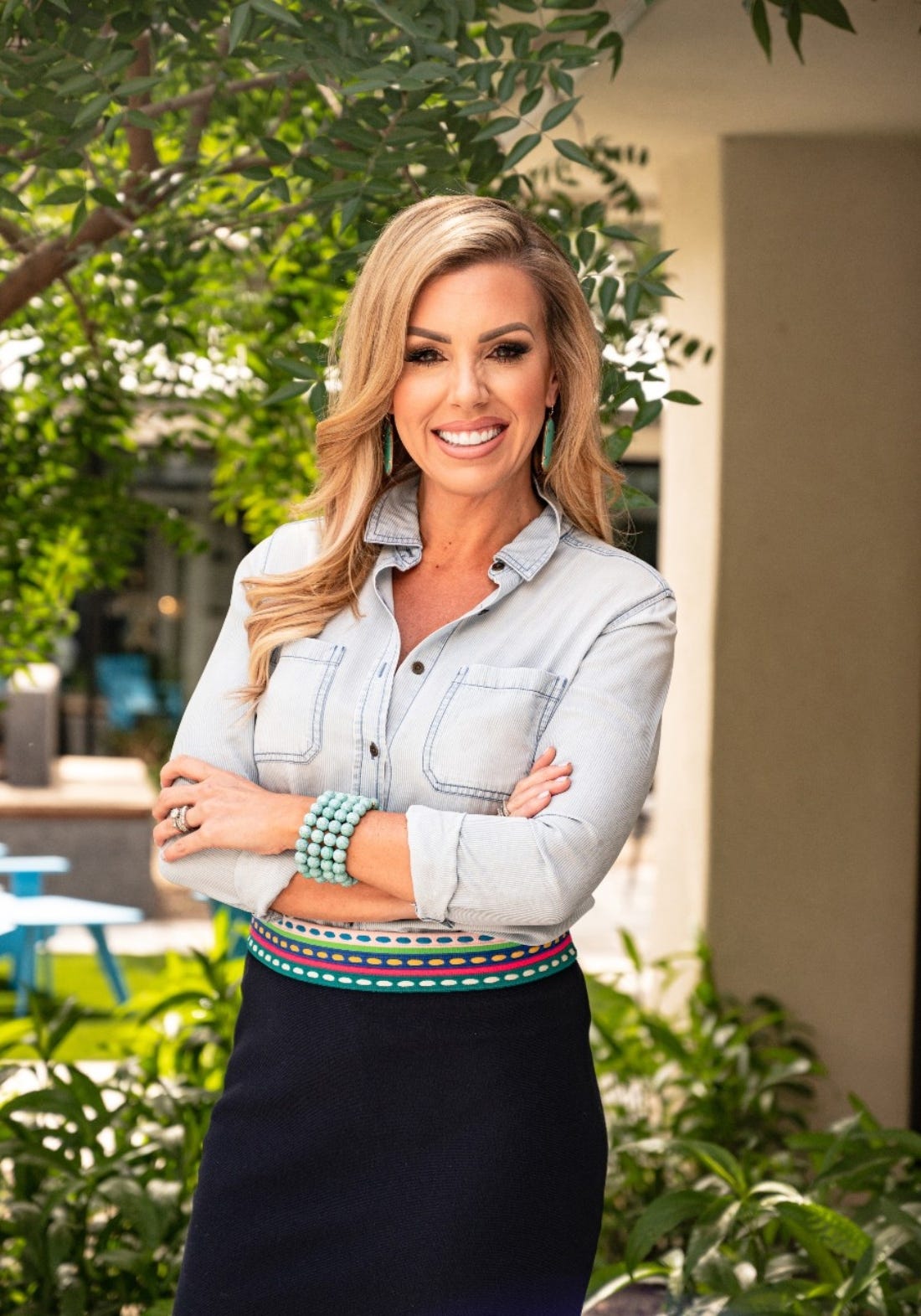
Before Veronique James built an agency, she built the appearance of one. The office was her living room. The staff was Veronique James. When the phone rang, she occasionally answered in a different voice, playing receptionist before transferring the call to herself. The British accent was especially convincing until a client from London happened to be on the other end.
It is a funny memory now, and useful because it punctures the smooth mythology that collects around a twenty-year company. The James Agency began in Scottsdale in 2005 without a grand launch or a suite of departments. It began with freelance graphic design at night and on weekends, work James took during a bruising personal reset. The bills were immediate. The business plan was not.
James had left a short marriage carrying roughly $250,000 in debt. She had also left behind her home, car and dogs. After finding an inexpensive place to rent, she sent an email saying she needed furniture. Within a day, friends had emptied useful pieces from their storage units and filled the rooms. Years later, she spoke of the gesture as a kind of contract: if other people believed in her, she owed their belief a serious effort.
“I measure my life on moments more than I do things.”Veronique James
The architect who missed the art
James was born and raised in San Diego and arrived at the University of Arizona intending to study architecture. The attraction made sense. She liked math and problem-solving, the tidy side of making things stand up. A year into the program, she missed creative freedom and switched to visual communications. That choice supplied the central tension of her career: she is a designer who likes the numbers, a brainstormer who reads the operating statement.
After earning her BFA, she joined a small, female-led agency in Scottsdale. With only a handful of colleagues, disciplines overlapped. She could watch how the whole shop worked instead of polishing one narrow skill. A larger hospitality-focused firm followed, bringing bigger budgets and four- and five-star travel clients. It also showed her the drag created by a rigid hierarchy and a corrosive workplace. She learned agency craft in the first job and collected a vivid list of things not to reproduce in the second.
Meanwhile, her freelance work was outrunning her salary as an art director. Independence first appeared not as a lifestyle accessory, but as the practical route through a stack of obligations. The James Agency was born when that route became more convincing than the day job. There is something refreshingly unromantic about it. Necessity handed a visual communicator a balance sheet and asked her to become an operator.
Five turns in a twenty-year build
- 2005A living-room design practice becomes The James Agency.
- 2016James opens the P&L to her leadership team.
- 2020A 62% net revenue loss tests every promise.
- 2023Stratagem formalizes an insights-first model.
- 2024-25Inc. recognizes both growth and workplace culture.
The courage to show the P&L
By 2016, the one-woman shop had become a multimillion-dollar company with the ordinary complications of growth: more people, more overhead, more ways for a good month to be misunderstood. James felt the weight of the enterprise collecting on her desk. An entrepreneur friend asked a disarming question. What shame was there in showing the leadership team a clean balance sheet and the full profit-and-loss statement?
She was frightened that disclosure might produce judgment or demands. Instead, a two-hour, line-by-line working session produced context. Leaders could see how staffing, utilization, timing and expenses connected. James could see responsibility moving outward from the founder's chair. The executive team now reviews the full P&L monthly, while the wider agency gets a rolled-up view each quarter. Financial literacy became part of the job, not a private language spoken above it.
Transparency, translated into practice
This is the less photogenic version of company culture. It has no scooter, no snack wall, no flattering natural light. Yet it explains the endurance of James's senior group better than decorative perks can. In a 2025 interview, she noted that one leader had been with the firm for 19 years, another for 13 and another nearly 14. Tenure is not proof of perfection. It is evidence that the relationship has survived more than a recruiting pitch.
Thirty minutes, sixty-two percent
In early 2020, The James Agency celebrated its fifteenth anniversary by taking the team on a cruise to Mexico. Within weeks of their return, the hospitality, food, beverage, entertainment and destination clients at the center of its portfolio were in free fall. Cancellations and pauses arrived by email, text and phone in a single rush. James has said the agency lost 62 percent of net revenue in less than a day.
For a moment, James lay on the floor at home and thought the business was finished. Advice arrived quickly: cut most of the staff, furlough the rest, protect the core. She looked at the recommendation from the other end. If she dismantled the team, what exactly would remain when clients returned?
The agency kept its staff. People moved into roles that matched the work available. Sales intensified, the client mix broadened, and every recurring expense faced inspection. James called one exercise the “10% Project”: hunt through subscriptions, software seats and small habitual costs until the P&L could breathe again. Cash flow was tracked day by day. Each Friday, employees received a scorecard covering cash, client departures, client wins and the next decisions.
The firm finished the year about $100,000 in the red, a narrow landing beside the hole that had opened in March. More important to James, it landed with the team intact. The open books she had once feared became useful in extremis. Employees did not need a cheerful fiction. They needed coordinates.
“There is always a way.”Veronique James
Insights before decoration
The crisis changed the agency's portfolio and sharpened its method. Clients no longer trusted old assumptions about their audiences. James pushed the firm deeper into research and strategy, asking who people were now, how they gathered information, which channels could reach them and what those choices might return. In 2023, the agency formalized that emphasis in an expanded model called Stratagem. In late 2025, it carried the idea further by recasting the firm as a marketing consultancy, with production serving strategy instead of standing in for it.
The evolution sounds less like a departure than the adult version of James's architecture dilemma. Creative freedom remains, but the foundation must carry weight. Campaigns begin with evidence; brand instinct has to meet channel cost. Her favorite question is “What if?” Her next questions tend to involve the audience, the mechanism and the price.
Recognition accumulated along the way. James was named to Phoenix Business Journal's 40 Under 40 class in 2014 and its Most Admired Leaders list the following year. Az Business included her among Arizona's Most Influential Women in 2015. The James Agency appeared on the Inc. 5000 in 2015, 2018 and 2024, and earned Inc. Best Workplaces recognition in 2024 and 2025. The chronology is useful, but James tends to redirect individual honors toward the team. It is consistent with a founder who learned early that an empty room can become livable overnight when other people start carrying chairs.
The memory inside the machine
The agency now works from a larger Scottsdale footprint and gives employees some at-home flexibility while preserving office collaboration. Its lease runs through June 2028. James has spoken about buying a building after that and expanding again. The old architecture ambition has not entirely left the premises.
She also wants to protect what she calls the agency's authentic voice. That phrase is cheap in advertising and expensive in practice. In James's case, it seems to mean a combination of casual manner, exacting work, visible numbers and institutional memory. Her more recent talks have taken that argument into the age of AI: use the machine for speed, but keep discernment, positioning and human judgment in the room. Do not forget the friends with the furniture. Do not forget the colleagues who heard the first-generation iPhone on speaker from inside a bowl. Do not pretend the bad hour did not happen. Do not confuse a perk with trust.
The earliest Veronique James had to sound bigger than she was. The current one appears more interested in making the business legible to the people inside it. That is the quieter transformation: from one person doing every job to a founder willing to let everyone see how the jobs add up. The accent was temporary. The candor stayed.