The phone needs somewhere to sit. A stand will do. So will a case with a kickstand. College Board even permits a clear glass cup. For a student taking a CLEP exam at home, this modest piece of furniture has acquired an unusual responsibility: holding the second camera that helps show the person, keyboard and computer screen throughout the test.
It is a small detail with a large ambition behind it. Verificient, the company operating Proctortrack, wants institutions to trust a qualification earned beyond the exam hall. To do that, it turns an ordinary room into something more regulated. The journey to a testing center disappears. A new set of obligations arrives on the desk.
- The job: verify people and monitor remote sessions.
- The products: Proctortrack for exams; RemoteDesk for workforce security.
- The trade: less travel, more setup, cameras and scrutiny.
01 The identity check that would not end
A login answers a narrow question: did someone present the right credentials? An exam sponsor has a longer question. Was the authorized candidate present for the whole assessment, following its rules? Verificient sells software and services for that interval between entry and exit.
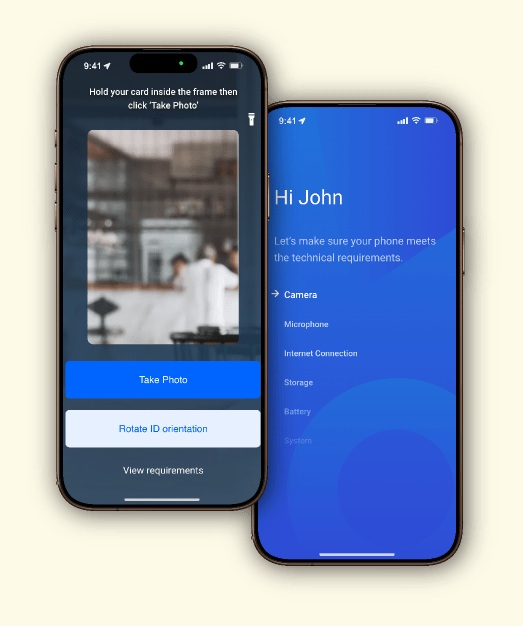
Its toolkit combines biometrics, computer vision and machine learning. Veripass creates a baseline identity profile using face and ID scans. Information collected during exams can then be checked against that profile. Customers can use Veripass alongside Proctortrack or separately. Identity verification is therefore a component that can travel between workflows.
The founders bring different backgrounds to that work. Rajnish Kumar leads research, development and product design. Rahul Siddharth handles operations, branding and strategy; his biography includes advertising and an MFA from Parsons. Verificient joined the inaugural Kaplan EdTech Accelerator in 2013, putting its early technology inside a network built around education.


02 A phone becomes part of the furniture
CLEP makes the proposition concrete. College Board says its remote exams use a human proctor and retain the timing, content and format of the test-center version. Verificient provides the identity verification and remote supervision. It does not award the credit or distribute the scores.
College Board lists a $30 remote proctoring fee, additional to the exam fee, with an exception for DANTES-funded candidates. That is a program-specific consumer price, rather than a price list for Verificient’s entire business. Schools and enterprise buyers encounter a sales-led service with different levels of supervision.
CLEP remote proctoring fee.
Separate from the exam fee.
The preparation is substantial. Current remote CLEP requirements specify a Windows 10 or 11 PC, administrative permissions and a private room. They exclude Macs and Chromebooks. A smartphone supplies the second camera. These are CLEP’s requirements, not universal restrictions on every Proctortrack deployment.
College Board’s instructions specify the second-camera app for exams beginning July 1, 2025. The extra angle reveals the practical logic: a webcam pointed at a face leaves much of the desk outside its view. Remote convenience still needs a carefully arranged physical space.
03 The human returns to the loop
Verificient’s range runs from browser lockdown through automated monitoring to human-reviewed and live services. ProctorDIY lets instructors conduct live proctoring themselves; ProctorTA addresses classroom testing. The choice lets a buyer match supervision to the assessment instead of treating a quiz and a professional certification as identical problems.
That range also complicates the old promise of “proctorless” testing. In April 2025, Proctortrack’s own writing argued that automated systems can miss nuance and that human-only supervision is expensive and difficult to scale. Its proposed answer was a blend: software identifies moments for people to review.
For an institution, that makes service design part of the purchase. A browser lock restricts the testing environment; a live proctor adds someone who can intervene. Neither description alone establishes how an assessment will feel to the candidate or how much work an instructor will inherit afterward.
This is the useful distinction for a buyer comparing Proctortrack with alternatives such as Proctorio, Respondus Monitor or ProctorU. The question is who reviews an event, under which rules, and how a student can challenge an interpretation. A software flag needs a decision process around it.
04 The guard needed guarding
In October 2020, Verificient confronted a failure in its own perimeter. Its incident FAQ acknowledged unauthorized access to an automated testing server and announced a suspension affecting Proctortrack, RemoteDesk and Verificient accounts while it assessed the impact.
The company described firewall upgrades, stronger access controls and outside forensic assistance. Subsequent reporting on the resumption of service relayed Verificient’s statement that user data had not been exposed. That statement belongs to the company; the initial FAQ documented an investigation still underway.
“Your data privacy is our responsibility.”Verificient’s stated accountability value
There are two audiences for this promise. The institution chooses the service, while the student supplies the room, device and personal information. A workable implementation has to explain the rules to both. Otherwise, even an assessment that is technically secure can become an exercise in confusion before the first question appears.
The episode exposes a dependency every remote institution inherits: when supervision stops, an assessment may stop with it. Verificient’s March 2025 privacy policy also identifies the sponsor as data controller and Verificient as processor. The school’s agreement and rules belong in the purchasing conversation alongside the detection features.
05 The same question, another market
RemoteDesk carries continuous identity assurance into distributed work, alongside insider-risk monitoring, data protection and compliance tools. The commercial logic is easy to follow. An employer handling sensitive information also needs confidence about who remains behind the screen after login.
Proctortrack’s current site reports more than 15 million identity verification and monitoring sessions, with reach across 150-plus countries. Those are company-reported sessions, not unique users. Its integrations with systems including Canvas, Moodle and Blackboard place supervision inside tools institutions already use.
The 2021 Edsby partnership took that integration strategy into Canadian K-12 education. It illustrates a second route to market: reach institutions through the learning platform they already use. For a teacher, another vendor matters less when it fits the existing course.
The transferable lesson is practical: find another setting with the same underlying identity problem. For customers, the lesson is equally concrete. Rehearse onboarding, establish review procedures and check the actual equipment requirements before committing an exam. A private room, compatible hardware and an acceptable monitoring arrangement are part of whether this service works. So, occasionally, is a glass cup.
Open another window
PRODUCTS, PEOPLE & FURTHER READING