For six years, the American team at Telit Cinterion had used the same tool to answer security questionnaires. They had filled it with information, learned its habits, and built a working routine around it. Then Itzik Menashe, the company’s acting CISO and global IT productivity executive, proposed trying Vendict. The team’s reluctance was understandable. Changing software can mean doing yesterday’s work all over again.
- Vendict drafts security answers from company documents, with evidence attached.
- Its customers include Telit Cinterion, Aidoc, Orca Security and Similarweb.
- The same document analysis now supports buyer-facing Trust Centers and managed vendor assessments.
Telit’s problem was becoming visible at quarter-end. Sales wanted to close deals; security faced a pile of urgent questions. The existing tool still demanded manual input and training, and struggled with unfamiliar wording. Familiarity had become expensive. In Vendict’s published account, Menashe offered a controlled proof of concept. Upload the existing repositories. Try the work. Decide afterward.
Six years of habit, seven days of doubt
After a week, the skeptics returned with an automotive comparison. The new software, they said, was a Ferrari. This is a customer testimonial published by the vendor, with all the selectivity that implies. Still, the experiment has an appealing shape: people protective of their old system tested a replacement on material they already understood.
“Vendict is like a compliance Ferrari - it has speed, power, and precision.”
Itzik Menasche · Telit Cinterion, in Vendict’s case study
The lesson is useful far beyond compliance. A team’s resistance may be a sensible objection to migration costs. Telit’s trial reduced that uncertainty by using its existing documents, rather than demanding a fresh library of manually written question-and-answer pairs. The result changed the team’s mind. The spreadsheet had finally met a credible challenger.
The answer was already in the building
Vendict’s starting observation is almost embarrassingly ordinary. A business asked about access controls, encryption or disaster recovery may already have documented those practices. Yet a specialist must locate the right passage, interpret a buyer’s wording, and enter an answer in the required format. Repetition disguises itself as expertise because the person doing it needs expertise.
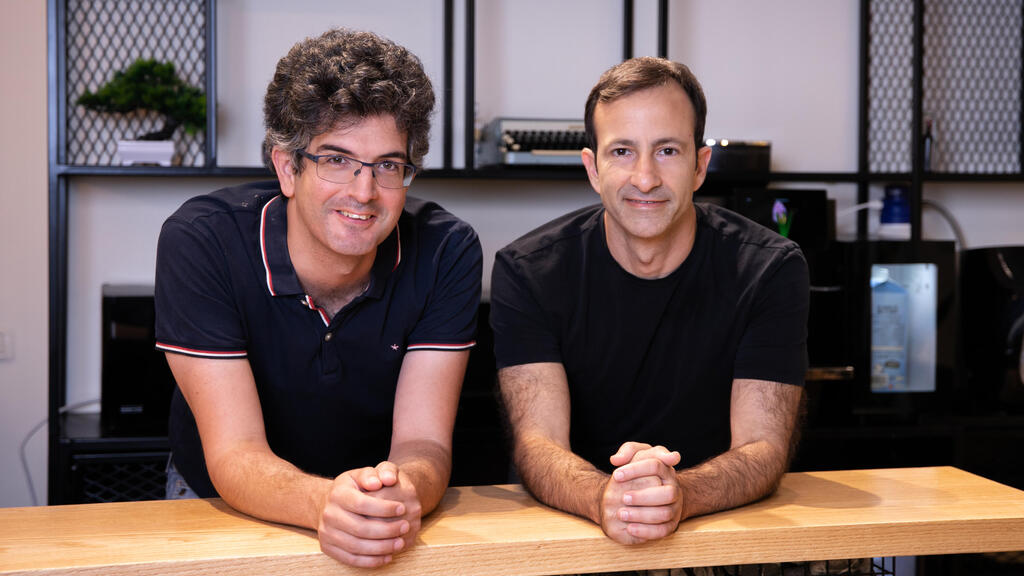
Co-founders Udi Cohen, CEO, and Michael Keslassy, CTO, built a company around that translation problem. Vendict emerged from stealth in July 2023, disclosing $9.5 million in funding. Its early pitch focused on linguistic generative AI for security and compliance teams. The raw material was organizational knowledge; the intended output was an answer another organization could examine.
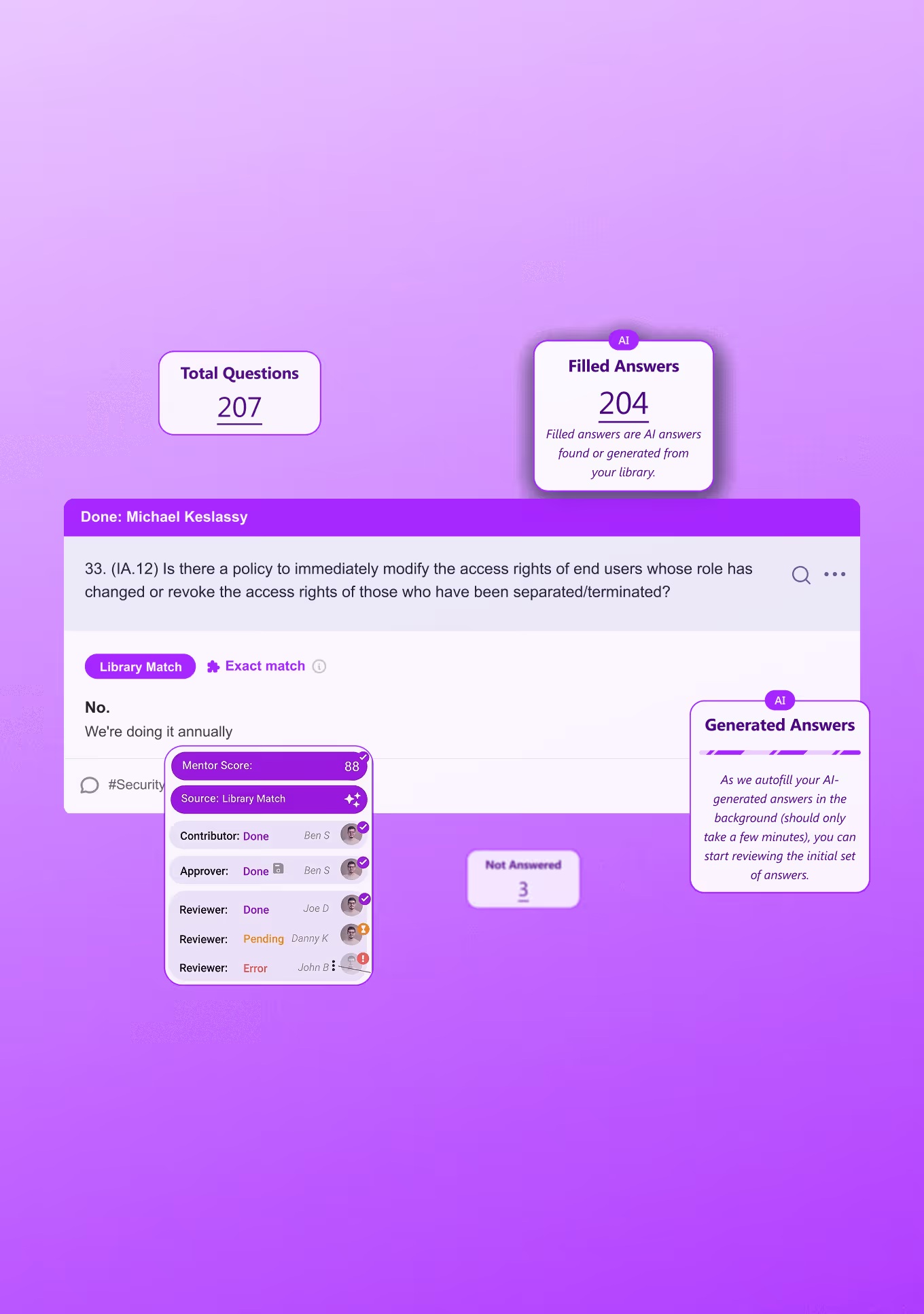
Today, questionnaire automation takes policies, audit reports and other uploaded documentation into a knowledge base. It generates responses linked to supporting evidence, with review and approval workflows. GRC Mentor adds contextual guidance and framework benchmarking. Self-Assessment maps documentation against requirements to expose gaps. RFP and RFI automation applies the approach to proposal work.
The important distinction is between producing a plausible sentence and producing a defensible response. Vendict markets its AI as “hallucination-free.” That is the company’s claim. For a buyer, the practical test is whether each consequential statement has adequate evidence and survives review. A confident answer cannot repair a missing control.
- 01Company evidencePolicies, reports, documentation
- 02AI interpretationQuestion matched to relevant material
- 03Referenced draftAnswer connected to its evidence
- 04Review and approvalA person owns the response
The questionnaire has two owners
There is an asymmetry in the original problem. The seller wants to answer quickly. The buyer wants to understand the risk of giving that seller access to systems or data. Faster prose alone does not reconcile those interests. Both sides need to work from evidence.
Vendict’s Interactive Trust Center brings the seller’s security documentation into a controlled, buyer-facing workspace. February 2026 enhancements let prospects upload questionnaires directly. Vendors can offer AI-generated or human-reviewed responses; generated answers use documents explicitly shared with that prospect. Permissions matter as much as speed. A security review is a peculiar place to be generous with confidential files.
On the purchasing side, Vendict’s third-party risk tools analyze vendor documentation and manage assessments. In April 2026, the company announced Managed TPRM, combining AI agents with GRC specialists to execute assessments. Customers receive platform visibility while Vendict takes on the operational work. The offering addresses a different constraint: a team may need completed reviews more urgently than another tool to administer.
This direction was present at the launch. Cohen’s 2023 statement imagined eliminating questionnaires by generating assessments from sellers’ documents and vendor criticality. The newer service makes that ambition concrete. It also reveals the breadth of Vendict’s market: security assurance sits between sales, procurement, risk management and compliance.
Buy the workload, measure the result
The customer numbers are tempting. Aidoc’s case study reports a 92% reduction in questionnaire completion time. Orca Security’s reports more than 70%. These are vendor-published customer outcomes, rather than a forecast for every deployment. Their useful implication is narrower: repetitive document work can consume enough specialist time to merit a deliberate experiment.
Vendict sells subscriptions and customized managed engagements. Its questionnaire tiers count monthly questionnaires and knowledge libraries, with unlimited seats. Trust Center tiers count profiles and buyer-domain access. Managed pricing depends on vendor mix, assessment frequency, monitoring and workflows. Procurement therefore starts with the workload, followed by a quote and a test of what the team actually saves.
The alternatives are real. HyperComply also combines AI questionnaire automation, human reviewers and trust pages. Manual spreadsheets remain cheap to begin and costly to maintain. Vendict’s pitch joins document-based answers, framework analysis and vendor-risk execution. Its $10 million Series A, announced in August 2025, supplied capital for that broader ambition.
The experiment worth copying is Telit’s. Bring a difficult questionnaire, current evidence and skeptical reviewers. Measure the time to an approved response, not the time to the first draft. Check unsupported answers and permission boundaries. Stale policies, contradictory documents or absent controls still demand human work; framework mapping cannot confer certification. A smaller queue is valuable only if the answers deserve to leave it.