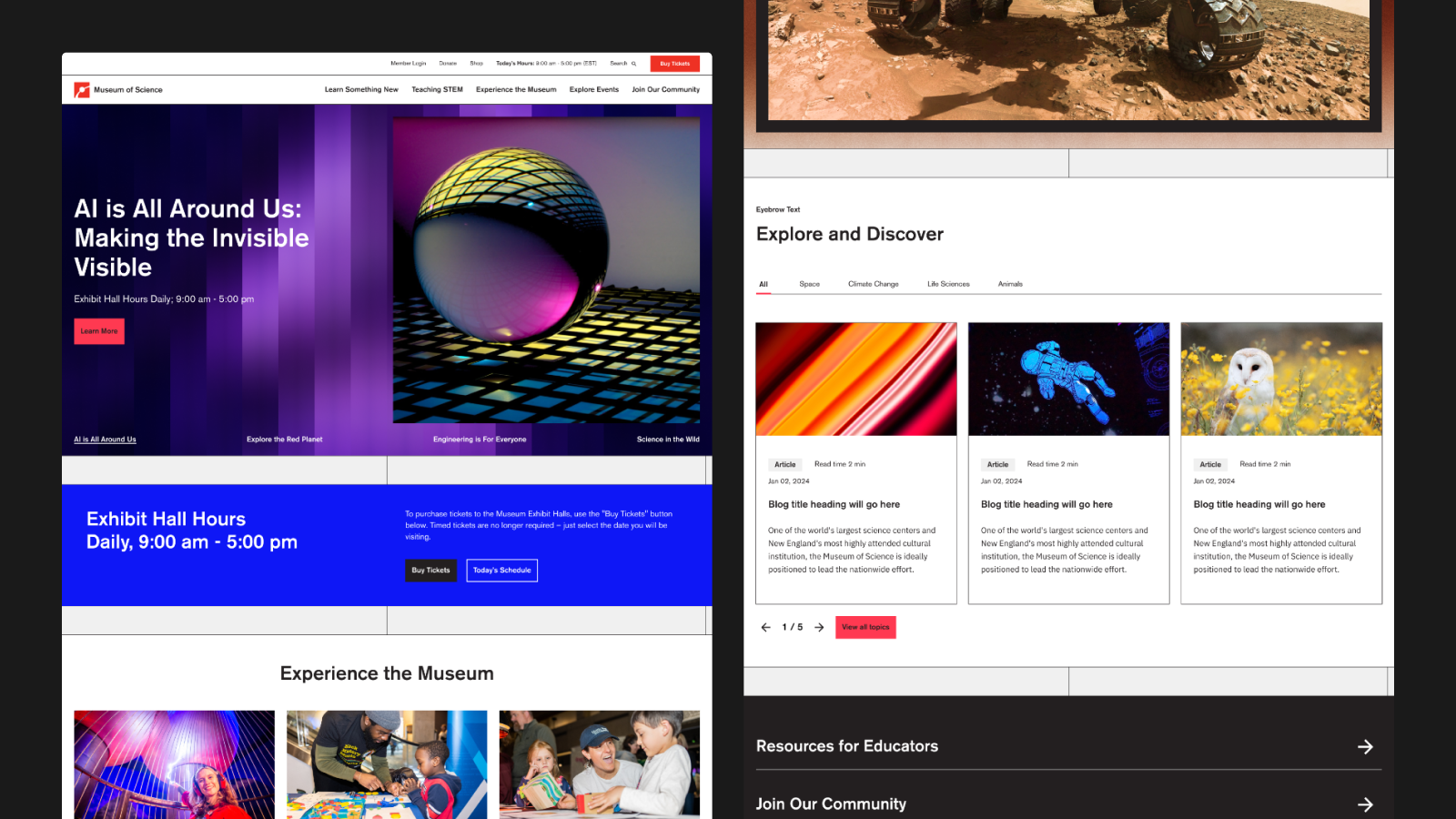
At the Museum of Science in Boston, the people responsible for publishing scientific content had a distinctly unscientific problem. Their website had accumulated years of patchwork updates. Hundreds of templates and modules were difficult to change. Sometimes, developers had to post content themselves. An institution hoping to reach audiences far beyond its building was struggling with the machinery of putting a page online.
- Velir connects website design, marketing and data engineering.
- Its clients include museums, associations, nonprofits and commercial brands.
- The repeatable lesson: fix publishing and data connections before adding complexity.
Velir’s response included a Drupal 10 website, a reusable component library and drag-and-drop page building. Content authors could assemble pages without asking developers to construct each one. The project reduced the site to seven custom modules. Velir reports that accessibility issues fell 94%. The intriguing detail is the redistribution of work: editors gained control over things editors should be able to do.
A foundation, an apartment, a very long relationship
That concern with information reaching people runs back to Velir’s beginnings. Mark Gregor founded the company in 2000. Its first client, the Annie E. Casey Foundation, wanted to bring its KIDS COUNT Data Book online. The material concerned children’s health and well-being. Making it usable meant helping an audience understand evidence that could inform public decisions.
In a twentieth-anniversary recollection, Gregor remembered hiring two people in his Cambridge apartment. He also recalled the less romantic side of starting a technology business: “I had nightmares of debugging errors in the early days.” The foundation remains a client more than two decades later, according to Velir’s company history.
Today, Velir sells professional services across experience design, platform engineering, digital marketing, analytics and support. Think of an organization whose website must serve several audiences while drawing information from several systems. A university, membership association or financial institution can recognize that situation immediately. So can the person responsible for keeping its content current.
The data was there. The connection wasn’t.
Hyland, the enterprise software company, illustrates another version of the problem. It collected information about prospective customers’ companies, industries and locations. Yet its website struggled to turn that information into relevant content. Possessing a useful customer record and acting on it were separate accomplishments.
Velir connected Hyland’s Twilio Segment customer data platform with Sitecore XP. Information could flow into Sitecore’s Experience Database, where marketers could use it to tailor content and calls to action. The visible result might be a different banner. The consequential work was making the visitor’s context available to the system deciding what to display.
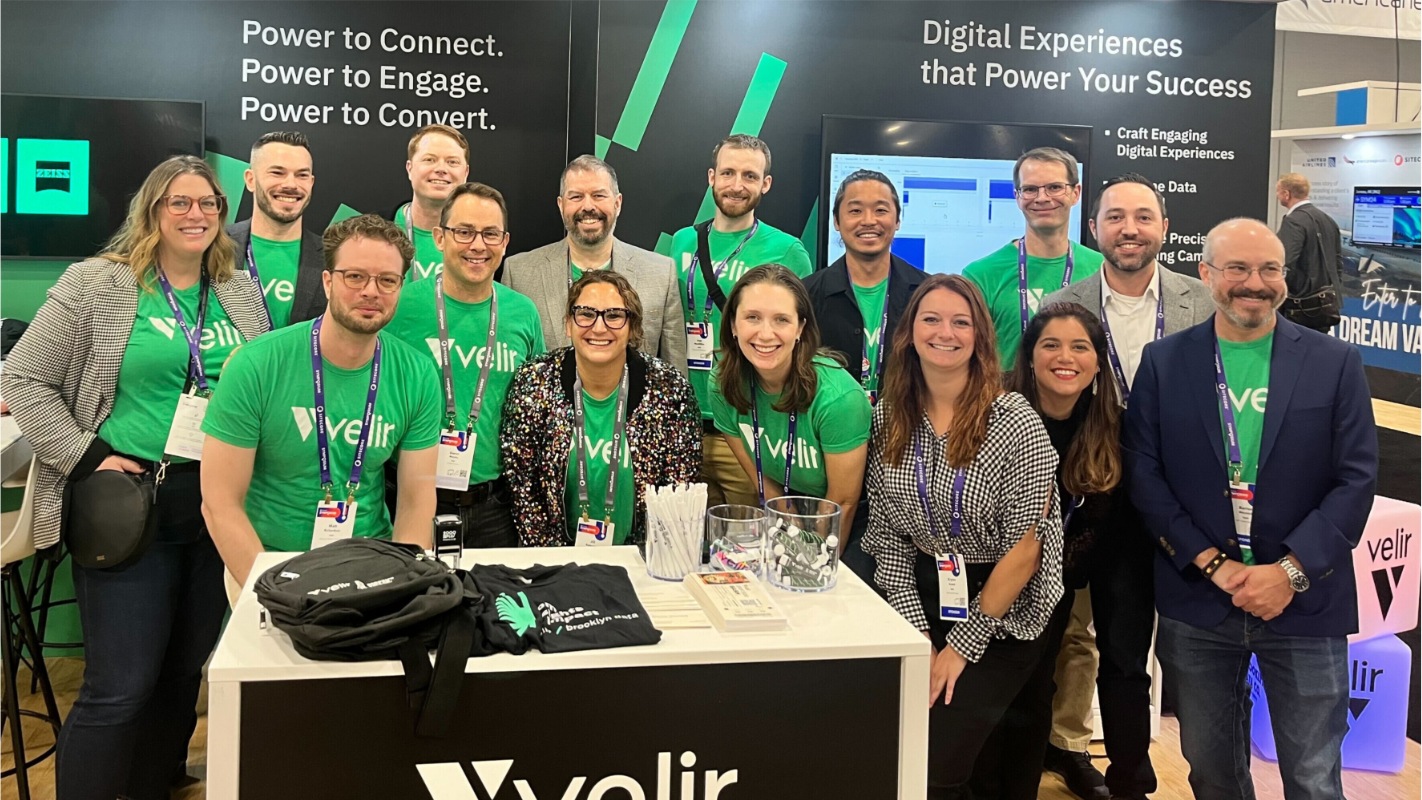
That helps explain Velir’s 2023 acquisition of Brooklyn Data, now its in-house data studio. The deal brought data engineering and analytics closer to the people building customer experiences. Stella Point Capital’s earlier equity investment, announced in January 2021, had identified data integration, personalization and acquisitions as priorities.
This combination defines Velir’s pitch in a crowded agency market. A design consultancy can rethink the interface; a data consultancy can organize the records. Velir offers both under one roof, alongside implementation and continuing operations. Its partner roster spans Sitecore, Acquia, Optimizely, Adobe, Snowflake and dbt Labs. The attraction is fewer handoffs between specialties, provided those specialties actually collaborate.
The sensible thing to postpone
At the Urban Land Institute, Velir initially narrowed the scope of Knowledge Finder, its member content site, to launch a minimum viable product. Basic personalization arrived first. More ambitious recommendations waited. After launch, the teams developed a plan around Sitecore, Coveo search and ULI’s account management system.
The later features used different kinds of evidence. Recommended Content drew on browsing patterns. For You combined members’ declared interests with topics and recent material. Newsletters reused the interest-based logic, with rules to avoid repeating recommendations in successive editions. This was a sequence of specific editorial and engineering decisions.
Velir reports 147,000 personalization impressions in 2023. Members exposed to at least five personalizations had longer sessions and higher lifetime value than those exposed to fewer. Those comparisons describe associations between behavior and outcomes; they do not establish that personalization alone caused the difference. Engaged members may also encounter more recommendations because they visit more often.
Launch something people can use. Learn from it. Earn the next layer of complexity.An editorial takeaway from the ULI project
The business after launch
Suncoast Credit Union shows how the relationship can continue. Velir redesigned its site, integrated its blog, introduced personalization and built an Express Lane for frequently used services. Editors could place ten financial calculators on pages. Following launch, Suncoast moved to Velir’s managed services team for 24/7 support and further roadmap planning.
Velir’s case-study figures. Separate measures; no controlled attribution is presented.
The commercial logic is straightforward: project work can lead to continuing support and optimization. Velir also packages repeatable engineering work into accelerators. Horizon, built for SitecoreAI, includes more than 40 configurable components and six core page types. Its advertised $250,000-plus of built-in project value is a vendor value claim, rather than a purchase price.
There is a practical purchasing question underneath all of this. Who will operate the experience once the project team leaves? A component library needs editors who understand it. A recommendation engine needs useful content to recommend. A dashboard needs someone willing to change a decision after looking at it. Buyers can use those questions to make a brief more precise before choosing an agency or platform. They also make ongoing support easier to judge: the point is to help the client keep doing useful work, with fewer recurring obstacles and a clearer view of what happens next.
The company keeps extending that position. Wendy Karlyn was named CEO in June 2025. Velir announced Optimizely Platinum status that September, a Sitecore Velocity partnership in January 2026 and Vercel certification in June. These credentials help describe its technical relationships. A buyer should still examine work resembling their own problem.
The approach makes sense when publishing, customer data and integrations create continuing friction. It asks for people who own the content, maintain the data and can measure change. For a straightforward brochure site, that machinery may be excessive. The useful idea to copy is smaller: find the task that repeatedly gets stuck, then change the system that keeps making it difficult.