On June 9, 2021, Vedavyas Avula had a question for a technical forum. His team was trying to connect IBM DataPower with Microsoft messaging. Had anyone done it before? The client wanted to keep Microsoft MQ. That preference set the terms of the problem: whatever came next had to accommodate something already there.
It was an ordinary predicament in enterprise technology. Companies accumulate systems for good reasons, and those systems do not all grow up speaking the same language. An architect inherits the introductions. Somewhere between the business requirement and the working connection, a tidy diagram acquires several inconvenient details.
Avula asked for help. Other practitioners offered suggestions. On July 6, he returned with a result: the team had written a VB.NET program to read and write Microsoft messages, exposed it through an API and used a DataPower gateway endpoint. He also reported that AMQP 1.0 had worked with RabbitMQ.
The return visit is a pleasing detail. Internet discussions have a habit of ending just before the useful part. Avula came back to close the loop.
“Neil, want to conclude the thread.”
Vedavyas Avula · July 2021
The education of an integration architect
Avula, also known publicly as Wade, is the founder and CEO of Pragma Edge. His route into that role ran through programming and architecture. He worked as a programmer analyst at iSoft Plc from 2002 to 2004. His professional history then places him at Miracle Software Systems, with a role described as VP SSG and lead architect beginning in July 2004.
Those titles locate him close to the machinery. Integration architecture involves decisions about what connects, how information changes along the way and what happens when the expected exchange fails. A business can describe the outcome in one sentence. Making the systems agree on that sentence can take rather longer.
His education includes the University of Madras, and he lists information technology studies at SriRam Engineering College between 1998 and 2002. By the time he contributed to an IBM Redbooks publication, his professional biography described a consultant specializing in business process management and service-oriented architecture.
The book, Business Process Management: Modeling through Monitoring Using WebSphere V6.0.2 Products, appeared in 2007. Avula shared authorship with Ueli Wahli, Hannah Macleod, Mohamed Saeed and Anders Vinther. Even its title followed the work beyond the initial design: model a process, implement it and observe what actually happens.
It makes a useful early marker in his career. Years before enterprise AI entered his public vocabulary, he was working on the relationship between a business process and the software expected to carry it out.
The scope of that work matters. A process model describes the intended sequence. Monitoring concerns the sequence that actually took place. Between them sit implementation decisions, exceptions and the possibility that a technically successful step has left the larger task unfinished. Avula’s early authorship placed him across those stages, rather than at a single point in the exchange.
coauthor
founded
keynote speaker
A company in the handoffs
Pragma Edge was founded in 2013. In April 2023, the company marked its tenth anniversary. For Avula, the business created an organizational home for work that had already occupied much of his technical career: connecting enterprise systems and making their exchanges manageable.
The company is based in Jacksonville, Florida. Its present focus includes integration and AI automation, spanning business applications, partner networks and operational workflows. That territory rewards attention to the unglamorous junctions. A message must arrive in a useful form. An exception needs an owner. The team supporting the system needs to understand what the implementation team has left behind.
Pragma Edge describes its work through people, process, technology and partners. The sequence is helpful. Buying software does not settle who will approve a change, investigate a failed exchange or explain a delay to a customer. Those responsibilities travel with the technology.
Avula’s public career continued to combine technical participation with a wider company role. In 2023, he was named in the IBM Champions class. That May, Pragma Edge announced him and principal architect Alok Sudhakar as keynote speakers for its Sterling Data Gateway gathering in Orlando, with a session on architecture spanning EDI, managed file transfer and APIs.
The file has arrived. Has the work?
One way to understand Avula’s professional territory is to follow a file. Its arrival is a technical event. The business may still be waiting for transformation, application acceptance or a response. Each system can report on its own part while the person waiting for the result remains unsure whether the whole transaction is complete.
Pragma Edge’s IANN FileGPS is designed to correlate files, events and integration milestones across that journey. Its capabilities include tracking expected activity and detecting missing steps. An absent event matters because silence can conceal a stalled process just as effectively as an explicit error.
The distinction is easy to appreciate without becoming an integration specialist. A parcel marked dispatched has not necessarily reached the kitchen table. Enterprise transactions have their own equivalents of the gap between a cheerful notification and an empty doorstep.
FileGPS gives the company’s work a concrete shape: connect the evidence, relate it to the business commitment and help the responsible team investigate. Success has to be defined far enough downstream to mean something to the person who asked for the exchange.
sends a file↓Gateway
receives it↓Application
processes it↓Business
confirms completion
The next partner needs a way in
A second product, Community Manager, approaches the exchange from the other end. Before a trading partner can send anything useful, someone must collect requirements, configure the connection, test the documents and agree that the arrangement is ready for production. A commercial agreement is only the start of that introduction.
Community Manager supports a repeatable partner lifecycle on IBM Sterling B2B Integrator, including self-service and certification. It also addresses changes after the initial connection: contacts move, certificates expire and requirements evolve. The relationship has administrative weather.
For Avula’s company, this puts a product around work that otherwise risks becoming a fresh coordination exercise each time. Reusable workflows give routine steps a common path while leaving room for the particular requirements of a partner.
There is an appealing modesty to the problem itself. A business wants its next partner to become operational. The software has to help several people agree on what that means, then preserve enough of the arrangement for future changes to be handled sensibly.
For a founder working in this field, the product and the service are closely related. The product supplies a repeatable mechanism; implementation establishes how it fits the particular organization. A certificate reminder has to reach someone who can act. A test result needs an agreed interpretation. Even a well-organized onboarding sequence eventually meets a person with a question. The practical value sits in how those encounters are handled.
Giving AI a specific assignment
Avula’s stated interest in generative AI fits this operational setting. In a watsonx.ai technology-preview testimonial, he described plans to assist business analysts with trading-partner setup and transaction management, and to reduce the daily support required around data gateways. The proposed work included platform management and Pragma Edge tools such as FileGPS and Jarvis.
The language was prospective. It described what the company wanted to explore with IBM watsonx.ai and Sterling Data Exchange. The interesting feature is the specificity of the assignment: there were already tasks, systems and users in view.
That gives the AI ambition a connection to Avula’s earlier architecture work. A business analyst configuring a partner needs information about the actual exchange. A support team checking a transaction needs context about the systems it crossed. Assistance becomes useful when it can engage with those particulars.
The same testimonial identifies Avula as founder and CTO. By Think 2026, IBM was presenting him as founder and CEO. Across those public descriptions, the technical subject matter remains recognizable: the everyday operation of enterprise connections, now with another set of tools to consider.
Trust, with a working definition
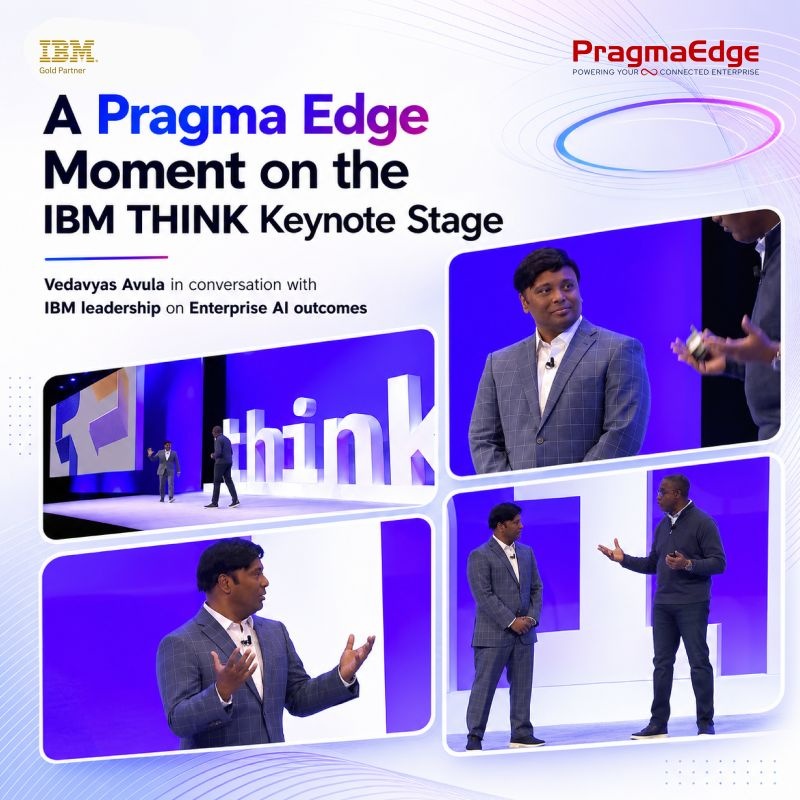
At Think 2026, Avula appeared in the partner keynote, The Power of the Ecosystem: Turning AI Potential into Enterprise-Grade Client Impact. The speaker lineup included IBM leaders Kareem Yusuf and Arvind Krishna, alongside executives from Nexar and TD SYNNEX and analyst Patrick Moorhead.
Avula’s contribution centered on trust. He connected delivering appropriate customer solutions with a change in how Pragma Edge and IBM approached joint account planning. Partnership, in that account, had practical consequences for coordinating work and matching opportunities.
“Once we built the trust and delivered the right solutions for the customer”
Vedavyas Avula · IBM Think 2026, excerpt
It is a useful working definition for a word that can otherwise float away in a conference hall. Trust supports the next shared piece of business because somebody has seen how the previous work was handled. The relationship carries a memory.
Read alongside his technical work, the comment gives Avula’s story a consistent scale. Customer delivery comes first in his explanation of the relationship. The planning grows from that experience. It is a sequence an architect would recognize: establish a connection that works, understand its behavior and decide what it can support next.
There had been another company milestone the previous year: Pragma Edge announced its selection as the 2025 IBM Partner Plus North America geography winner for modernization. The recognition belonged to the company and its partnership work. Avula’s appearance on the following year’s stage gave that relationship a public voice.
Still, the smaller scene from 2021 remains worth keeping beside the conference photograph. A client had a system it wanted to retain. An architect asked a question. Peers contributed. The team built a connection, and Avula returned to explain the result. The stage has grown; the old thread still supplies a rather good test of what happened next.