Consider the last few millimetres of a vaccine’s journey. Before them come the laboratories, the trials, the factory and the refrigerated shipment. Then someone rolls up a sleeve. Vaxxas has built a company around the proposition that this final handoff deserves its own engineering department. The question sounds small: where, exactly, should the vaccine go? The answer could change what happens much earlier in the journey.
- Dry-coated vaccine, delivered to immune cells beneath the skin.
- A platform for vaccine partners, with human trial experience.
- Patch vaccines remain investigational, including proposed home use.
The address is the idea
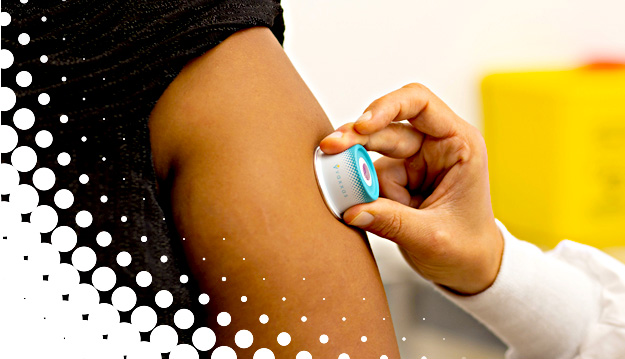
A conventional intramuscular injection takes vaccine into muscle. Vaxxas’s high-density microarray patch, or HD-MAP, targets the immune-rich tissue immediately beneath the skin’s surface. Thousands of short projections carry dried vaccine on their tips. An applicator puts them to work. There is something pleasingly literal about this: bring the material closer to the cells you want to notice it.
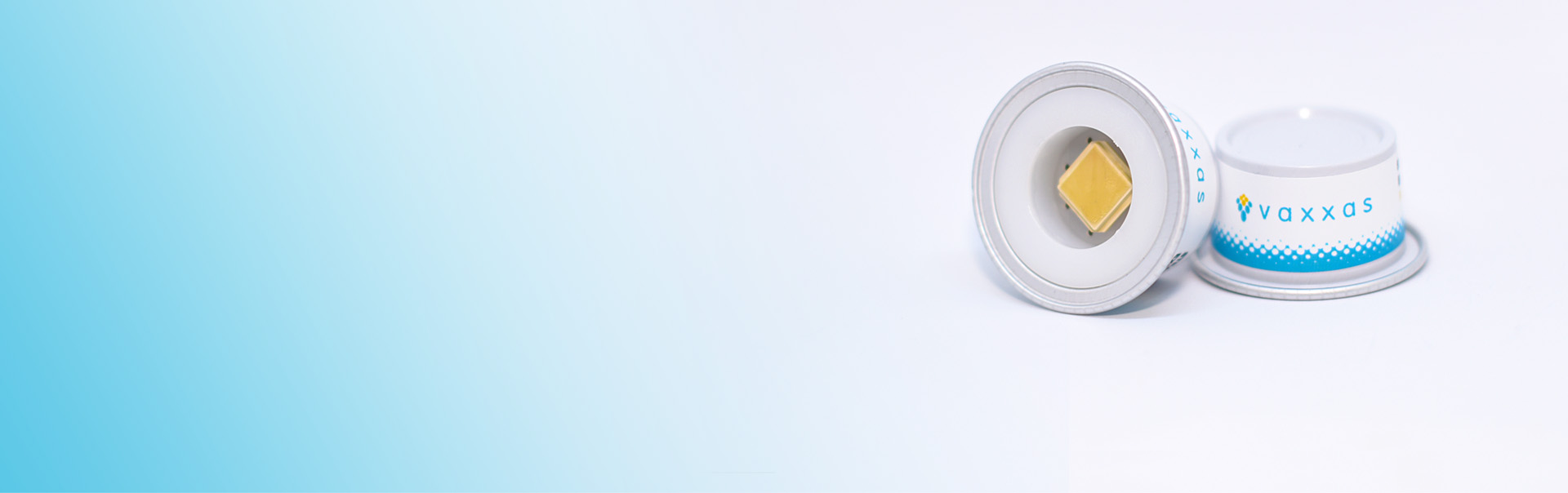
The projections are approximately 0.25 millimetres long. The current platform uses injection-moulded patches and an integrated, single-use applicator. Making that sound simple requires ignoring the hard bits: preserving the vaccine during drying, coating tiny tips under sterile conditions and delivering a reproducible dose. Each is a product-development problem hiding inside an object that fits between fingers.
One-sixth is a question worth asking
In a Phase I influenza study published in 2020, researchers tested lower antigen doses delivered by patch against an injected comparator. A patch dose containing 2.5 micrograms produced measured antibody titres not significantly different from those following a 15-microgram intramuscular dose. That is one-sixth of the antigen. It is also an early study, with small groups, measuring immune responses rather than proving equal protection against illness.
Similar measured antibody titres at these doses. This graphic compares antigen quantities, not clinical protection.
The commercial attraction is easy to see. If a particular vaccine works at a lower dose, a supply of antigen might stretch further. But a successful result for one formulation does not write the instructions for every other vaccine. Dose savings have to be earned again, product by product.
Another published Phase I study examined measles and rubella vaccination in 63 healthy adults. That matters because a platform needs evidence beyond a single disease. It also illustrates why the audience matters: results in adults do not automatically establish performance in infants, who would be central to many routine immunisation programs. Each new population adds questions about dosing, tolerability and how the device will actually be used.
The refrigerator comes along for the ride
Drying changes another part of the equation: storage. Liquid vaccine formulations can impose demanding temperature requirements. A patch that tolerates warmer conditions could make distribution easier, particularly where reliable refrigeration is difficult. The important word is “could”. Thermostability belongs to a particular formulation under particular conditions, rather than to every vaccine that happens to touch a patch.
In January 2025, Vaxxas reported preclinical mRNA work showing stability for at least 12 months at refrigerator and room temperatures, and at least a month at 40°C. CEPI supported progression of the program, involving SK bioscience’s Japanese encephalitis mRNA candidate. These were development findings, including animal work. They make a case for more research, not a shopping list for a pharmacy.
The invention needed a factory
The story began in Mark Kendall’s University of Queensland laboratory. Vaxxas launched in 2011 to commercialise the technology then known as Nanopatch, backed by A$15 million from a venture syndicate. University invention and industrial product are different assignments. Years of studies, formulation work and engineering sit between them.
In June 2023, Vaxxas opened a 5,500-square-metre biomedical facility in Brisbane. In December 2025, Australia’s Therapeutic Goods Administration granted the company a manufacturing licence. That is a consequential step for a business built around aseptic production. A manufacturing licence, however, does not authorise a particular vaccine for sale.
The company’s August 2025 financing announcement explains the scale of the undertaking: A$49.22 million in Series D equity, plus a A$40 million debt facility linked to eligible research activity. The money was intended for manufacturing lines and further clinical development. Those figures describe financing capacity. They do not tell us the price of a finished patch.
Sell the route, partner on the cargo
Vaxxas sits between vaccine discovery and vaccine administration. Its prospective commercial customers are vaccine developers and manufacturers. The business model includes partner-funded development, platform licences, milestones, royalties and fees for services. It also in-licenses candidates, including an RSV vaccine candidate from the US National Institutes of Health. The expertise spans formulation science, devices, clinical development and manufacturing.
Its market already has an inexpensive, familiar incumbent: the syringe. There are patch rivals, too. Micron Biomedical develops dissolving microneedles; the similarly named Vaxess Technologies uses slowly dissolving tips in its MIMIX platform. Vaxxas’s dry-coated solid projections offer a distinct design. Different mechanisms require their own evidence, and a clever mechanism still has to fit purchasing and delivery systems.
Now ask the person holding it
In February 2026, a consortium of Vaxxas, SK bioscience and IDT Biologika secured a phase-one European influenza development tender. September brought a study of public attitudes in Germany, France and Italy, including perceptions of self-administration. That sequence exposes a useful truth about the business: technical performance and willingness to use a device are separate questions.
“Innovative technologies only create impact if they are designed with the end user in mind.”Angus Forster, Chief Technology Officer, September 2026
For product teams elsewhere, there is a practical lesson: test the delivery conditions alongside the thing being delivered. Study the instructions, the storage and the manufacturing process before treating them as solved. Vaxxas’s published workplace values even include shared ownership of successes and failures. Its current research makes the user’s behaviour part of the development work.
The company reports six Phase I trials involving more than 750 participants. Its patch vaccines remain unapproved for sale anywhere. The next chapters depend on clinical evidence, consistent production and regulatory decisions. For now, Vaxxas has made the last few millimetres of vaccination a serious place to look for improvement.