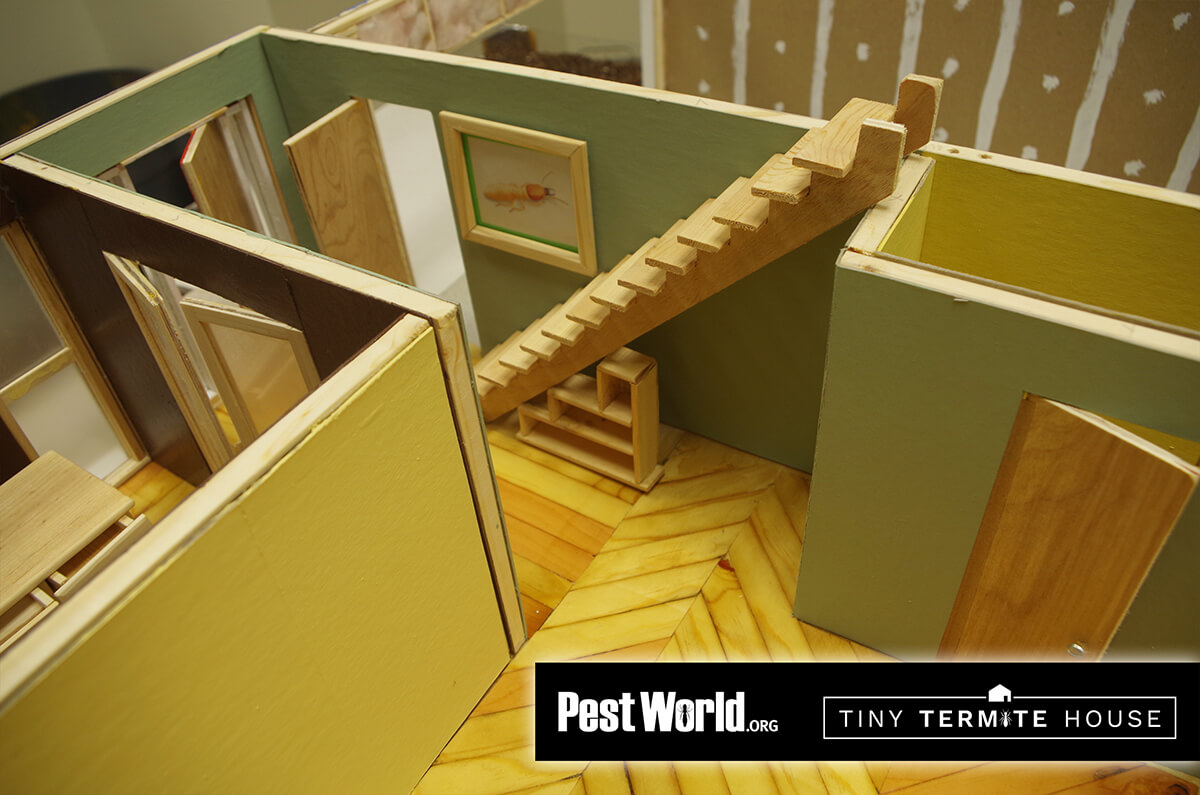
The termites arrived as talent. Five hundred thousand of them. Their set was a miniature dream house, built to scale and handsome enough to make its coming destruction feel faintly rude. The National Pest Management Association had a familiar problem: homeowners know termites exist, but the damage happens behind walls, which makes the threat easy to postpone. Vault Communications gave the threat a floor plan.
The agency and its partners filmed the colony eating. The result, called Tiny Termite House, was at once demonstration, spectacle and news hook. It generated more than 36 million impressions, more than one million social video views and beat the client's stated objective by 34 percent. Fox, The Weather Channel and the New York Post covered it. Terminix and Orkin used the material with customers. A pest problem had become a piece of programming.
This is the most useful way to understand Vault, an independent communications firm in Conshohocken, Pennsylvania. It does the expected agency things - public relations, crisis planning, branding, advertising, social media, influencer work, video and design. But its better work begins one step earlier, with the question beneath the assignment: what would make an audience care enough to look?
Make the hidden thing visible
Vault began in 1989 as a small business-to-business PR firm in suburban Philadelphia. Today it operates across paid, earned, shared and owned media. The alphabet soup matters less than the translation. A medical company needs people to discuss a condition they may not name in public. A utility needs residents to understand a contaminant measured in nearly unimaginable quantities. A tourism office needs footage of a party that has not happened yet. These are not distribution problems first. They are problems of comprehension.
For Hologic's fibroid-awareness campaign, the hidden thing was a knowledge gap around a common women's health condition. Vault anchored the work in Harris Poll research, built an educational hub, paired physician expertise with the comedian Amber Ruffin, and produced approachable animated videos. Earned media syndication reached an estimated 307 million people across more than 198 outlets. Influencer work delivered 1.24 million impressions, 137,000 video views and 46,000 engagements. More modest but arguably more revealing: healthcare professionals downloaded 65 resources, and patients submitted stories.
The pattern is consistent. Start with the part nobody can see, then give it a physical or human form. The tactic is not always theatrical. Vault has turned sustainability data into annual reports, executives into credible trade-media voices and patient milestones into timely health stories. The deliverable changes; the act of translation does not.
The spectacle worked because it was also the explanation. Remove the termites and the little house is just a little house.The useful distinction between an idea and a stunt
A party filmed before the party
The Visit PA assignment exposed another useful constraint. Pennsylvania was preparing for a crowded 2026 calendar - the NFL Draft, FIFA World Cup matches, a PGA Championship, MLB All-Star Week and America's 250th anniversary. The state wanted an invitation big enough for the moment. There was one obvious problem: the events had not happened, so the footage did not exist. Production was also scheduled in winter.
The conventional tourism commercial failed before anyone pressed record. Rather than counterfeit summer with generic scenery, Vault made the fans the destination. It staged the feeling of the coming celebration and produced a 60-second spot with a 30-second cutdown for paid, earned and owned channels. The campaign recorded more than 14 million total impressions, five million video completions and connected-TV completion rates of 96 to 99 percent.
What changed the idea was not a brainstorm in isolation. It was the absence of the obvious raw material. This is the part worth copying: write the constraint at the top of the brief, then ask what remains true. No event footage? The fans are already here. Invisible pest damage? The eating can be watched. A stigmatized condition? Trusted people can say its name.
A campaign method hiding in plain sight
- Name the invisible obstacle. Confusion, stigma, future tense and hidden damage are more useful than broad goals like “awareness.”
- Build one proof object. A model house, an original poll, a patient story or a staged party gives every channel something specific to carry.
- Translate, do not duplicate. The same idea should behave differently in a television spot, an interview, a short video and a resource hub.
- Measure the next action. Reach matters, but so do completions, downloads, return customers and sales.
The business behind the idea
Vault sells projects and ongoing agency relationships rather than a software product. Its advantage is breadth with a senior-counsel pitch: one firm can map stakeholders, prepare a spokesperson, design a brand, buy social ads, manage creators, shoot video and monitor a crisis. Public case studies name Hologic, Subaru, Visit PA, Axogen, Accolade, Best Egg, Datacolor and the National Pest Management Association. Its industry list spans healthcare, utilities, financial services, consumer products, associations, tourism and industrial companies.
That generalist position is deliberate. It gives the team more places from which to borrow an idea, while industry specialists supply the necessary fluency. For geographic reach, Vault belongs to Worldcom Public Relations Group, a network of independent agencies covering more than 115 major international markets. The arrangement offers local operators without asking one Pennsylvania office to pretend it understands every press room on earth.
Crisis work is the sober half of the portfolio. Vault advertises 24/7 support for data breaches, workplace violence, product recalls, industrial accidents, misconduct and other reputation threats. There is no termite-house whimsy in a fatality response. The common ingredient is judgment: knowing when speed helps, when it harms, which stakeholders need a voice and what can be said before facts settle.
LEAP is also the clearest public window into cost and consequence. For the inaugural participant, sneaker maker Bungee Brand, Vault refreshed organic social, ran Facebook, Instagram and search advertising, and pitched fashion media. The case study reports a 51 percent year-over-year sales increase, a 46 percent rise in return customers and 106 percent more website traffic. Later participants included Philadelphia Diamond Company and Mount Airy Candle Co. The latter's media placements totaled 2.2 million impressions and a reported $650,000 in advertising value.
Attention is rented. Trust takes longer.
Vault's culture vocabulary is Heart, Hunger, Curiosity and Excellence. The words could live on any agency wall, so the better evidence lies in behavior: paid internships, flexible scheduling, profit sharing, professional-development support, public DEI scorecards and an annual employee red carpet event called the Vaulties. CEO Kate Shields began at Vault three days after college, left for in-house roles at Campbell Soup Company and ARAMARK, then returned as a partner before turning 30. That round trip helps explain the agency's insistence that communications must survive contact with a client's actual business.
The approach has limits. A proof object cannot rescue a false premise. A celebrity cannot substitute for clinical credibility. Impressions do not establish trust, and reported advertising value is not revenue. The method works when the demonstration is true, the messenger belongs in the conversation and the next action is measurable. It works poorly when spectacle is asked to conceal a weak product or when every channel receives the same resized asset.
The reader can copy the discipline without copying the termites. Find the hard-to-picture part of the problem. Give it a form simple enough to explain over lunch. Let specialists adapt it to the places where the audience already pays attention. Then choose a metric that would disappoint you if the work merely went viral.
The tiny house eventually came down, which was the point. The more durable structure was the story around it: an unseen risk, made visible; an audience, made curious; and a brand with something useful to say before asking to be heard.