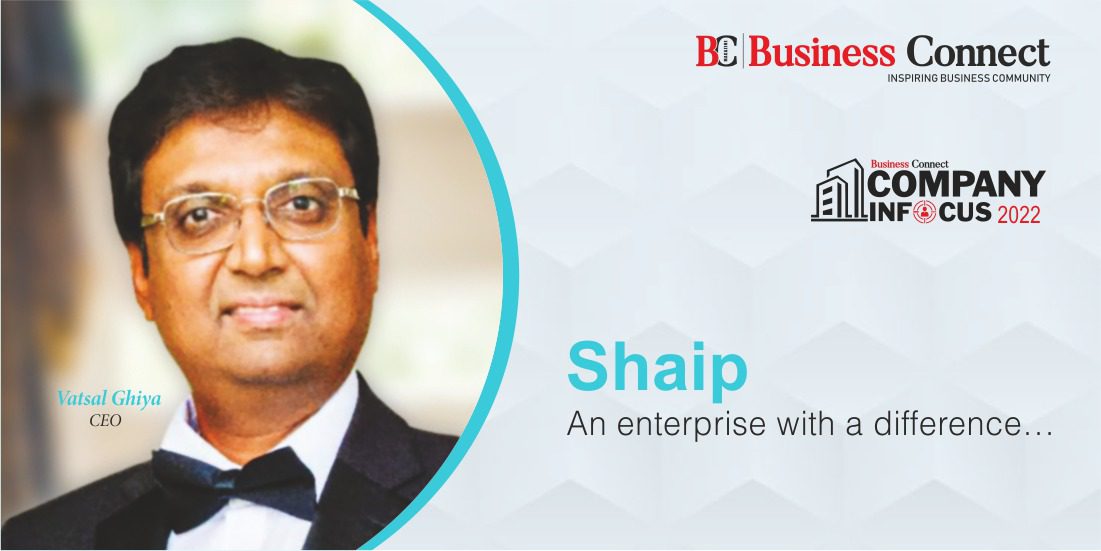
A fan is running. A television murmurs somewhere behind the speaker. A door opens. For most of us, these are the ordinary interruptions of a room with people in it. For Vatsal Ghiya, they became part of the assignment: help a machine distinguish a voice from everything surrounding it. The future, it turns out, has a background-noise problem.
When Ghiya described Shaip’s early work on speech data, he talked about recording speakers in different languages, transcribing short segments, and identifying the sounds around them. An assistant that seems effortless to use depends on a great deal of preparation. Somebody must decide what belongs in the recording, what counts as an interruption, and whether the transcript actually matches the voice.
Ghiya built a business in that space between a persuasive demonstration and a product that survives an ordinary Tuesday. His story moves through transcription, language software, international data collection, and an acquisition. Running through it is a partnership that began at university, long before either founder had a company to sell.
Before the companies, a shared room
Ghiya and Chetan Parikh became roommates and friends as engineering students at the University of Massachusetts. Their eventual working relationship grew out of that earlier connection. In 2004, they started the transcription business that became part of the foundation for their later software ventures. The partnership had years of friendship behind it before it acquired the usual entrepreneurial furniture: customers, deadlines, and difficult decisions.
The beginning has the appeal of a friendship that lasted. Two engineering students knew each other, kept working together, and found successive problems worth addressing. Their companies changed; the relationship persisted. For a founder, a long partnership can be a form of institutional memory that no onboarding document could quite reproduce.
Ghiya’s career includes co-founding Mediscribes and ezDI, followed by Shaip. The move toward language software grew from work involving large amounts of text. A service that processes information brings its operators into regular contact with the places where information becomes awkward. That proximity gives this career its continuity: each venture sits close to the practical work of making language usable.
By September 2021, ezDI had been acquired. Shaip would follow a different route, taking the operational experience of handling language into the growing market for AI training data. The two businesses were connected by people and experience, though they addressed different parts of the work.
Seven million ways to be understood
The scale becomes easier to picture in a project Shaip announced in August 2022. For an unnamed Fortune 500 technology company, the team collected and transcribed more than seven million short utterances, representing over 22,000 hours of audio across more than 13 languages. Delivery took less than eight months. Each utterance lasted 30 seconds or less.
Those figures describe a company project under Ghiya’s leadership, with all the coordination that implies. The team had to account for differences in speakers and recording environments, then deliver transcripts and metadata. A number like seven million sounds wonderfully abstract until somebody has to check whether the files are named correctly.
Ghiya explained the need in terms of spontaneous speech: people express the same intention in different ways. A person looking for something nearby might ask a direct question, give an instruction, or leave half the request implied. Multiply those habits by languages and dialects, and the tidy script begins to look rather optimistic.
The project makes a useful portrait of the work he chose. Its raw material was ordinary human variation. Success required organizing that variation without flattening it away. There is a commercial argument here, but also an everyday observation: the customer is unlikely to consult the training manual before speaking to the machine.
The small sample gets a vote
For all the large numbers, Ghiya’s description of project delivery included a deliberately small beginning. In a hypothetical order for 100 videos, Shaip would first prepare five for the customer to review. Corrections would be discussed and documented before the larger production run. He called the initial sample a “mini database.”
It is an appealingly modest phrase for a consequential step. Five examples can expose a misunderstanding before it has been copied a hundred times. The customer sees what the instructions produce; the team sees what the customer actually meant. That meeting between intention and output deserves its own calendar invitation.
The broader business lesson is easy to recognize. A precise instruction often becomes precise only after someone tries to follow it. A small review creates a place to resolve ambiguity while changing course remains manageable. In Ghiya’s account, feedback was part of how work accelerated.
- 01Agree the briefDefine the use case and the collection rules.
- 02Review a sampleLet the customer inspect the early output.
- 03Record correctionsTurn feedback into shared instructions.
- 04Expand deliveryCarry the agreed approach into production.
Putting the instructions into software
In July 2024, Shaip announced a data platform with three components: Manage, Work, and Intelligence. Manage handled project requirements and collection parameters. Work connected contributors to assignments. Intelligence performed automated checks on data and metadata before human validation. The architecture gave different names to different kinds of responsibility.
That distinction matters. Defining a job, doing it, and checking it are separate activities, even when they happen inside one platform. Making those handoffs visible is part of turning a collection of tasks into a repeatable business. It also creates a useful question for any organization buying data: who gets to decide that the work is finished?
The launch described individual consent as part of data sourcing and human review as part of validation. In a business built around inputs, the route by which those inputs arrive deserves attention. A dataset has a history before it has a filename.
Later that month, another platform announcement addressed the evaluation and monitoring of AI applications. It included tools for reviewing performance and tracking cost and usage, with expert human oversight. The scope was widening from supplying material to helping examine what systems did with it. For an operator, the inspection station can be as interesting as the production line.
A leader has an audience all day
Ghiya’s comments on workplace culture carry a similarly practical emphasis. He described training, discussion, and the example set by leaders. His point was that employees watch what their leaders do. It is an inconvenient rule for anyone hoping to delegate the company’s values to a presentation.
“People don’t do what you say, they will do what they see their leaders do.”
Vatsal Ghiya
The observation fits a business in which quality depends on many people making small decisions. An annotation, a review, a correction, a question raised early: none can be supplied by a slogan alone. Training and example give employees a way to understand which decisions the organization will support when the brief becomes less tidy.
His public writing offers another view of his working interests. In April 2023, he wrote about conversational search, personalized chatbots, voice assistants, and the collection of training data. The range moved from the experience a customer sees to the recordings and annotations underneath it. Even in an article about future applications, the preparation received its own place.
That is a useful way to read his career. The visible product keeps changing. The recurring concern is how people organize the information and decisions that allow it to function. There is room for ambition in that work, and also for a rather unfashionable virtue: checking.
His business interests also extend beyond software. Triple Crown Properties names Ghiya, Parikh, and Sundeep Dronawat as its founders, with interests in hospitality, multifamily properties, and real estate investment. The same partnership appears in a setting where the product includes buildings and guest experiences. A hotel and a dataset might seem unlikely companions in a career. Both, however, give an operator plenty of ways to discover whether a promised standard survives repeated delivery.
That connection offers a broader view of Ghiya than an AI job title alone. His public business record involves services, software, and property. Across those settings, a customer encounters the result of many decisions made out of sight. The businesses have different tools and different economics. Each requires people to agree what should happen, organize the work, and notice when the result falls short.
An exit, with the partnership still open
On February 22, 2026, Shaip announced that it had become part of Ubiquity Global Services. The combination gave the data business access to a wider operational footprint, enterprise relationships, and investment capacity. The announcement emphasized continuity for customers and the teams delivering their projects.
An acquisition is often told as a finish line because it provides such a convenient photograph. In an operating business, the following morning still contains assignments. Customers need their work delivered, managers need clear responsibility, and the platform needs investment. Shaip’s next phase involved placing its specialized work inside a larger organization.
For Ghiya, the change also meant a new job. He announced that he was stepping down from the CEO role and moving from RAAPID’s board into a full-time position as chief marketing officer. RAAPID now lists him as co-founder and CMO. Parikh remains his partner there, extending a working relationship that has already crossed several companies.
The decision gives the story a more interesting ending than a sale alone. After years running a company that helped machines interpret people, Ghiya took a role concerned with explaining a company to its market. Different audience, familiar demand: understand the context, choose the words carefully, and make sure somebody on the other side can follow.
His trajectory makes the ordinary work behind AI unusually visible. Speakers must be recruited. Instructions must be agreed. Samples must be reviewed. Partners must keep trusting one another. The assistant may eventually speak in a fraction of a second. Getting to that second has occupied much of Ghiya’s working life.