Vasco Pedro was fourteen when he worked in a meat factory. He likes the joke that he got to see where the sausage was made. Years later, with a doctorate and a company to run, he decided that starting Unbabel had been harder. There is something reassuring about a technology founder whose account of entrepreneurship includes an actual factory. The language may become more elaborate; the work remains work.
In August 2025, TransPerfect acquired Unbabel, the translation business he had co-founded in Lisbon in 2013. Pedro stayed to help with integration. He also made his intentions plain: another company would follow. A career in venture capital held little appeal. “I am a builder at heart,” he said. Retirement, it seems, had failed the product interview.
That next company is Spinnable AI. It builds AI workers for businesses, with Pedro as founder and CEO. His old problem was helping people communicate across languages. His new one is helping small teams get work done. Between those two ventures lies a remarkably persistent question: how much of the machinery must a person understand before it can be useful?
The boy with a cassette tape
Pedro learned to code at six on a ZX Spectrum 48K. Weekend newspapers carried lines of code for games, which he typed in and recorded onto cassette. A game began as text and became something he could play. The experience gave him an early appetite for making things. Before software could eat the world, it sometimes had to wait for a tape to finish.
He also sold Christmas cards with his sister. Later, at the Pupilos do Exército school, he learned about giving and receiving orders. The institution left him with an understanding of how groups function, alongside a resistance to instructions whose purpose nobody could explain. His interest in language grew out of a wider curiosity about intelligence and human consciousness.
He studied Language and Knowledge Engineering at the University of Lisbon, then went to Carnegie Mellon for graduate work. His academic trail is unusually tangible. There are papers on question answering, knowledge representation and the difficulties of drawing information from separate systems. The doctorate, completed in 2009, was called Federated Ontology Search. Dinner-party conversation was plainly going to require a little translation.
The underlying problem is approachable. Different knowledge collections organise the world differently. How can a computer search across them and combine useful results? Pedro worked with researchers including Jaime Carbonell and Eric Nyberg. Long before today's conversational AI became a consumer habit, he was occupied with getting machines to handle language and knowledge together.
Different businesses. A recurring interest in making computers useful to people.
A surfing trip with consequences
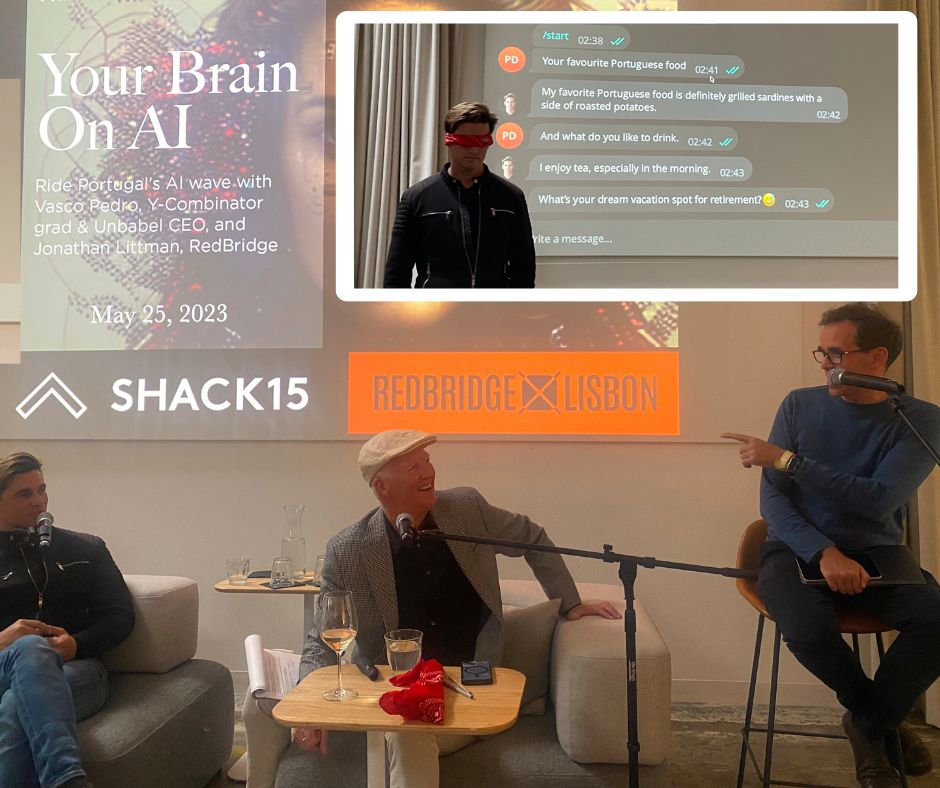
Unbabel emerged from discussions on a surfing trip in 2013. Pedro and his colleagues were considering a gap familiar to anyone who had tried automatic translation: the promise was enormous, while the results could still be awkward. They wanted to make communication possible across languages without demanding that everyone become a linguist.
The founding group included João Graça, Sofia Pessanha, Bruno Silva and Hugo Silva. A purple notebook helped gather their ideas. The company joined Y Combinator's Winter 2014 batch. For a venture beginning in Lisbon, the accelerator offered access to a network far beyond Portugal. An idea discussed away from the office had acquired the obligations of a business.
Pedro already had experience of starting companies, including Bueda and Dezine. His old Carnegie Mellon research page records him running Bueda in Pittsburgh after graduation. Unbabel was another attempt to turn specialist knowledge into something people would pay to use. A doctorate may explain why a problem is difficult. A customer adds a useful supplementary question: when will it work?
The answer at Unbabel combined machine translation with human editing. Software handled the first pass; people supplied judgment where needed. The company built the coordination around that process, letting businesses manage multilingual communication at scale. The customer did not need to assemble a research laboratory and a translation operation before answering an email.
The difficult business of being understood
Customer support made the problem concrete. A person buying a product should be able to ask for help in a language they understand. For a business selling internationally, every additional language creates decisions about staffing, speed and quality. Unbabel placed its technology inside that everyday exchange, where an elegant research result has to survive contact with an impatient customer.
In 2019, the company raised a $60 million Series C round. The number marks a stage in the business, rather than a measure of Pedro's personal wealth. The funding helped turn a Lisbon-founded translation venture into an operation with international ambitions and the resources to pursue them.
Pedro's 2021 discussions of the company put particular emphasis on the translation pipeline: machine translation, estimates of quality and tools that make human editing more productive. He also talked about company culture as a reason researchers might join. For some recruits, the attraction was seeing work move from research into customer use within weeks. The distance between a paper and a practical result mattered.
By late 2023, his attention included how translation should be bought and organised. Content was being created and updated continuously. Treating each piece as a separate project could be cumbersome. He described a move toward ongoing translation flows, with explicit expectations for delivery and quality. The administrative details were part of the invention. Even brilliant software can get trapped behind a badly arranged queue.
“Connections mean the world to me”
Vasco Pedro, reflecting on the motivation behind Unbabel
A team player with an impatient ear
Pedro describes himself as someone who tries to bring groups together. The solitude of doctoral work was difficult for a person drawn to teams. He remembers starting a business during the final semester of his doctorate while writing his thesis and welcoming a third daughter. The company in that recollection predates Unbabel; his academic and entrepreneurial lives were already competing for room.
Shilling became Unbabel's first institutional investor, and Pedro speaks warmly about the advice of founders who have been through the process themselves. There is a practical modesty in that view. Experience does not make a founder self-sufficient. It may simply improve the questions they ask of other people.
His working preferences have their own flavour. In 2019, he described his approach as lean and said intuition played a larger role than process. He wanted colleagues to feel able to speak honestly. He also favoured autonomy for the people he hired. A founder can recruit talent and then spend the day obstructing it; Pedro's stated preference was to give it room.
He was fond of audiobooks played quickly, and said WhatsApp carried much of his important communication. Those habits acquire a pleasing sequel in Spinnable, which puts AI workers into tools people already use. The executive who disliked friction in his own communications now sells a way of reducing it for others. Some product roadmaps begin rather close to home.
August 2025: handing over the keys
TransPerfect announced the acquisition on 22 August 2025. The deal brought Unbabel's TowerLLM translation model and COMET evaluation technology into its GlobalLink portfolio. The financial terms were undisclosed. The technologies mattered, and so did the researchers and employees who had built and operated them.
Pedro's part was to oversee integration. He thanked the Unbabel team and described the opportunity for their work to reach a larger platform. In his account of the sale, he also acknowledged overlap between the businesses and the practical reality of a founder's cycle ending. Selling a company creates a handover, with people and customers on either side of it.
His next ambition was already taking shape. By September, he had announced a new venture in stealth. In November 2025, Spinnable appeared publicly. A sale had closed one chapter, but the appetite for starting again had survived the paperwork.
Unbabel · 2013How can a business communicate across languages?
Spinnable · 2025How can a small team get more work done?
The next colleague may be software
Spinnable's founding team includes Gil Coelho, its chief product officer, and Fábio Kepler, its chief technology officer. Both had worked at Unbabel. The new venture offers AI workers intended to handle tasks, initiate conversations and operate through familiar business tools. Pedro's argument centres on smaller businesses that lack the money or time to build their own AI department.
The hiring metaphor is deliberate. A business describes work, connects tools and delegates tasks. Spinnable presents controls for access and approval alongside that promise of autonomy. Pedro has also written about AI workers joining WhatsApp groups, reading the conversation and contributing when useful. The ambition is to fit into an existing working day, with fewer excursions to another dashboard.
He is based in Lisbon, and at Spinnable's launch he expressed a preference for working physically alongside a small team. In September 2026, he and Coelho were listed as speakers for a Lisbon AI Week session about practical uses of AI workers. The subject had moved from a new-company announcement to demonstrations of work businesses might delegate.
The appeal of Pedro's career is in these recurring practical questions. How do separate systems exchange knowledge? How do customers get understood? How does a small business find enough hands? He keeps returning to the space between a technical possibility and a person's working day. At six, it involved typing a newspaper's code into a Spectrum. Decades later, the tape has gone. He still wants to see what he can make happen.
Follow the conversation
Companies, conversations and earlier work.