An injection into the eye is a small event with a large shadow. For someone with wet age-related macular degeneration, the appointment can return every eight to twelve weeks. The drug may protect sight; the calendar makes sure the patient never forgets the disease. Valitor, a Berkeley biotechnology company, has organized its work around a deceptively ordinary question: could one injection buy more time?
- Valitor engineers protein-based drugs to remain active longer in target tissue.
- Its lead candidate, VLTR-559, is designed for wet AMD and a possible six-month dosing interval.
- The durability and safety evidence disclosed so far comes from preclinical studies; human benefit remains to be shown.
The company is taking aim at an established treatment rather than an obscure biological mystery. Anti-VEGF medicines block a protein involved in the abnormal blood-vessel growth that damages the retina in wet AMD. They are a standard of care. Their nuisance is recurrence: the medicine eventually leaves the eye or loses useful activity, and the patient returns for another injection and more monitoring. Valitor's proposed answer is to change the molecule's staying power.
A longer leash for a familiar drug
Valitor calls its technology the multivalent polymer platform, or MVP. Picture a long chain of hyaluronic acid carrying many copies of a small anti-VEGF antibody along its length. The chain changes how the medicine moves and persists in ocular tissue; the antibody copies keep working on a familiar target. The company says the same design logic can mix other polymers and bioactive molecules, which is why it describes MVP as a platform, not a single invention built for one eye disease.
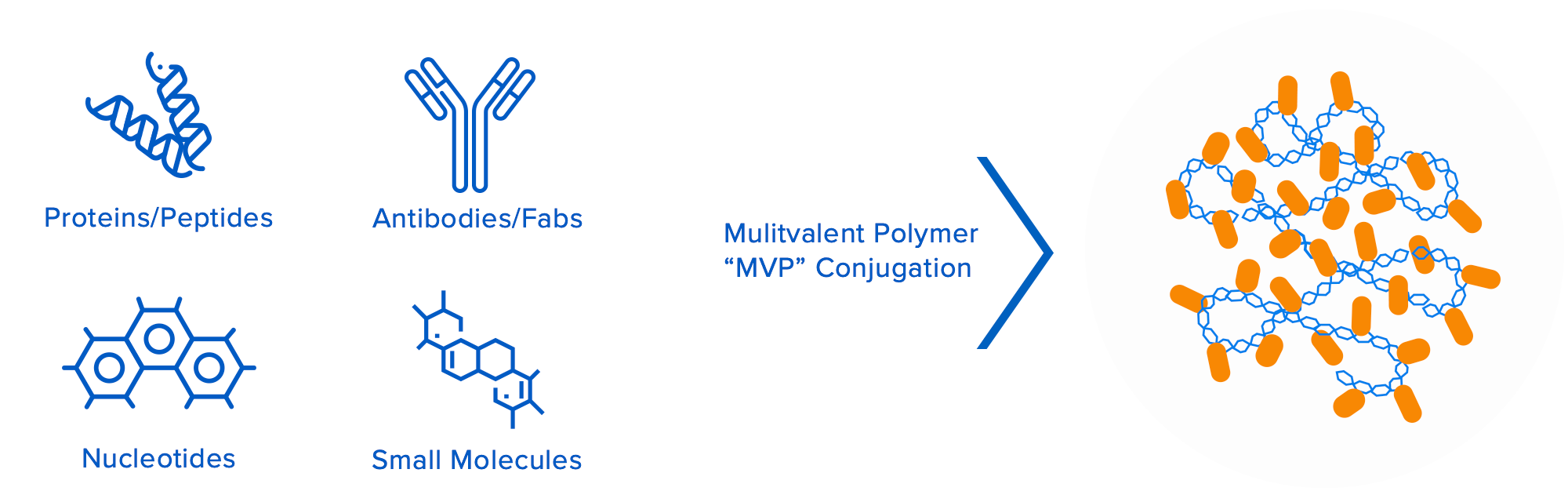
This is a specific bet on where the bottleneck lies. If a proven target works but patients need frequent doses, improving retention could be more useful than discovering a new target. It could also bring a distinct problem: a longer-lasting molecule must remain safe, stable and potent for the whole interval. One elegant pharmacology number does not settle those questions. Retina specialists need to see both protection of vision and tolerability over time.
These are preclinical half-life figures, not demonstrated dosing intervals in patients.
In May 2026, Valitor reported a roughly 12-day vitreous half-life for VLTR-559 in preclinical models, compared with about three to five days for conventional anti-VEGF biologics in the same account. Its researchers also found the candidate in retinal tissues after dosing and reported maintained activity in follow-up testing. The company presented these findings at the ARVO ophthalmology research meeting and described a favorable tolerability profile in its animal studies. It aims for a treatment protocol around six months apart; CEO Gregory Kunst said clinical evaluation was planned for the following year.
The company that started in borrowed space
Valitor's story begins well before that conference slide. Founded in 2010 around technology from the University of California, Berkeley, it was incubated through shared research spaces including Berkeley SkyDeck and the QB3 Garage. Co-founder and chief scientific officer Wesley Jackson told Berkeley's Bakar Labs that the first practical breakthrough was access to infrastructure. He said the company could start with a $300,000 NIH grant because it did not have to build an entire laboratory from scratch.

There is a useful correction to the romance of the lone scientist in Jackson's account. He said he once assumed excellent science would be enough to launch a business. What surprised him was the number of people required to keep one alive: investors, employees, advisers, clinical experts, facility operators, lawyers and more. In biotech, a molecule cannot book its own lab, fund its own studies or persuade a regulator to listen. An invention may begin at a bench; a medicine must travel through an institution.
“I naively assumed that if the science was great enough, it would be sufficient to launch the business.”Wesley Jackson, speaking to Bakar Labs
That long apprenticeship helps explain the gap between founding and financing. In October 2022, Valitor closed a $28 million Series B led by Morningside, with First Spark Ventures, ExSight Ventures, Berkeley Catalyst Fund and Pandect Bioventures participating. The company said the money would support its ophthalmology programs. At the time its public lead candidate was called VLTR-557; today's pipeline names VLTR-559. Public materials establish that sequence, though they do not explain the precise reasons for the candidate change. Calling it a failed program would be a story the evidence does not tell.
The hard part starts when the needle meets a person
Valitor has no marketed drug or disclosed commercial customer base. Its immediate audience is the people who can judge and fund development: researchers, retina clinicians, regulators, investors and potential pharmaceutical partners. Its eventual users, if the candidate succeeds, would be patients with wet AMD and the clinicians who treat them. Diabetic macular edema appears as a follow-on indication on the company's pipeline. Two other pharmaceutical collaborations are listed without partner names or disclosed indications.
The commercial logic is familiar to drug development. Valitor uses grants and investment to fund research and may pursue co-development or licensing; no product sales have been disclosed. What sets it apart is the way it applies a reusable molecular scaffold to known drug biology. Existing anti-VEGF therapies are the practical comparator, especially aflibercept-based treatment, which Valitor has used in its preclinical presentations. A patient might reasonably care less about the scaffold than about whether it reduces injections without giving up vision. That is precisely the question preclinical work cannot answer on its own.
The broader platform could eventually matter in other therapeutic areas. Earlier company materials discussed oncology and joint disease; the current public pipeline is concentrated on ophthalmology and unnamed collaborations. For now, VLTR-559 is the clear test case. It is where a laboratory idea about polymer size and antibody copies has to become a reliable clinical schedule.
What this small story teaches
There are two lessons in Valitor worth copying, though neither is a shortcut. The first is scientific: look for an effective treatment whose inconvenience comes from duration, then ask whether delivery and molecular design can improve the patient's day. The second is organizational: use shared infrastructure early and keep the people who control the next step aligned. Jackson's $300,000 beginning was possible because the lab, grant and collaborators arrived in a workable combination. That recipe depends on access to research facilities and credible science; it does not turn every molecule into a medicine.
Valitor's six-month ambition is appealing because it is easy to understand. Two planned injections a year sound better than a revolving appointment book. But the most honest version of the story still ends with a question mark. The company has shown promising retention and tolerability in preclinical work. The patient's calendar changes only if those properties hold up in human eyes, at a safe dose, while preserving vision. That is the next appointment Valitor has to keep.