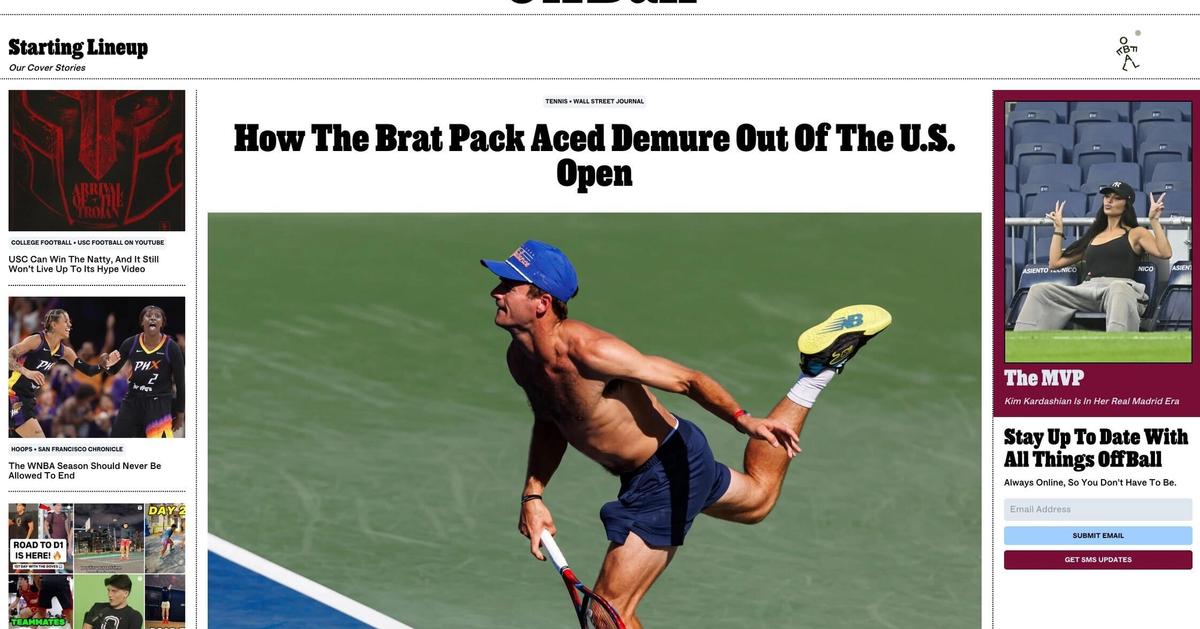
In September 2024, a new sports site appeared with a peculiar idea about the internet: perhaps a person, rather than an algorithm, should decide what was worth your time. It was called OffBall. Its homepage looked like the front of a boisterous tabloid and behaved like a clever friend who had spent the morning reading everything. The publication’s co-founders included two seasoned sports-media people and Adam Mendelsohn, the founder of Upland Workshop. A communications firm had helped make a media company. That small fact explains Upland better than a page of agency language.
Most public-relations businesses occupy the last few yards between a client and a reporter. A company announces something; the firm packages the announcement and tries to earn attention. Upland starts earlier. It asks what the client is trying to change in the business, which audiences can help change it, and what story those audiences will believe. A press placement may follow. So might a partnership, a documentary, a newsletter, an executive platform, or a new piece of intellectual property.
The distinction sounds tidy. In practice it means stepping into problems that do not belong neatly to PR, marketing, corporate strategy, or product. Upland describes the work in four broad lanes: communications strategy and planning; content creation and optimization; enterprise partnerships; and the modernization of systems, resources, and infrastructure. Its customers are founders, executives, investors, athletes, artists, and institutions whose reputations are entangled with their commercial choices.
The useful scar tissue of The Decision
Mendelsohn arrived at this model by an unusual route. He had worked in politics, including as deputy chief of staff to California governor Arnold Schwarzenegger, before becoming a longtime adviser to LeBron James and his business circle. Politics teaches speed, coalition building, and the unpleasant truth that a message belongs to its audience as soon as it leaves your mouth. Elite sports teaches the same lesson with louder microphones.
James’s 2010 television special, “The Decision,” became a durable case study in how control can backfire. The announcement drew enormous attention and an equally enormous backlash. Four years later, James announced his return to Cleveland through a first-person essay. The line “I want an opportunity to explain myself uninterrupted” helped inspire Uninterrupted, the athlete-led media platform. The repair was not simply better publicity. It was a better format, a more human voice, and eventually an owned channel.
That is the scar tissue beneath Upland’s thesis. Exposure is not the same as understanding. Control is not the same as trust. And the most durable answer to a broken distribution system may be to build a new one.
“The future of communications is going to be working with leaders and organizations on their narrative.”Adam Mendelsohn, speaking about the shift beyond exposure and publicity
A client list shaped like an intersection
Upland’s public client relationships range from James and Maria Sharapova to RedBird Capital Partners, Dragoneer Investment Group, Stephen Ross, and Naomi Osaka’s Hana Kuma. It has supported the Steadfast LA rebuilding coalition and recruited for communications work tied to the Cadillac Formula 1 Team. These are different worlds on paper. In reality, they share a problem: business, celebrity, capital, politics, and culture now arrive in the same feed.
A private-equity firm may need the fluency of a political campaign when a deal attracts scrutiny. An athlete may need the discipline of an investor presentation when launching a company. A civic initiative must coordinate donors, officials, residents, and reporters without speaking to any two groups in quite the same way. Upland’s answer is a team assembled from those overlapping environments. Former political communicators work beside journalists and operators with experience in finance, technology, entertainment, and sports.
The hiring pattern is revealing. In 2024, Upland added Alex Barinka and Julia Verlaine, both with deep reporting experience at Bloomberg, while Meredith Cash arrived after covering sports at Business Insider. In 2026, Arielle Patrick became managing partner, taking charge of New York and expanding the firm’s financial-communications work. The product is judgment, so the firm keeps buying experience that can recognize what is interesting before trying to make it sound interesting.
The press clip is no longer the finish line
OffBall is the most visible demonstration of what Upland means by business impact. The outlet launched in September 2024 with human curation at its center. Instead of publishing an endless stream of commodity stories, it pointed readers toward the liveliest conversation around sports and culture. Upland helped incubate the business; Mendelsohn co-founded it. In 2026, OffBall partnered with women’s-sports company TOGETHXR, which took a minority stake. The two agreed to combine audiences and share resources.
This does not mean every communications assignment should end with a new company. It means the firm’s preferred unit of value is larger than coverage. A narrative might make a partnership legible, give an executive a direct relationship with an audience, or identify a media property hiding inside a client’s expertise. The method works best when there is substance to uncover: a distinctive point of view, credible authority, and leaders willing to behave consistently after the campaign meeting ends. Without those ingredients, “narrative” becomes expensive decoration.
This positioning also answers where Upland sits in the market. It competes with global advisory firms such as Brunswick, FGS Global, and Teneo; specialist executive-positioning shops; and the in-house communications chief who knows the company better than any outsider. Upland’s difference is not scale. It is the promise of senior attention plus a willingness to cross the border from counsel into creation.
A small firm betting against billable bulk
Traditional agencies tend to grow by adding clients, employees, hours, and offices. Mendelsohn has argued that AI makes this labor-based bargain harder to defend. If technology compresses the time required for research, drafts, and monitoring, clients will question why speed produces the same bill. His alternative is to charge, in effect, for sharper thinking and measurable consequence. Upland does not publish its fees, revenue, or outside funding. It is privately held and sells advisory and execution work, while selectively incubating and investing in media ideas.
There is a useful tension here. A boutique wins because experienced people stay close to the work. But senior time is finite, and original ventures demand attention that client service also wants. The model therefore depends on selection: the right assignments, clients prepared to act on advice, and ideas with enough commercial energy to survive after the launch post. A company seeking only a high volume of routine press outreach may prefer a larger machine. A leader unwilling to communicate directly will struggle in a strategy built around executive voice.
What another company can steal
- Write the business objective before writing the communications brief.
- Give one senior person authority across message, content, and distribution.
- Treat owned channels as products with an audience promise, not corporate storage.
- Hire for judgment from adjacent fields. A reporter, operator, or campaign hand may see the problem faster than a category specialist.
- Ask what durable asset remains when the news cycle moves on.
Upland Workshop’s strongest idea is also its simplest: communications should be upstream of the announcement. The story is not a ribbon tied around the strategy. It is one of the ways strategy becomes visible, repeatable, and useful. Sometimes that produces a careful message. Sometimes it produces a partnership. And sometimes, if the idea has enough life in it, the press adviser ends up helping to build the press.