In the spring of 2024, a team of scientists climbed the largest tree on Earth and listened to its vital signs. General Sherman is 275 feet tall, roughly 2,200 years old and, like many giant sequoias, living through drought, wildfire and an emerging bark-beetle threat. The scientists were doing serious fieldwork. Landis Communications gave the public a simpler picture: the old giant was getting a doctor's check-up.
That phrase is the Landis business in miniature. The agency did not invent the science or own the tree. It found the human-sized doorway into a difficult subject, built a press event around the examination and made the image easy for an editor to understand. NPR, the Los Angeles Times and other outlets picked it up. PR Daily later named it the year's best nonprofit campaign. The work competed in a category for campaigns under $50,000.
The campaign's award category supplies the only defensible number. Landis otherwise prices by estimated hours, scope and deliverables, then bills a monthly retainer.
A small firm with a borrowed map of the world
Landis began in 1990 at David Landis's kitchen table in San Francisco. It remains small: the supplied company data and LinkedIn snapshot list 16 employees. The roster is designed around experienced counselors rather than a pyramid of junior billable hours. Its client archive ranges from UCSF and Sutter Health to Velodyne LiDAR, Whole Foods Market, Walmart and Save the Redwoods League.
Small, however, need not mean geographically trapped. Since 2006 Landis has represented San Francisco in the Public Relations Global Network, a federation of more than 50 independent agencies. When a client needs London, Singapore or New York, Landis can assemble local practitioners without buying an office or passing the assignment into a distant holding-company chart. In 2026 it joined the network's health group, a more formal bench of 93 specialists working across four continents and 11 languages.
in San Francisco
campaign idea
each market
This is where Landis sits in the market. A giant global agency sells integrated scale. A solo consultant sells direct attention. Landis tries to keep the second while renting the first. Its competitors are Bay Area independents, specialist healthcare and climate shops, big agency networks, in-house teams and, in some cases, the client's ad budget.
The handoff was the opposite of a crisis
On October 1, 2021, David Landis retired and general manager Sean Dowdall became president. Founder transitions have a familiar failure mode: the name remains on the door while every decision waits for the person who supposedly left. Here the choice had been made in advance. Dowdall already managed operations, marketing, digital work and finance. The founder exited publicly and cleanly.
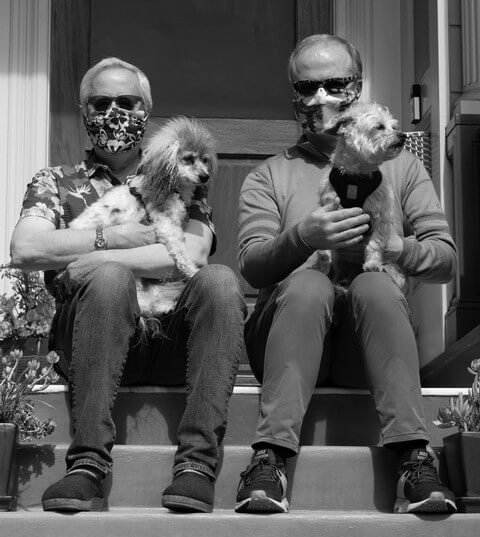
The photograph announcing the change is revealing. David and Sean sit on front steps wearing pandemic masks, each holding a shaggy dog. Gaston and Alphonse do not appear worried about governance. The firm kept the founder's name, but Dowdall brought a different biography: banking, digital marketing and nonprofit board leadership, including two $10 million capital campaigns for San Francisco dance organization ODC.
What changed was not the agency's belief in earned attention. It was the definition of where attention happens. Landis now sells public relations, media training, crisis counsel, social and digital strategy, video, thought leadership and generative engine optimization. The last item sounds fashionable, but the underlying bet is conservative: an AI answer is more likely to trust a business whose expertise appears in credible, independent places.
“The audience may now include an algorithm, but credibility still starts with people.”Makenzi Jordan Rodriguez, Landis Communications
The campaign is a chain, not a clipping
Consider the Global Alzheimer's Platform. The obstacle was not lack of sympathy. Many people said they would join a clinical trial; far fewer actually did. Landis treated that gap as the story, commissioned a Harris Poll and paired the finding with public-service announcements featuring Paula Abdul and Ron Reagan. It then connected national coverage to email, partner research sites, targeted landing pages and Google and Facebook advertising.
The campaign produced about 160 million impressions and 20,000 PSA airings, but the interesting number is the nearly 10,000 new registry members, a 27 percent increase over previous months. Attention had somewhere to go. The press hit was neither the finish line nor proof by itself.
The same discipline appears in a much smaller story. Becoming Independent, which supports adults with developmental disabilities, wanted attention for two clients who hosted a sports show. Landis arranged credentials for them to cover the Golden State Warriors, then pitched just two outlets: KPIX and the Santa Rosa Press Democrat, the television station and newspaper that mattered most to the organization's audience. Both said yes. More pitching would have made the spreadsheet busier, not the result better.
What fails first
The first thing to fail in public relations is often the promise. A company wants a guaranteed headline, an agency wants the account, and uncertainty is quietly edited out of the sales conversation. Landis's own FAQ refuses the bargain: only paid media guarantees placement. Earned coverage depends on whether the story is genuinely newsworthy, whether the timing works and whether a journalist believes it belongs in front of an audience.
The second failure is counting activity instead of consequence. Landis says it begins by defining success with the client - sales, site visits, engagement, message pull-through or another observable response - and maintains campaign trackers and weekly meetings. This is not a magical attribution system. PR still collides with advertising, seasonality and events outside anyone's control. It is, at minimum, an agreement about which direction is forward.
What readers can copy
Name the desired behavior before choosing tactics. Then give every piece of attention a next step: a page, registration, donation, interview or clear idea worth repeating.
What changed the method
Discovery moved from ten blue links toward generated answers. Landis added GEO, but kept the old raw material: credible coverage, structured facts and recognizably human expertise.
The approach has limits. It works poorly when leadership cannot make time for interviews, the underlying offer disappoints, the organization has no proof for its claims or the desired result is simply guaranteed exposure. It also struggles when approval chains outlast the news cycle. In those conditions, an ad buy may be more honest, a product fix more urgent, or silence more useful.
Values as a sorting mechanism
Landis is LGBTQ+-owned and certified as a diversity supplier. Its current emphasis on healthcare, environmental work, nonprofits and LGBTQ+ advocacy is not merely a market segmentation slide. The agency says its giving concentrates on environmental stewardship, social justice, health, arts and culture; employees can direct an annual pool toward causes they choose. In 2024, according to Landis's account of a San Francisco Business Times ranking, it placed second among Bay Area corporations by percentage of profits donated.
That percentage matters more than the raw dollars. A 16-person firm cannot outspend a bank. It can decide what proportion of itself it is willing to put behind the claim. The same logic runs through its best campaigns: choose a sharp measure, build the story around something visible, and resist confusing size with force.
Keep digging
The agency publishes its services, client archive and campaign case studies openly. Its video channel and social accounts show the people behind the briefs.