There is a useful difference between knowing how a printing company works and being the person who must explain why the posters are not ready. University Graphic Systems lives inside that difference. Tucked into Building 26 at Cal Poly San Luis Obispo, UGS is at once a commercial print shop, a retail counter and a management exercise with consequences. Students make estimates. They impose files. They load presses, cut vinyl, bind books, answer email and meet the person who ordered the thing. A grade may arrive later. The customer arrives now.
This has been the arrangement since 1968, according to UGS and Cal Poly's Graphic Communication Department. The current operation is managed by ten students, advised by a faculty member and a full-time technician. Students first train for two quarters in a chosen area - sales, marketing, prepress, estimating, offset lithography, bindery, finishing or mailing. Then they can apply for paid positions. Those interested in management interview to run the company for the next annual cycle.
“You don't get any deeper, hands-on learning than you do in UGS.”Stephanie Tang, former specialty printing manager
The counter is the classroom
The shop's customer list explains the lesson. A student walking in before a career fair needs resumes and business cards. A club needs stickers. A department needs a brochure. Cal Poly has used UGS for Mustang News, commencement booklets, annual reports and student publications. Local clients can ask for commercial work, too. Each order converts an abstract skill into a small promise: this many copies, on this stock, by this date, at this price.
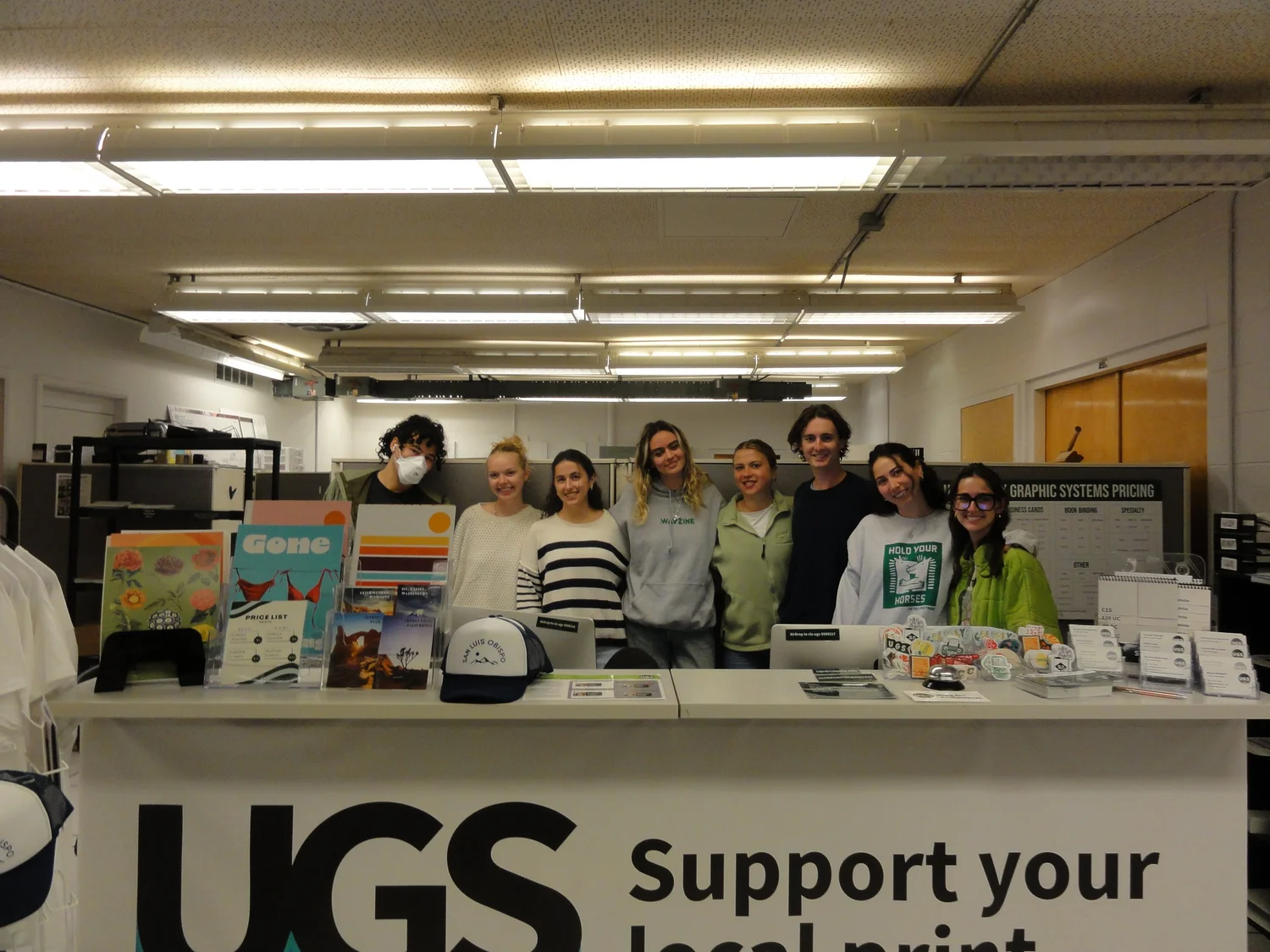
That sequence is the transferable idea. Many student programs begin with observation and end with a tidy capstone. UGS begins with production work, then widens responsibility. The would-be manager has already seen what a bad file, a late handoff or a vague request can do downstream. The faculty adviser remains close, but the students hold the operating roles. It is apprenticeship arranged as a company.
Then the campus went quiet
The model met its sharpest public test in 2020. Ordinary campus business was disappearing just as a mostly student-operated company was training managers over Zoom. The first thing to fail was not a press. It was the familiar flow of work. Cal Poly Facilities, meanwhile, needed signs telling people where to walk, how far apart to stand and how many bodies belonged in an elevator.
That collision changed the plan. UGS had equipment and capacity; Facilities had an urgent, campus-wide order. Students began producing directional and distancing signs in July. They learned machinery that had not previously been central to the service mix. Adviser Dina Vees helped create a digital storefront so customers could order remotely. The team also assembled a San Luis Obispo kit of buttons, stickers, a mug and a shirt for new students learning from elsewhere.
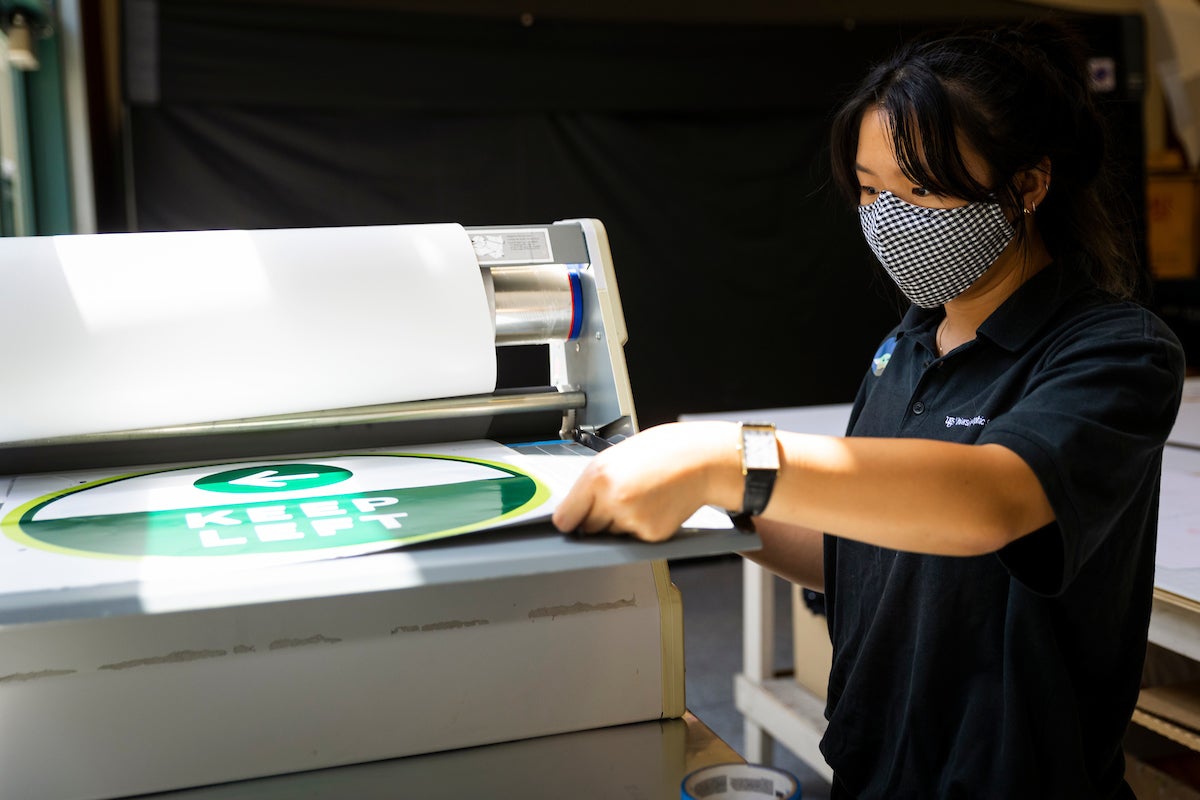
The pivot is interesting because it was not a contest entry or a classroom simulation. People were going to follow those arrows. Facilities installed the finished signs across campus buildings. The students saw their own work underfoot and on doors. A disrupted business became useful again because the team matched idle capability to an immediate local problem.
“Although we do make mistakes and we learn through our mistakes, we're still a company that holds quality as one of its highest standards.”Elise Monroe, former account manager
A menu broad enough to make judgment unavoidable
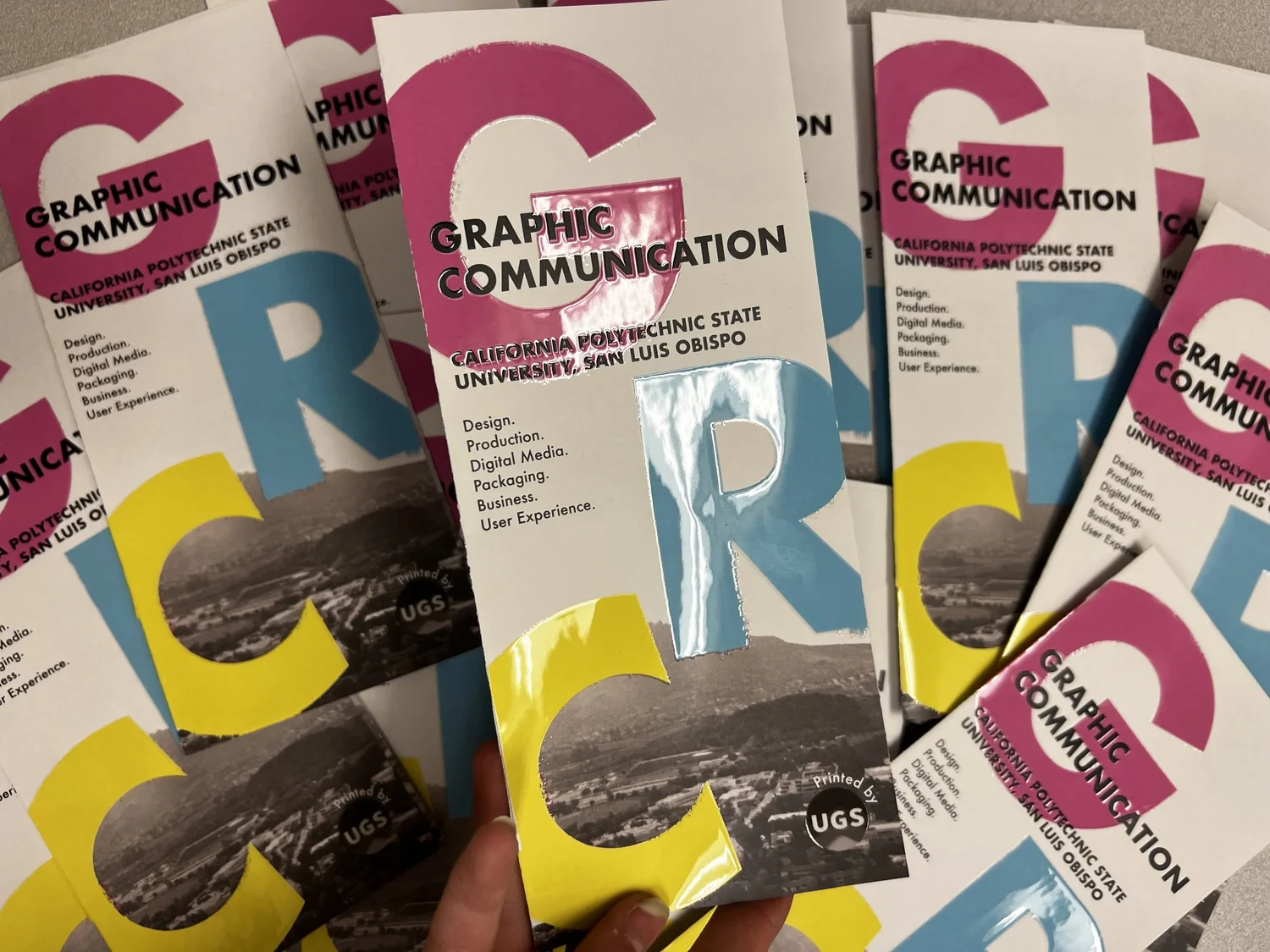
Today the menu runs from ordinary sheets to rather less ordinary surfaces. UGS prints flyers, posters, business cards and folded pieces. It makes stickers, window decals, door wraps and wide-format graphics. It screen-prints apparel, applies direct-to-film designs and dye-sublimates mugs and shot glasses. Binding includes saddle stitch, spiral, Wire-O and perfect binding. Design work covers print layouts, social graphics, web elements and the small rescue operations required when a customer's file is almost, but not quite, printable.
Paper
From a resume to a 40-inch-wide banner, including folding, cutting, lamination and binding.
Adhesive
Die-cut stickers, window graphics, door wraps and vinyl that must survive handling.
Wearable
Screen printing for volume and direct-to-film color for small batches of one to thirty.
Participatory
Pop-ups where as many as thirty people per half-hour can pull a print themselves.
The posted prices make the operation unusually legible. Wide-format paper printing is $6 per square foot. Design is $35 an hour, with a $10 fee for minor file edits. A dye-sublimated mug is $11, and interactive events generally run about $10 to $15 per person. Perfect binding starts at $12 for the first small-quantity book and $4 for each additional copy. Large and unusual jobs are quoted.
Those prices are not a claim that every job is cheaper than every alternative. Cal Poly itself lists other on-campus and local printers, from Print & Copy in the library to ASAP Reprographics, Poor Richard's Press and regional commercial suppliers. UGS occupies a narrower, stranger place: convenient enough for a student with a resume, equipped enough for a department with a publication and educational enough that buying the work also supports the people learning to make it.
The useful part is not the press
Another school could copy the visible pieces - a counter, a price list, some equipment - and miss the mechanism. The mechanism is real demand paired with staged responsibility. UGS gives beginners time to learn a specialty. It creates paid work before management. It defines roles for accounts, projects, specialty production, marketing and finance. It keeps expert adults close enough to prevent an expensive lesson from becoming a catastrophe, but far enough away that students must still make the call.
It also benefits from conditions that are not universal: a large graphic communication program, specialized labs, industry supporters and a dense campus full of recurring print needs. Its academic calendar is a constraint. Hours can bend around class conflicts and university holidays, and jobs needing uninterrupted year-round staffing or industrial scale may fit a conventional commercial printer better. The model works when customers value proximity, range and the educational purpose along with the finished piece.
What UGS ultimately sells is perfectly ordinary: a poster that hangs straight, a book whose pages stay put, a shirt that survives the wash. What it produces alongside those objects is harder to see. Somewhere between the estimate and the trimming table, a student discovers that craft is only half the job. The other half is making a promise in public - and then putting it in the customer's hands.