The revealing moment in United Financial Freedom’s origin story is a customer returning. John Washenko and Skyler Witman had worked in mortgage brokerage. Their borrowers came back to refinance. Then some came back again. According to the company’s account, the relief offered by a new loan could leave a family returning to the same conversation: how do we make these payments manageable?
- Money Max organizes cash flow and models debt payments.
- Customers make the transfers; the software updates the forecast.
- Available cash, consistent use and the purchase price determine the practical value.
There is a business hiding inside that repetition. A borrower can understand the monthly payment perfectly and still struggle to see the next twenty years. United Financial Freedom built Money Max Account around the space between those two views. Its product offers a running plan for what money might do next. The company traces the groundwork to 2002.
Washenko’s motivation, in that account, also reaches back to his own family’s financial hardship and the loss of their home when he was a teenager. The repeat refinancing appointments gave that personal concern a business problem to solve: borrowers needed a way to understand the consequences of their choices between visits.
01 / The balance is only the beginning
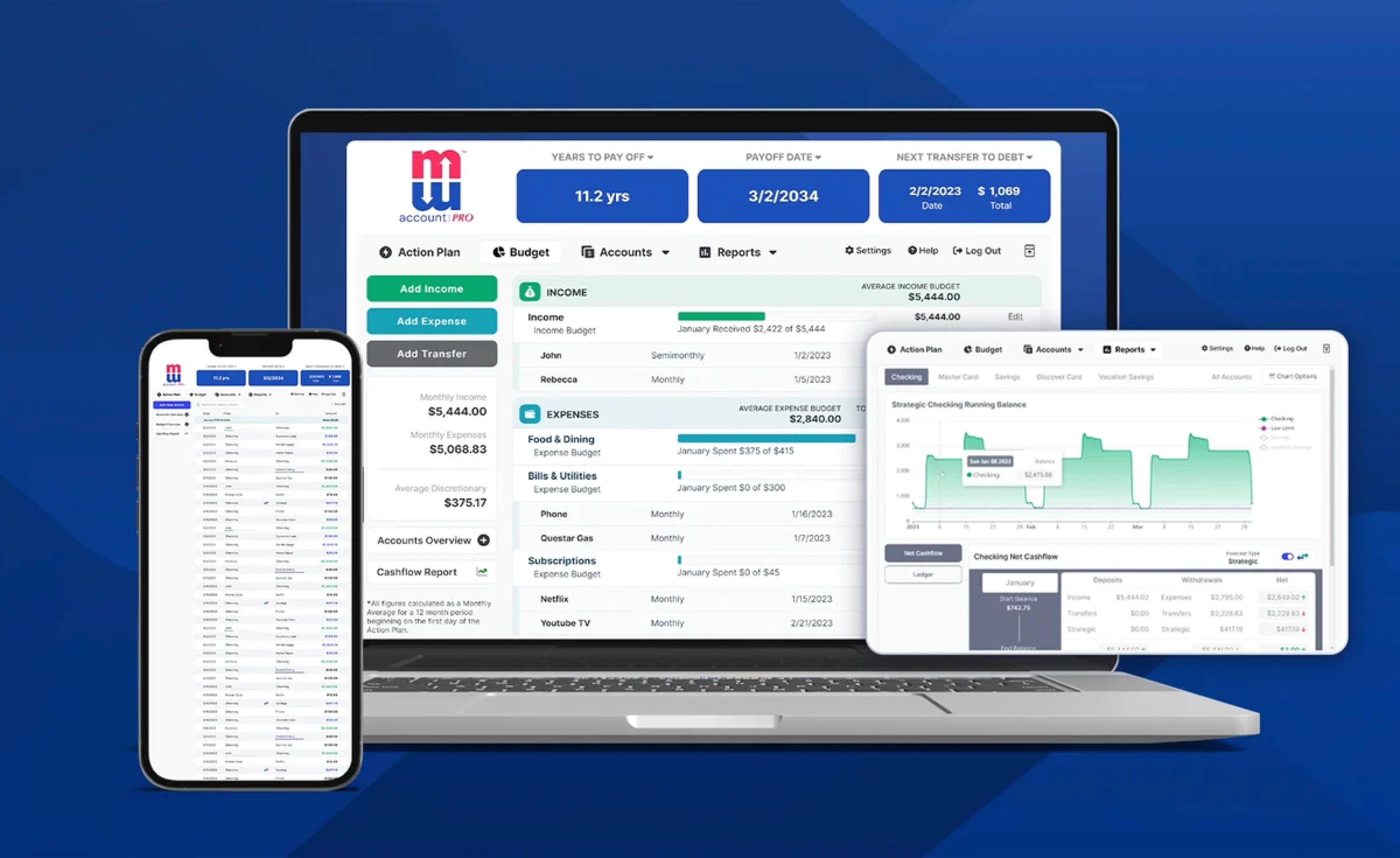
Open the product description and the familiar household pieces appear: checking, savings, income, expenses, outstanding debts. Money Max brings them together, adds budgets and reports, and calculates suggested payment amounts and timing. Its Account Connect feature downloads and categorizes transactions. The point is to make information usable before the next decision, rather than simply explain where last month’s paycheck went.
That distinction matters because a checking balance is an incomplete answer. Some of that money already belongs to upcoming bills. Some may need to remain available for a surprise expense. The interesting number is what remains after those commitments. Money Max’s cash-flow view is designed to help users see the timing of income and expenses, then explore what available money could accomplish against debt.
02 / A GPS with a human driver
The company calls this a financial GPS. It is a useful description when taken literally: directions require someone to follow them. Money Max analyzes information and suggests payments. Customers carry out the transfers. Its explanation of account access says the software cannot do anything with their money. The automation concerns calculations and information, while action stays with the household.
The requirements guide recommends checking in at least weekly, especially when income, spending or debts change. That is the unglamorous hinge of the proposition. A forecast based on yesterday’s circumstances needs fresh information when circumstances move. A household buying this product is also adopting a recurring appointment with its finances.
- 01OrganizeIncome + bills
- 02ReviewSuggested payment
- 03TransferCustomer acts
- 04UpdateForecast adjusts
Scenario planning extends the same idea beyond the next transfer. The company describes entering a prospective rental property’s mortgage and expected income to explore the effect on a repayment plan. The useful output is a comparison under stated assumptions. It lets a customer examine a proposed commitment before adding it to the household’s actual obligations.
03 / The rate stays. The balance moves.
Money Max occupies the repayment-planning part of consumer finance. Its pitch concerns how existing money is allocated against existing obligations. Refinancing is not required. The company’s FAQ explains that paying principal sooner can reduce future interest while leaving the contractual rate unchanged. The mechanism is understandable: a smaller outstanding balance changes the interest calculation.
That gives buyers a sensible comparison. Hold payment amounts and timing constant, then compare the software-assisted route with the same payments made independently. A spreadsheet or payoff calculator offers a baseline. Money Max adds coordination, ongoing projections and help using the tools. Whether those additions justify a purchase depends on how much useful work they do for that particular household.
04 / The price belongs inside the calculation
Software intended to reduce financial costs has a cost of its own. An official compensation document dated August 25, 2020 uses a customer purchasing Money Max for $3,500, with financing illustrated through a $1,000 down payment. That is a historical example. A buyer today needs the actual written quote, including any additional services and financing charges.
Purchase price used in the 2020 agent compensation plan. Current pricing requires an individual quote.
The current FAQ describes pricing that varies with the customer’s situation and advertises lifetime access with a one-time payment. Meanwhile, a public affiliate plan also mentions financing and subscription activations. It sets different commissions for different product groups. Distribution therefore belongs in the story: representatives introduce the software and can be paid when a customer activates it.
05 / Someone has to explain the dashboard
A second product sits beside the calculations: assistance. United Financial Freedom’s coaching page collects customer comments about learning the program and getting questions answered. The homepage similarly highlights support experiences. One selected customer excerpt is unusually plain:
“Professional, patient, respectful, and understanding of my concern. Not pushy.”Tyrell D. / customer excerpt published by the company
These are selected testimonials, not a controlled measurement of financial outcomes. They do reveal what the company chooses to emphasize. A customer buying a complicated financial tool may need a patient explanation as much as another report. The company’s education pitch makes sense in that setting: the dashboard has to become something a person can use repeatedly.
One published review from Paige T. describes another consequence: using the program drew attention to expenses she could trim. Her account puts the software’s influence somewhere quite concrete. Seeing spending clearly changed a spending decision. That is an individual report, but it helps explain why a forecasting tool might matter beyond the precision of its arithmetic.
06 / The forecast has conditions
Homeowners are a central audience, but Money Max also addresses credit cards, vehicle loans and student loans. The requirements page identifies steady cash flow as essential and advises people already behind on their mortgage to stabilize their finances first. That boundary matters. A repayment model needs money available for the payments it proposes.
The limited warranty makes the dependency explicit. Its payoff-date coverage rests on accurate data and following the directed transfers. Coverage ends if the customer stops using the program, supplies inaccurate information or fails to follow those transfers. A qualifying refund excludes finance charges. Read that alongside any projected date: participation is part of the calculation.
The useful habit readers can copy is modest. Look ahead to the bills, identify genuinely available money, compare repayment scenarios, and revisit the numbers when life changes. United Financial Freedom packages that habit in software and support. Its commercial question is whether the package makes a household more consistent. The answer arrives through payments made over time, one ordinary week after another.