The revealing detail in Unicorn of India’s proposition is a rather ordinary object: the business model. An entrepreneur arrives with an idea. An investor wants to understand how it becomes a company. Between those two positions lies the work that makes a pitch worth listening to. The name supplies the fantasy; the operating plan has to supply the arithmetic.
- Investor access and preparation for Indian founders.
- Mentoring and business services around the presentation.
- A separate franchise offer with a stated ₹1–2 lakh investment.
The Mumbai-based company describes a platform where entrepreneurs present ideas and business models to investors. Its LinkedIn description even calls those investors “Unicorn”. The language is theatrical, but the proposed exchange is familiar: capital for a stake in a business. The investor decides whether the proposition merits the money. Confidence gets a founder through the presentation; it does not settle the investment decision.
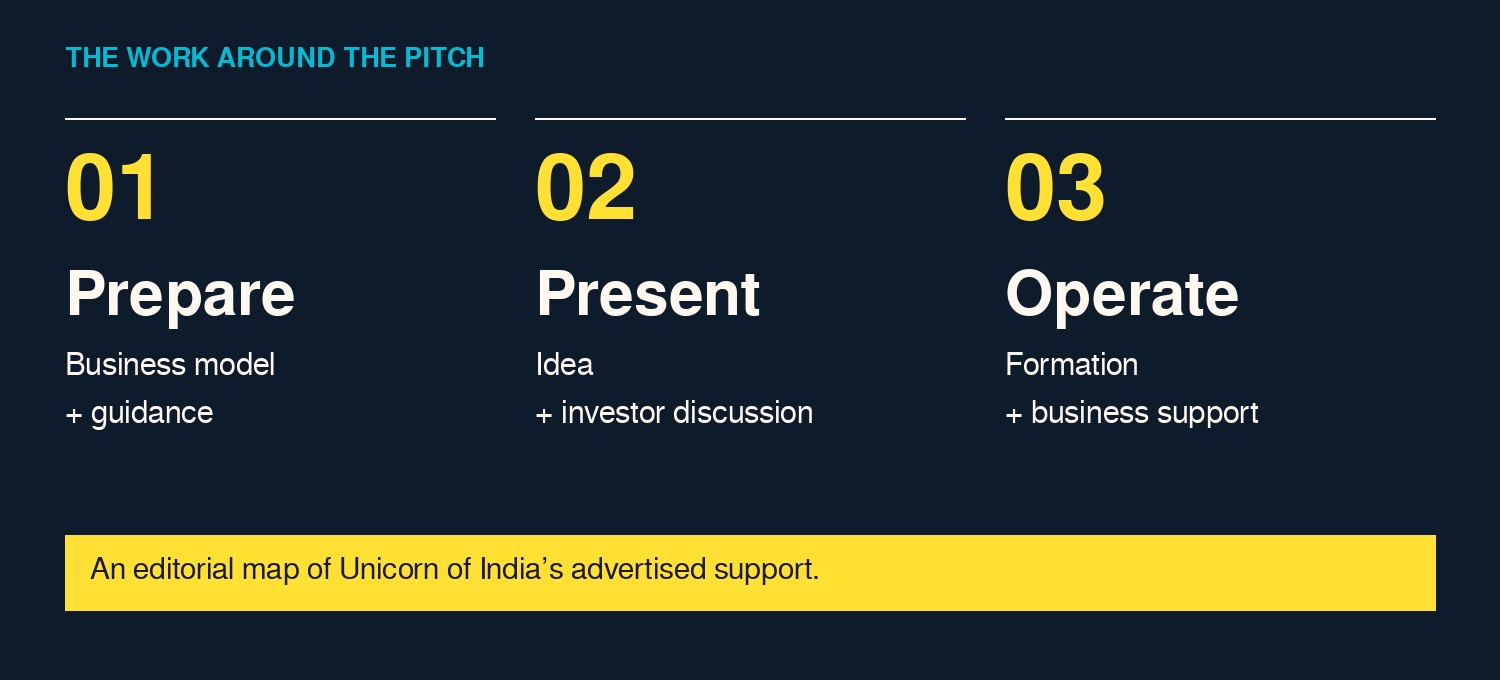
That distinction gives the company a useful place in the startup market. It addresses people who need access and preparation: prospective entrepreneurs, early businesses and founders looking to grow. Its advertised remit stretches from the first idea to scaling. Read as a proposition, this is an attempt to bring several awkward steps into one conversation, rather than asking a founder to assemble every introduction alone.
A stage with a back office
A company-authored explanation published in March 2022 divides its offer into funding support, networks and startup resources. The networks include mentors, investors, accelerators, corporations and incubators. The resources include help finding a co-founder, forming a company, marketing, technology, marketplaces and intellectual property. These are advertised areas of support, rather than a list of completed investments.
The breadth is the interesting part. A pitch platform draws attention to the moment a founder speaks. Unicorn of India’s menu draws attention to the things that must surround that moment. Someone has to build the product, establish the business and explain its market. Someone may also have to work out who owns the name. Entrepreneurship has a remarkable appetite for forms.
The services page makes the administrative side explicit, listing registration, compliance, accounting, tax, legal contracts and fundraising documentation. It also advertises web and app development, digital marketing and hiring support. Its stated expertise spans the preparation and operation of a business. The company’s distinction is this combination of introductions and practical services; the proposition rests on how those pieces fit together.
Four stages, four different conversations
Unicorn of India names four stages for funding support: ideation, validation, early traction and scaling. That sequence is more helpful than treating every founder as someone with the same problem. A person considering an idea has a different conversation to have from a business that already has customers. Calling both “startups” can conceal most of what matters.
For a reader weighing the platform, the sequence offers a sensible starting question: which stage describes the business today? The answer should shape the request. An introduction, a co-founder search and help preparing documents are different assignments. A founder who can specify the assignment gives a support provider something concrete to do. The useful habit to copy is precision about the next obstacle.
This is also where the company’s bundle can be evaluated against alternatives. A founder could approach an investor directly, join a local incubator, hire an accountant or commission a developer. Those routes divide the jobs among specialists. Unicorn of India presents them beneath a common startup-support umbrella. Convenience is the proposed advantage; the relevant comparison is the particular service a founder needs.
- 01Ideation
- 02Validation
- 03Early traction
- 04Scaling
The price belongs to the proposition
The company’s franchise page adds a second audience: people seeking a business opportunity. Its listings span business services, IT and digital marketing, retail, consulting and other sectors. Across the listings, it states an investment size of ₹1–2 lakh and describes unit franchises with locations open across India. The listings name Pune as headquarters, while the company’s LinkedIn profile identifies Mumbai.
That published range answers a narrow cost question. It describes the advertised franchise investment, not a price for pitching and not the value of an investment in a startup. Keeping those sums separate matters. Buying into a service business, paying for professional help and selling shares to an investor are three different transactions, even when they sit on the same website.
The visible commercial proposition therefore has several parts: support services, investor connections and franchise opportunities. An entrepreneur considering it should define the deliverable before discussing the bill: an application, a prepared presentation, a registration or another piece of work. An investor introduction remains an introduction. In the company’s own description, the investor retains the decision about whether to invest.
The published franchise range. A separate transaction from startup fundraising.
The quiet test inside the template
One of the company’s most useful public resources is its business-plan template. It asks for customer research, evidence of demand, competitor profiling, a pricing policy and cash-flow forecasts. These are unglamorous headings with considerable bite. A founder can describe a dream at length without answering any of them. A template is useful precisely because the blank spaces refuse to applaud.
The page asks for evidence such as customer testimonials or pre-agreed contracts. It also separates startup costs, sales forecasts and cash flow. The practical lesson is to turn an assertion into something another person can examine. Who wants the product? What supports that belief? What costs arrive before the receipts? A founder can copy those questions into a working document before seeking any platform’s help.
The same exercise exposes the conditions in which a pitch-led approach becomes less useful. If the immediate problem is uncertain demand, a polished presentation still leaves that uncertainty in place. If a founder needs specialist execution, a broad catalogue needs to become a specific assignment. These are implications of the advertised process, rather than claims about a particular founder’s experience.
A template is useful precisely because the blank spaces refuse to applaud.THE BUSINESS-PLAN TEST
Money arrives with company
Unicorn of India also publishes startup commentary. Its LinkedIn posts discuss businesses including Meesho, BigBasket, Udaan and Darwinbox. The posts show an editorial interest in how companies operate and attract capital. They should be read as commentary about those businesses, rather than as evidence that those businesses are customers or investment partners.
Two articles published in November 2024 sharpen that interest. One examines founder equity and the tension between capital and control. Another discusses AI in investment decisions, arguing for a combination of data analysis and human relationships. Together they put the pitch in a wider frame: attracting money also means deciding whom to work with and what ownership to share.
The appealing idea behind Unicorn of India is simple enough to borrow. Treat the pitch as one part of building a business. Put the customer evidence, operating plan and required help beside it. Then ask for an introduction with an intelligible purpose. The performance may last minutes. The business has to make sense when everyone has stopped clapping.