Consider the journey of a gas molecule. Before it can help build a semiconductor, it has to travel through valves, fittings and carefully welded tubing to reach a process chamber. Along the way, contamination is an unwelcome passenger. The chip gets the attention. The machinery controlling that journey has its own demanding economics. Ultra Clean Technology, usually called UCT, has built a business around them.
- Build the difficult bits: gas delivery systems, precision assemblies and integrated equipment.
- Keep them working: clean, coat and test chamber parts for reuse.
- Watch the dependency: two customers supplied 58.7% of 2025 revenue.
For anyone trying to understand how semiconductor investment becomes actual production, UCT is a useful place to look. Its customers need equipment that behaves predictably, shipment after shipment. UCT sells the engineering, manufacturing and contamination control that help make that possible. A bad weld or an inconsistent surface can undermine an otherwise expensive machine.
The plumbing has a pedigree
The business began in 1991, when Mitsubishi Corporation founded Ultra Clean Technology Systems and Service. The present holding company arrived in 2002; the public listing followed in March 2004. That distinction matters. UCT was an industrial operation before it became a stock-market story, with a specific starting point in gas delivery.
Today, its gas and chemical systems manage the precise delivery of materials used in semiconductor processing. Its capabilities include orbital welding, hand welding and precision tube bending. Final assembly takes place in controlled cleanrooms. These are tangible manufacturing disciplines, with technicians, inspection procedures and joints that must meet customers' cleanliness requirements.
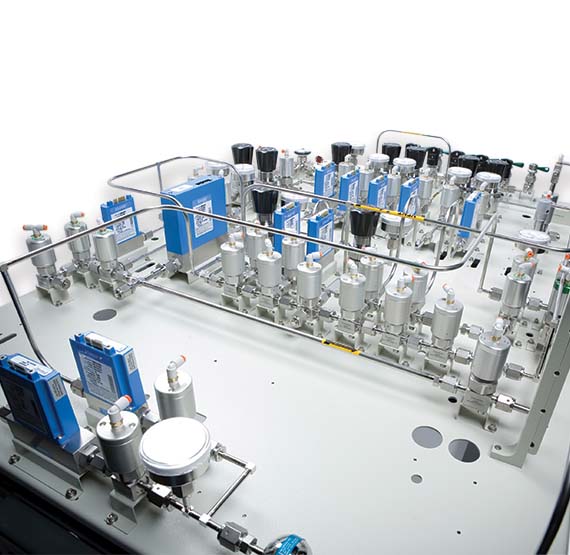
The catalogue extends into mechatronics, thermal solutions, fluid components and system integration. Wafer-handling robots and positioning mechanisms have to place a wafer consistently inside a chamber. UCT's integration work addresses another awkward problem: manufacturing relatively small numbers of complicated assemblies with many possible configurations. Repeating one design a million times requires different skills from managing this much variation.
A customer can also be your gravity
UCT sits between specialist component suppliers and the companies building semiconductor production equipment. Applied Materials and Lam Research are its two largest customers. In 2025, Lam represented 37% of revenue and Applied Materials 21.7%. Those relationships provide access to substantial equipment programmes. They also give two buyers considerable influence over UCT's results.
Qualification helps explain why such relationships matter. Customers inspect facilities and evaluate engineering, documentation, manufacturing and quality controls before approving a supplier. Winning approval takes work. Once inside, UCT can coordinate sourcing and assembly through a single accountable contact, reducing the number of manufacturing problems an equipment maker has to manage directly.
Its competitive pitch is this breadth of responsibility. Ichor is an alternative in gas and fluid delivery subsystems; customers can also retain manufacturing internally. UCT combines subsystem production with downstream cleaning and analytical services. For an equipment buyer, the practical question is whether outsourcing improves delivery, quality and engineering capacity enough to justify the supplier relationship.
The machinery has to work again tomorrow.The recurring-service logic
The $342 million return trip
In August 2018, UCT paid $342 million in cash, subject to balance-sheet adjustments, for Quantum Global Technologies. The deal added chamber-parts cleaning, coating and contamination analysis. Financing included a new $350 million term loan alongside cash; that loan also refinanced existing debt. Buying the capability required a substantial financial commitment.
The strategic attraction was explicit: revenue tied to wafer starts and the installed equipment base. A customer buying a new machine creates one kind of opportunity. A customer running that machine creates repeated maintenance needs. UCT wanted both. The acquisition widened the business from helping equipment enter production to helping its parts return to production.
Cleaning a used chamber part is surprisingly delicate. Deposited films must come off without damaging the component underneath. UCT explains that recycled parts need contamination performance approaching new parts. Protective coatings address corrosion and particle generation; ChemTrace supplies analysis that helps customers identify contamination and check whether parts meet their specifications.
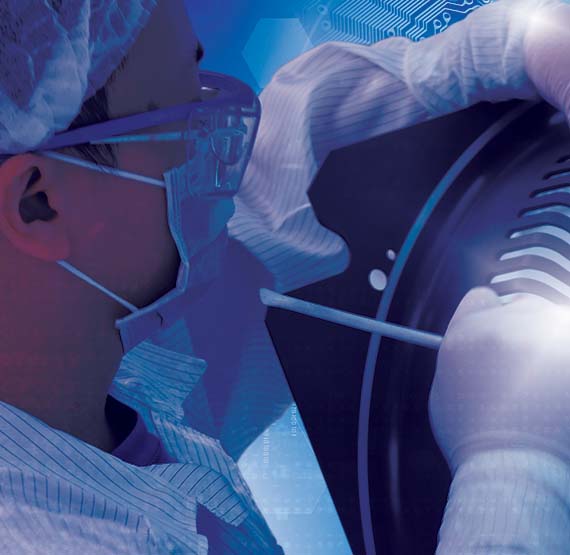
That offers a practical lesson beyond semiconductors: study what customers must do after they buy the main product. Maintenance can reveal a second market. The condition is demanding, though. Reuse only makes economic sense when cleaning preserves the part and meets the process requirements. Cheap cleaning that introduces variability can become an expensive interruption.
Orders move faster than factories
The two businesses responded differently in 2025. Product revenue fell 2.9% to $1.799 billion as purchasing slowed; services rose 4.4% to $254.7 million. Total revenue slipped 2.1% to $2.054 billion. Services provided some balance, but remained a much smaller business. The arithmetic limits how much protection they can offer.
$1,799.3m12.4% Services
$254.7m
Services grew while products contracted. Scale still favoured equipment.
There was an accounting setback, too: a $151.1 million goodwill impairment in the second quarter of 2025. That was a noncash charge, distinct from a factory's immediate operating bills. It nevertheless reduced the recorded value of acquired businesses. Acquisitions can broaden a company's capabilities while leaving expectations that later need revising.
James Xiao became chief executive in September 2025 after a long career at Applied Materials. By August 2026, he was describing “UCT 3.0”: more manufacturing capacity, stronger engineering and operations, and digital transformation. The latest reported quarter, ended June 26, delivered $644.9 million in revenue and $8.7 million in net income attributable to UCT.
The recovery carries a cash requirement. Inventory reached $629.9 million at June 26, up from $390.9 million at year-end, while first-half operating cash flow was negative $74.4 million. Preparing to ship more equipment means paying for materials before collecting the resulting sales. For UCT, readiness has a balance-sheet address.
The transferable idea is precise: own a difficult, repeatable task, then look for the adjacent task customers cannot stop doing. UCT connects fabrication, integration and maintenance around the same production process. Its success still depends on customer demand, qualification and execution. The gas molecule has somewhere to go. Someone must make sure the route stays clean.