An investment idea has an agreeable habit of looking finished before the difficult work begins. Someone still has to obtain the data, write the code, test the result and decide whether it belongs anywhere near a live portfolio. Taesoon (Tyger) Park’s career has taken him through several levels of that work: portfolio manager, research leader and founder. The change in job titles conceals a more interesting change in responsibility. Eventually, the task includes building the place where other people’s ideas can be put to work.
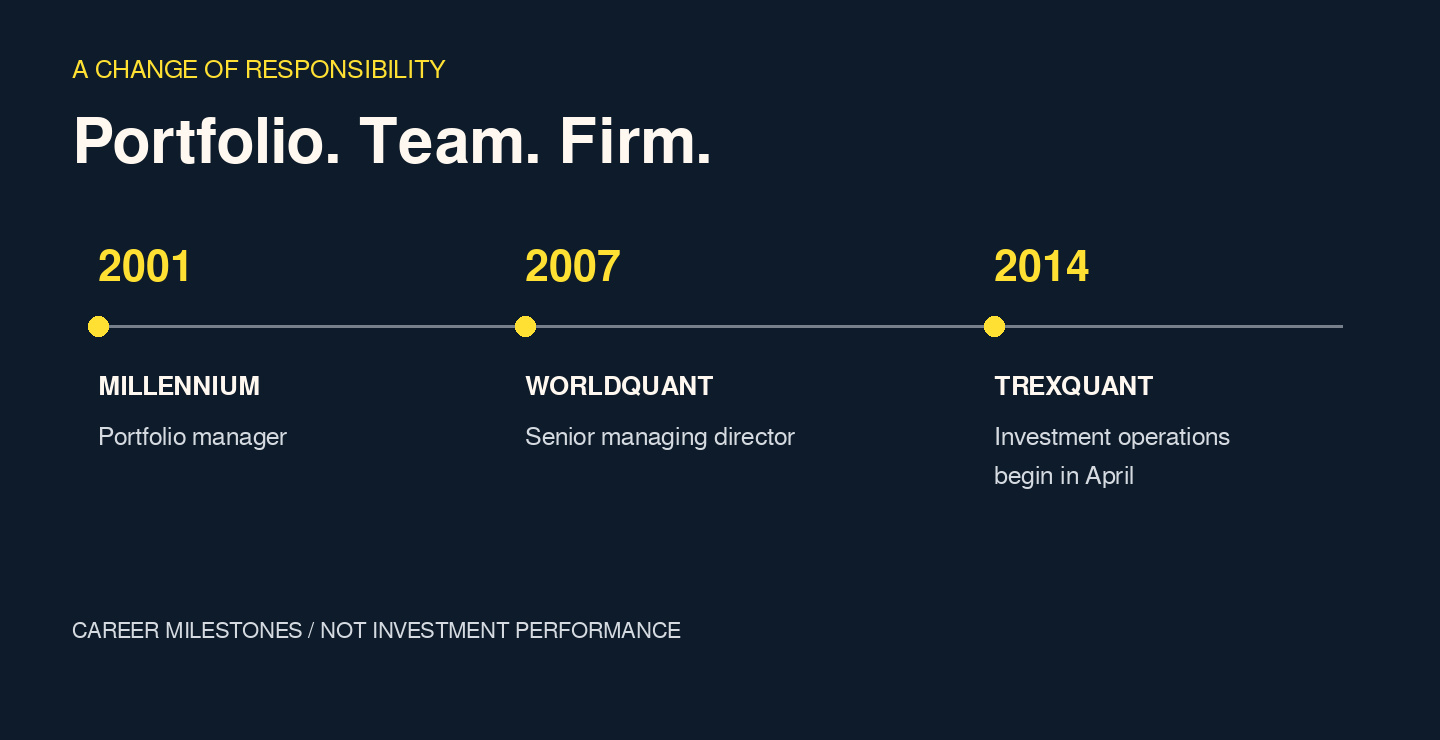
Park is the founder and chief executive of Trexquant Investment LP, the quantitative investment firm whose operations began in April 2014. Before that came a decade at Millennium Partners and WorldQuant. At WorldQuant, he was one of three senior managing directors, with responsibility for a substantial portfolio and a global team of more than 40 researchers. Founding Trexquant meant taking that experience into a business of his own.
Three degrees, then a decade in the markets
His education offers a compact introduction to the territory. Park earned a Bachelor of Applied Science in Electrical Engineering at Simon Fraser University, a master’s in computer science at the University of Toronto and an MBA at Cornell. Engineering, computing and business appear here as three separate courses of study. In quantitative investing, their concerns frequently share a desk.
Consider the ordinary demands of the work. An observation must become something a computer can calculate. A calculation needs a dependable implementation. An investment process needs an organization capable of running it. These are useful ways to understand the disciplines on Park’s résumé, without pretending that a degree certificate explains a person’s every subsequent decision. The subjects fit the work; the work supplies the detail.
Park’s portfolio-management role at Millennium Partners ran from August 2001 to December 2006. He moved to WorldQuant in January 2007 and remained there until March 2011. By then, his remit included researchers spread around the world. A portfolio manager has decisions to make about investments. A research leader also has to contend with how many people arrive at those decisions, using which tools, and through what process.
April 2014: a research business begins
April 2014 is the useful date for the start of Trexquant’s investment operations. The limited partnership was formed that January; Park’s managing-member status in Trexquant Management LLC dates to December 2011. Building an organization produces several birthdays. For the story of putting an investment process to work, the operational beginning is the clearest marker.
Trexquant’s stated investment objective is to construct market-neutral equity portfolios. Its research process takes data, develops trading signals called Alphas, tests them and combines them into more complex Strategies. Its proprietary platform, TREX QUANTA, supplies a common environment for research, simulation and evaluation. The important sequence is observation, test and combination. A promising signal is one ingredient in a larger investment process.
That distinction makes the founder’s job easier to picture. A business organized around quantitative research needs more than a succession of clever observations. It needs a way to handle them repeatedly. In general, a historical test can make an idea look persuasive while leaving difficult questions about its future usefulness. A lovely result on yesterday’s data still has to meet tomorrow. The market has never been obliged to admire the presentation.
Park’s move into founding can therefore be read as a change in the scale of the problem. He had managed investments and researchers. Trexquant placed him at the head of the firm housing both. This is an interpretation of his professional trajectory, rather than a claim about a private ambition: the organization becomes part of the work.
The organization becomes part of the work.
A summer project reaches the market
A smaller episode gives this research world a human scale. During the summer of 2017, Rawal Khirodkar worked at Trexquant. With Park as his adviser during the technical internship, he implemented an attention autoencoder that achieved 34 percent data compression. The strategy was subsequently deployed into live trading in European markets.
The percentage describes data compression, a technical measure distinct from investment performance. That distinction matters because the interest of the episode lies in its practical sequence: a technical implementation reached an actual trading environment. An autoencoder is a machine-learning model used to learn a compact representation of data. Here, an otherwise abstract account of research acquires a project, a researcher, an adviser and a destination.
Khirodkar went on to doctoral study in robotics at Carnegie Mellon and work at Meta Reality Labs. His path gives the episode another point of interest: the technical skills brought to a finance internship can also belong to a career in computer vision and robotics. It would be too much to credit one internship with that later career. Park’s connection to this later robotics researcher is specific: he advised Khirodkar during this particular piece of work.
For a profile dominated by senior titles, the internship is a welcome change of scale. There is something concrete to examine. A method was implemented. Data was compressed. A strategy reached a market. The example gives research moving toward use a concrete shape, with a technical task and a practical destination.
Giving an idea somewhere to work
The question of who gets access to a research environment also appears in Trexquant’s Global Alpha Researcher program. Participants work as independent contractors with access to the firm’s research and development tools. They develop signals and use simulation to test and refine their ideas. The program describes a community drawing participants from India, China, the United States and elsewhere.
Its description includes several kinds of contribution: helper functions, Alphas, strategies and competitions. That range is revealing about the work available inside a quantitative research process. Some contributions provide a component that others can use; others attempt a more complete investment idea. It takes a considerable supporting cast to get a calculation onto the stage.
A separate Global Alpha Trader program addresses people who already have systematic strategies and need infrastructure. Trexquant offers data, simulation tools and engineering support, alongside a process for considering strategies for its portfolio. Its listed requirements include a relevant higher-education degree, quantitative skills and at least a year of experience operating systematic strategies.
These programs belong to the company Park leads; they should be read as organizational arrangements rather than personal promises. Their relevance to his career is practical. The former leader of a global research team now heads a firm with formal routes for outside contributors to use research infrastructure. Access to tools and acceptance into a trading process remain separate steps. An opportunity to test an idea does not settle whether the idea will work.
The university door stays open
There is another route into the same territory. Trexquant’s University Partnership Program sets out two aims: working with academics on research that could be implemented in global markets, and meeting graduates interested in quantitative research. Activities include visiting classes, inviting professors to present, sponsoring capstone projects and machine-learning competitions, and attending career fairs.
For Park, whose own studies crossed three universities and three disciplines, this academic connection is a relevant part of the institution he has built. The connection is organizational and visible. It does not require a sentimental account of a formative lecture or a professor who changed everything. The actual activities are specific enough: a class visit, a research presentation, a project that can be evaluated.
The program also spells out the limits. Research can be adapted, implemented or rejected by Trexquant’s team. Participation does not guarantee employment, funding, publication or commercial use. Those boundaries make the relationship easier to understand. Academic engagement opens a conversation and a research process; it does not predetermine the outcome.
For a technically trained founder, the university relationship presents a recurring organizational question: how does work travel from an academic setting into an investment firm? Trexquant’s answer includes shared ideas, educational activities and an internal evaluation process. It is a set of arrangements through which the question can be pursued.
The responsibility gets larger
In July 2026, Park remained Trexquant’s chief executive and a controlling owner. The firm’s reported regulatory assets under management stood at approximately $13.48 billion across nine accounts. That is a regulatory measure of the assets managed by the business. It is not a measure of Park’s personal wealth, and it should not be read as investor equity capital or an investment return.
Company assets managed, not personal wealth
The leadership around him includes distinct responsibilities for strategy, finance, legal affairs and compliance. The research organization also extends across the United States, China and India. The founder’s remit now sits within that larger set of people, places and responsibilities. Models may be mathematical objects; running the business around them involves rather more departments.
Park’s career offers a particular view of technical entrepreneurship. Engineering and computer science precede investment management. Managing a global research team precedes founding a firm. A later internship supplies a small example of research being put to work. The continuity lies in the process connecting an idea with something that can be tested and used.
The story ends, for now, with Park still responsible for the organization around that process. A portfolio once defined part of his remit. A global team enlarged it. A firm enlarged it again. Each step brought more of the surrounding work into view. Better questions need people who can ask them, tools with which to test them, and a business capable of keeping the inquiry going.